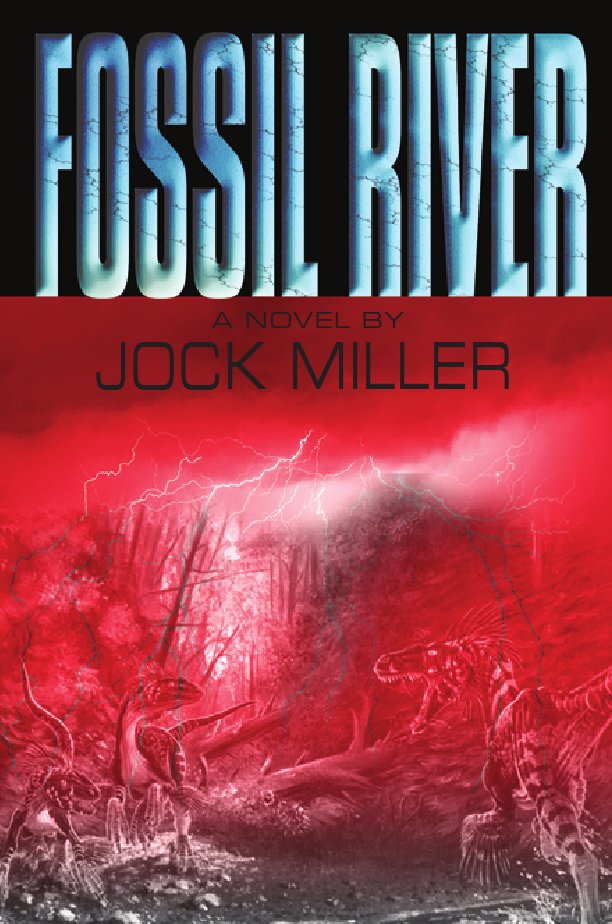
An action thriller by Jock Miller
Fossil fuel has an ageless affinity with dinosaurs. To create oil, dinosaurs died.
The perfect energy storm is sweeping over the United States: Japan’s Fukushima nuclear plant meltdown has paralyzed nuclear expansion globally, BP’s Gulf of Mexico oil spill has stalled deep water drilling, Arab oil countries are in turmoil causing doubt about access to future oil, the intensity of hurricanes hitting the Gulf’s oil rigs and refineries has intensified due to global warming, and the nation’s Strategic Oil Supply is riding on empty.As the energy storm intensifies, the nation’s access to Arab oil, once supplying over sixty percent of our fossil fuel, is being threatened causing people to panic for lack of gas at the pumps, stranding cars across the country and inciting riots.
The U.S. Military is forced to cut back air, land, and sea operations sucking up 58% of every barrel of oil to protect the nation; U.S. commercial airlines are forced to limit flights for lack of jet fuel; and businesses are challenged to power up their factories, and offices as the U.S. Department of Energy desperately tries to provide a balance of electric power from the network of aged power plants and transmission lines that power up the nation.
The United States must find new sources of domestic fossil fuel urgently or face an energy crisis that will plunge the nation into a deep depression worse than 1929.The energy storm is very real and happening this very moment. But, at the last moment of desperation, the United States discovers the world’s largest fossil fuel deposit found in a remote inaccessible mountain range within Alaska’s Noatak National Preserve surrounding six and a half million acres.
Preventing access to the oil is a colony of living fossil dinosaurs that will protect its territory to the death.Nobody gets out alive; nobody can identify the predator--until Dr. Kimberly Fulton, Curator of Paleontology at New York’s Museum of Natural History, is flown into the inaccessible area by Scott Chandler, the Marine veteran helicopter pilot who’s the Park’s Manager of Wildlife. All hell breaks loose when Fulton’s teenage son and his girlfriend vanish into the Park.
Will the nation’s military be paralyzed for lack of mobility fuel, and will people across America run out of gas and be stranded, or will the U.S. Military succeed in penetrating this remote mountain range in northwestern Alaska to restore fossil fuel supplies in time to save the nation from the worst energy driven catastrophe in recorded history?
Amazing Transportation Inventions: Self-Driving Car
Illustration courtesy Mike and Maaike
Take all the autonomy and privacy of personal vehicles, subtract the human propensity for distraction, and add a virtual chauffeur. What do you have? Autonomous cars that, in theory, can help commuters de-stress and allow freeways to flow more smoothly. That's the idea, anyway, behind driverless cars, which are gaining increasing attention from automakers and high-tech companies alike.
Demonstration models that Google, BMW, Volvo, General Motors, Stanford University, and others have built for testing look like modified regular cars (which they usually are -- computing gear can fit in the trunk). But designers have come up with more futuristic concepts, like the one pictured here from San Francisco industrial design shop Mike & Maaike. Dubbed Atnmbl ("autonomobile," derived from autonomy and automobile), the seven-seat design does away with the steering wheel, brake pedal, and driver's seat. It's envisioned as an electric- and solar-powered model for the year 2040.
But autonomous vehicle technology is being tested on some public roadways today, and General Motors executive Alan Taub said recently that vehicles capable of partially driving themselves could become available before the end of this decade.
"You think that driving a car is hard, but it's not actually that hard for a computer . . . if the computer actually has good data about what's around it," Google co-founder Larry Page said in a talk at the search giant's Zeitgeist Americas event this fall. "I think they'll work substantially better than an average person, and get better from there. You'll get a software update and your car will be safer."
Read More
Amazing Places on Earth: Mammoth Cave
![]() |
| Mammoth Cave is a hidden treasure trove of natural beauty. Image Credit: Image courtesy National Parks Service |
The hill country of Kentucky's Green River Valley certainly has its charms, but beneath its gentle woodlands there is an underworld. More than 390 miles (628 kilometers) worth of caves worm through the rocky depths, making Mammoth Cave the largest known cave system in the world.
For more than 10 million years, waters from the Green River have cut through the soft limestone, riddling it with all manner of cave formations. A visitor may pass through a lengthy passageway and into a vast cathedral. Vertical shafts descend into darkness while stalagmites, stalactites and bizarre crystal formations speak to the immensity of geologic time.
Yet Mammoth Cave is not just a place of minerals, stones and tourists. It also boasts an impressive ecosystem of cave flora and fauna, encompassing more than 130 documented species.
Mammoth Cave is a hidden treasure trove of natural beauty.
Read More
Hopeful Energy Stories: An Isle of Ambitious Energy Goals
Photograph by Richard Hughes, Kos Picture Source/Getty Images
Using the natural energy found in wind, a sailor slices through the sea just off the Isle of Wight. Onshore, supporters of the Ecoisland effort hope to turn the small slice of Great Britain into a utopia of renewable energy in the English Channel.
The project boasts more than 70 corporate sponsors joining forces to make the Isle of Wight self-sufficient with green energy by 2020. "It will be a living laboratory," said David Green, Ecoisland founder and chief executive officer. Green was inspired by seafarers who live on board ship and have developed ways to remain self-sufficient for weeks or months at a time.
If all goes according to plan, the island's electricity will be produced by solar, tidal, waste, geothermal, and wind energy projects. Sustainable food and water initiatives also will nourish inhabitants.
Similar projects are planned or under way on numerous islands worldwide. The Danish island of Samsø, in the North Sea, has already achieved enough energy self-sufficiency to send power back to the mainland.
READ MORE
Paleontologists - Robert Bakker
His evidence for which includes:
- Almost all animals that walk upright today are warm-blooded, and dinosaurs walked upright.
- The hearts of warm-blooded animals can pump much more effectively than the hearts of cold-blooded animals. Therefore, the giant Brachiosaurus must have had the type of hearts associated with warm-blooded animals, in order to pump blood all the way up to its head.
- Dinosaurs such as Deinonychus led a very active life, which is much more compatible with a warm-blooded animal.
- Some dinosaurs lived in northern latitudes where it would be impossible for cold-blooded dinosaurs to keep warm.
- The rapid rate of speciation and evolution found in dinosaurs is typical of warm blooded animals and atypical of cold blooded animals.
- The predator/prey ratio of predatory dinosaurs to their prey is a signature trait of warm-blooded predators rather than cold-blooded ones.
- Birds are warm-blooded. Birds evolved from dinosaurs, therefore a change to a warm-blooded metabolism must have taken place at some point; there is far more change between dinosaurs and their ancestors, the archosaurs, than between dinosaurs and birds.
- Warm-blooded metabolisms are evolutionary advantages for top predators and large herbivores; if the dinosaurs had not been warm-blooded there should be fossil evidence showing mammals evolving to fill these ecological niches. No such evidence exists; in fact mammals by the end of the Cretaceous had become smaller and smaller from their mammal-like-reptile ancestors.
- Dinosaurs grew rapidly, evidence for which can be found by observing cross-sections of their bones. Warm-blooded animals grow at a similar rate.
Fossils That Changed Dinosaur Brachylophosaurus (2000)
![]() |
| Restoration |
Only three complete fossils of the hadrosaur, or duck-billed dinosaur, Brachylophosaurus have ever been found, but they're so amazingly well-preserved that (as paleontologists often do) they were immediately given nicknames: Elvis, Leonardo and Roberta. (The same research team also found a fourth, incomplete fossil of a juvenile, which they dubbed Peanut.)
Leonardo had a birdlike crop on its neck (presumably to aid in digestion) as well as different-sized scales on different parts of its body, among other unique anatomical features.
Although it's named for the unusually short crest on its head (short, that is, for a hadrosaur), Brachylophosaurus stood out more for its thick, downward-turning beak, which some paleontologists take as evidence that the males of this genus head-butted one another for the attention of females.
Hopeful Energy Stories: A Price for Carbon
Photograph by Rich Pedroncelli, AP Images
Refineries like this one in Rodeo, California, face the prospect of paying to pollute. With an online auction, California launched its own cap-and-trade system with an aim of curbing carbon dioxide emissions 20 percent over the next eight years. Proponents hope it will serve as a model for wider action in the United States and globally.
Earlier this year, Australia launched its own modified "carbon tax." Coal-dependent Australia has one of the world's most carbon-intensive economies, but concern over climate change is high, as the nation has faced drought and wildfire and the degradation of its tourist gem, the Great Barrier Reef.
The challenge is great for jurisdictions that act on their own. Some in British Columbia are now questioning its pioneering carbon tax enacted in 2008, despite popular support for the plan. Proponents hope efforts here and elsewhere will serve as a model for the kind of wider global action that is needed.
READ MORE
Paleontologists - Luis Alvarez
Luis Alvarez is a good example of how an "amateur" can have a profound impact on paleontology. The word "amateur" is in quotation marks because, before he turned his attention to the extinction of the dinosaurs, Alvarez was a highly accomplished physicist (in fact, he won the Nobel Prize in Physics in 1968 for his discovery of the "resonance states" of fundamental particles). He was also a lifelong inventor, and was responsible for (among other things) the Synchrotron, one of the first particle accelerators.
| Luis and Walter Alvarez at the K-T Boundary in Gubbio, Italy 1981 (Photo: LBNL) |
In paleontology circles, though, Alvarez is best known for his late 1970's investigation (conducted with his geologist son, Walter) into the K/T Extinction, the mysterious event 65 million years ago that killed the dinosaurs. His theory--that the explosion of a large comet or meteor threw up tons of dust, blotted out the sun, and caused the earth’s vegetation to wither, with the herbivorous and then the carnivorous dinosaurs following in its wake--was greeted with skepticism at first, but is now accepted by most scientists.
Read More
Amazing Places on Earth: Devils Tower
Devils Tower
Teddy Roosevelt declared Devils Tower America's first national monument, and Steve Spielberg decided to land a UFO on top of it in "Close Encounters of the Third Kind. Long before either man thrust the natural landmark into the spotlight, more than 20 Native-American tribes held the site sacred -- including the Lakota people who dubbed it "Bear Lodge."
While its exact origins are unclear, many geologists believe the enormous column of igneous rock is an intrusion: a column of molten rock pushed up from the inner Earth through sedimentary rock layers. It's unclear whether the intrusion cooled before or after it breached the surface, but the vertical furrows indicate that cooling and contraction took place.
Geologists suspect the northeastern Wyoming tower formed more than 50 million years ago and remained buried beneath the ground up until roughly 2 million years ago [source: SERC]. Today, Devils Tower is a popular tourist destination, and licensed climbers can even scale the monolith for an unforgettable view.
Read More
Feathered Dinosaurs: Sinosauropteryx
![]() |
Digital illustration of the coelurosaurian dinosaur Sinosauropteryx prima, based on the holotype specimen. Coloration and pattern follows Zhang et al 2010. |
All described specimens of Sinosauropteryx preserve integumentary structures (filaments arising from the skin) which most palaeontologists interpret as very primitive feathers. These short, down-like filaments are preserved along the back half of the skull, arms, neck, back, and top and bottom of the tail. Additional patches of feathers have been identified on the sides of the body, and palaeontologists Chen, Dong and Zheng proposed that the density of the feathers on the back and the randomness of the patches elsewhere on the body indicated the animals would have been fully feathered in life, with the ventral feathers having been removed by decomposition.
Fossils That Made History: Sinosauropteryx (1997)
![]() |
| Fossil of Sinosauropteryx prima, the first “feathered” dinosaur. Its primitive feathers could be seen clearly on the head, back, and tail. The length of the fossil is about 130 cm. |
The first genus of dinosaur outside of Avialae (birds and their immediate relatives) to be found with evidence of feathers. They were covered with "furry" coats of very simple filament-like feathers. Structures that indicate colouration have been preserved for some of the feathers, which also makes Sinosauropteryx the first non-avialian dinosaurs where colouration has been determined. Colouration includes a banded tail with reddish and light bands.
Cities Bet They Can Curb Traffic With Games of Chance
The largest lottery jackpot in history inspired Americans to spend $1.5 billion for a slim chance at riches. Transportation experts are wagering that this fervor for small gambles can be put to use solving a big urban problem: traffic congestion.
Two experimental transportation projects under way in 2012 in Singapore and Silicon Valley aim to improve commutes through gaming.
Thousands of commuters so far have decided it's worth the effort to change their routines for a shot at $50 or $100.
Photograph by Munshi Ahmed, Bloomberg/Getty Images
Singapore's Electronic Road Pricing (ERP) system charges motorists for road use during peak hours, but disincentive programs have limitations. New schemes that offer drivers cash for adjusting their schedules may help cities win the fight against untenable traffic conditions.
Read More
HOPEFUL ENERGY STORIES: Innovation in Cities
![]() |
| Energy Sustainable Transport |
Photograph by Kike Calvo, National Geographic
The new aerial tramway in Medellin, Colombia, looks more like a ski lift than an urban transportation system—but the project is just one of the many creative energy innovations being advanced by cities around the globe. The tram cars, which traverse hilly, low-income neighborhoods, won a Sustainable Transport Award from the Institute for Transportation and Development Policy (ITDP).
In other cities, drivers are helping to ease gridlock—and the financial burdens of auto ownership—with car-sharing systems. And communities such as Singapore, the capital of the nation with the same name, and Stanford, California, home to Stanford University, are enticing drivers to skip rush hour entirely by giving them a chance to win cash prizes.
While many projects aim to ease traffic on city streets, others are looking below them in hopes of tapping an unusual energy source—the hot water that showers, dishwashers, laundries, and other users send down the drain each year. Some estimates suggest that the energy in America's wastewater could power 30 million U.S. homes per year—and fledgling projects in Vancouver and Chicago aim to capture that resource through heat-recovery systems.
READ MORE
More on the Maisaura
Illustration of a herd of Maiasaura walking along a creekbed, as found in the semi-arid Two Medicine Formation fossil bed. This region was characterized by volcanic ash layers and conifer, fern and horsetail vegetation.
| Maiasaura Nest Model in the Natural History Museum of London |
The eggs were incubated by the heat resulting from rotting vegetation placed into the nest by the parents, rather than a parent sitting on the nest. Upon hatching, fossils of baby Maiasaura show that their legs were not fully developed and thus they were incapable of walking. Fossils also show that their teeth were partly worn, which means that the adults brought food to the nest.
Amazing Places on Earth
You want a fantastic real-world locale? It's hard to improve upon the fairy chimneys of Cappadocia in central Turkey. Here, tall spires of stone dot the landscape like some manner of bizarre growth. What's more, early Christians carved countless storerooms, stables and domiciles into the fairy towers from the 4th to the 11th century.
To understand the formation of these stone spires (also known as hoodoos), look at the accompanying photograph. The fairy chimneys you see here were once part of a massive slab of earth covered in a layer of hardened volcanic ash called tuff. Over time, the erosive forces of wind and water wore away much of the underlying soft material, leaving only slender towers with caps of tuff.
The early Christians went so far as to carve whole monasteries and underground cities out of the stone in Cappadocia. Today, many such chambers are still in use -- some as guesthouses for visiting tourists.
Read More
PALEONTOLOGISTS: Jack Horner
Jack Horner is an American paleontologist who discovered and named Maiasaura, providing the first clear evidence that some dinosaurs cared for their young. He is one of the best-known paleontologists in the United States. In addition to his many paleontological discoveries, Horner served as the technical advisor for all of the Jurassic Park films, and even served as partial inspiration for one of the lead characters, Dr. Alan Grant.
In Montana during the mid-1970s, Horner and his research partner Bob Makela discovered a colonial nesting site of a new dinosaur genus which they named Maiasaura, or "Good Mother Lizard". It contained the first dinosaur eggs in the Western hemisphere, the first dinosaur embryos, and settled questions of whether some dinosaurs were sociable, built nests and cared for their young. The discovery established his career. Horner has named several other species of dinosaur (including Orodromeus makelai in memory of his late friend Bob Makela) and has had two named after him: Achelousaurus horneri and Anasazisaurus horneri.


