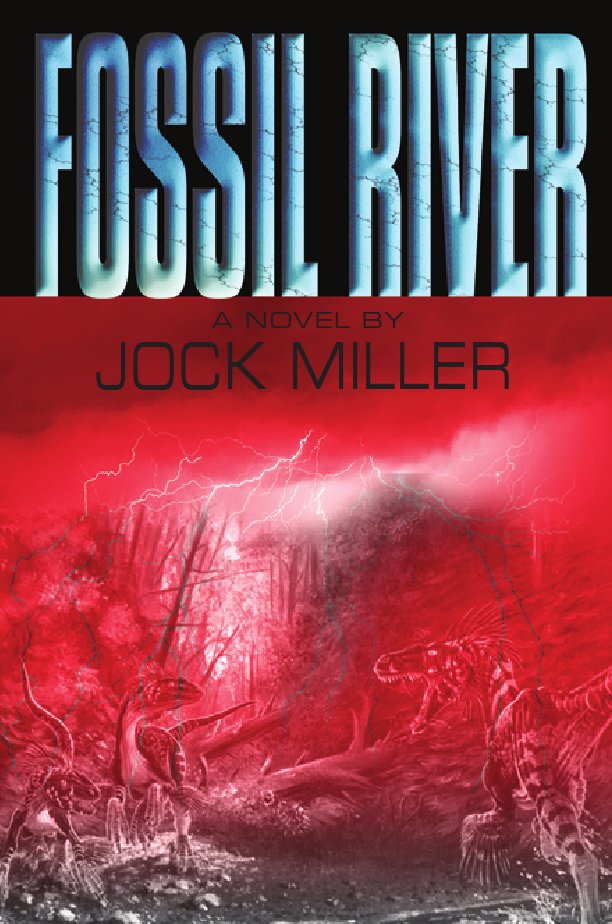
An action thriller by Jock Miller
Fossil fuel has an ageless affinity with dinosaurs. To create oil, dinosaurs died.
The perfect energy storm is sweeping over the United States: Japan’s Fukushima nuclear plant meltdown has paralyzed nuclear expansion globally, BP’s Gulf of Mexico oil spill has stalled deep water drilling, Arab oil countries are in turmoil causing doubt about access to future oil, the intensity of hurricanes hitting the Gulf’s oil rigs and refineries has intensified due to global warming, and the nation’s Strategic Oil Supply is riding on empty.As the energy storm intensifies, the nation’s access to Arab oil, once supplying over sixty percent of our fossil fuel, is being threatened causing people to panic for lack of gas at the pumps, stranding cars across the country and inciting riots.
The U.S. Military is forced to cut back air, land, and sea operations sucking up 58% of every barrel of oil to protect the nation; U.S. commercial airlines are forced to limit flights for lack of jet fuel; and businesses are challenged to power up their factories, and offices as the U.S. Department of Energy desperately tries to provide a balance of electric power from the network of aged power plants and transmission lines that power up the nation.
The United States must find new sources of domestic fossil fuel urgently or face an energy crisis that will plunge the nation into a deep depression worse than 1929.The energy storm is very real and happening this very moment. But, at the last moment of desperation, the United States discovers the world’s largest fossil fuel deposit found in a remote inaccessible mountain range within Alaska’s Noatak National Preserve surrounding six and a half million acres.
Preventing access to the oil is a colony of living fossil dinosaurs that will protect its territory to the death.Nobody gets out alive; nobody can identify the predator--until Dr. Kimberly Fulton, Curator of Paleontology at New York’s Museum of Natural History, is flown into the inaccessible area by Scott Chandler, the Marine veteran helicopter pilot who’s the Park’s Manager of Wildlife. All hell breaks loose when Fulton’s teenage son and his girlfriend vanish into the Park.
Will the nation’s military be paralyzed for lack of mobility fuel, and will people across America run out of gas and be stranded, or will the U.S. Military succeed in penetrating this remote mountain range in northwestern Alaska to restore fossil fuel supplies in time to save the nation from the worst energy driven catastrophe in recorded history?
World’s Worst Power Outages
Northeastern U.S. and Canada, 2003
Photograph by Andrew Lichtenstein, Corbis
On August 15, 2003, a mass of New York commuters crossed the Brooklyn Bridge on foot during a blackout that robbed 50 million people of power for as long as two days in southeastern Canada and the Northeastern United States. It also crippled all trains, stranding many travelers. The U.S.-Canada Power System Outage Task Force determined that equipment failures and human error had combined to cause the blackout, which started when power lines shut down after contact with trees.
An improving ability to monitor the exact condition of the power system at any given instant with voltage and current sensors, and to make rapid changes like taking lines out of service, is critical to avoiding the cascading effects that lead to widespread outages like the 2003 event.
"If something goes wrong and an ice storm brings down a line or someone blows up a transmission tower that will propagate a disturbance and we need to know exactly how far it propagates and exactly what it looks like—like the ripples of a pebble dropped into a pond, so that we can take a definitive corrective action," said EPRI's Clark Gellings. "When that capability doesn't exist, like it didn't in 2003 in the United States, the system is set up for some kind of failure."
Read More
World’s Worst Power Outages
Photograph by Tom Cunningham, NY Daily News/Getty Images
A lack of power poses plenty of inherent problems, but massive blackouts can also lead to bad behavior. A lightning-sparked outage in 1977, which left 9 million New Yorkers without power, lasted only about 24 hours on July 13 and July 14. But during that time, arsonists torched buildings like these on Marmion Avenue in the Bronx, setting a reported 1,000 fires. Looters and rioters also ran rampant and trashed some 1,600 stores during what Mayor Abraham Beame called "a night of terror." When similar outages struck the city in 2003, however, such problems were few and far between.
Read More
World’s Worst Power Outages
Photograph by Joerg Sarbach, AP
Onlookers wait for the newly built cruise ship Norwegian Pearl to leave the Papenburg, Germany, shipyard in November 2006. Soon after, on its trip down the River Ems, the ship indirectly caused a two-hour power outage for some 10 million people on the evening of November 4. The German power company E. turned off a 380,000-volt line over the river so that the ship could pass safely beneath on its way to the North Sea. But the dead line quickly increased pressures elsewhere in the German power grid and then sparked a chain reaction across parts of Germany, France, Belgium, Italy, Spain, Austria, the Netherlands, and Croatia. Critics said the incident showcased the need for more universal electricity distribution policies across Europe.
Read More
World’s Worst Power Outages
Operating Without Power, 1965
Read More
World’s Worst Power Outages
India, 2012
Photograph by Channi Anand, AP
A girl prepares food by candlelight in Jammu, India, on August 1, 2012. India's massive power failures on July 30 and 31 were unprecedented in size and left 670 million people without electricity across the nation's north and east.
Before power was restored on August 1, about half of all residents of India—nearly 10 percent of the entire world's population—were left in the dark by a cascade of collapsing regional systems. The outage's exact cause may be debatable, but the ultimate source of trouble was predictable: India's power structure is often unable to meet peak power demands. Prime Minister Manmohan Singh has called for a $400 billion investment to help increase the capacity and reliability of India's power grid, but the country's efforts to build "ultra-mega" coal plants have hit economic snags, while its effort to build the world's largest nuclear power plant faces protests and delays.
Read More
World’s Worst Power Outages
Photograph by Bob Gomel, Time Life Pictures/Getty Images
A full moon created an eerie skyline silhouette after New York City went dark during the blackout of November 1965. In a world that's increasingly dependent on constant power, massive electrical outages are a common concern and may strike systems across the globe.
Major power disturbances can be triggered by storms, heat waves, solar flares, and many other sources, but all have roots in the mechanical and human vulnerabilities of the power grids themselves. "Power delivery systems have a lot of parts, wires, transformers and other components all nicely tied together—which means there are a lot of things that can go wrong," explained Clark Gellings of the nonprofit Electric Power Research Institute. "Pieces break down and people make errors. A system is designed to tolerate a certain amount of disruption but past a certain point, it's simply gone too far and it falls apart."
The "great Northeast blackout," which began when a power surge near Ontario set off a chain of failures across New York State and beyond, covered 80,000 square miles. "Within four minutes the line of darkness had plunged across Massachusetts all the way to Boston," reported The New York Times on the day of the outage. "It was like a pattern of falling dominoes-darkness sped southward through Connecticut, northward into Vermont, New Hampshire, Maine and Canada."
—Brian Handwerk
Read More


