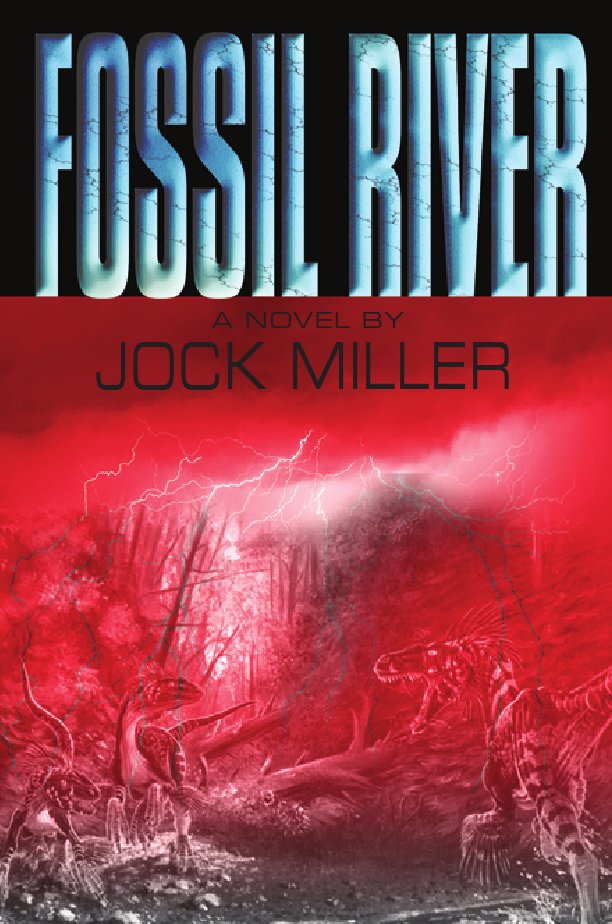
An action thriller by Jock Miller


Fossil fuel has an ageless affinity with dinosaurs. To create oil, dinosaurs died.


purchase on Amazon.com


The perfect energy storm is sweeping over the United States: Japan’s Fukushima nuclear plant meltdown has paralyzed nuclear expansion globally, BP’s Gulf of Mexico oil spill has stalled deep water drilling, Arab oil countries are in turmoil causing doubt about access to future oil, the intensity of hurricanes hitting the Gulf’s oil rigs and refineries has intensified due to global warming, and the nation’s Strategic Oil Supply is riding on empty.

As the energy storm intensifies, the nation’s access to Arab oil, once supplying over sixty percent of our fossil fuel, is being threatened causing people to panic for lack of gas at the pumps, stranding cars across the country and inciting riots.


The U.S. Military is forced to cut back air, land, and sea operations sucking up 58% of every barrel of oil to protect the nation; U.S. commercial airlines are forced to limit flights for lack of jet fuel; and businesses are challenged to power up their factories, and offices as the U.S. Department of Energy desperately tries to provide a balance of electric power from the network of aged power plants and transmission lines that power up the nation.

The United States must find new sources of domestic fossil fuel urgently or face an energy crisis that will plunge the nation into a deep depression worse than 1929.

The energy storm is very real and happening this very moment. But, at the last moment of desperation, the United States discovers the world’s largest fossil fuel deposit found in a remote inaccessible mountain range within Alaska’s Noatak National Preserve surrounding six and a half million acres.

Preventing access to the oil is a colony of living fossil dinosaurs that will protect its territory to the death.

Nobody gets out alive; nobody can identify the predator--until Dr. Kimberly Fulton, Curator of Paleontology at New York’s Museum of Natural History, is flown into the inaccessible area by Scott Chandler, the Marine veteran helicopter pilot who’s the Park’s Manager of Wildlife. All hell breaks loose when Fulton’s teenage son and his girlfriend vanish into the Park.


Will the nation’s military be paralyzed for lack of mobility fuel, and will people across America run out of gas and be stranded, or will the U.S. Military succeed in penetrating this remote mountain range in northwestern Alaska to restore fossil fuel supplies in time to save the nation from the worst energy driven catastrophe in recorded history?

______________________________________________________________________________________________________________________________________


Showing posts with label Dinosaur Facts. Show all posts

Toothless 'dragon' pterosaurs once ruled skies


Ancient winged reptiles called pterosaurs were so successful that they ruled Earth's skies for tens of millions of years, according to a study published in the journal ZooKeys.

The fearsome fliers, part of a family of pterosaurs named Azhdarchidae, get their name from azdarha, the Persian word for "dragon." Unlike earlier pterosaurs, they had no teeth, and they dominated from late in the Cretaceous period (around 90 million years ago) until the extinction event that also killed off the dinosaurs some 66 million years ago.

“This shift in dominance from toothed to toothless pterodactyloids apparently reflects some fundamental changes in Cretaceous ecosystems, which we still poorly understand,” study author Alexander Averianov of the Russian Academy of Sciences wrote in the paper.

Pterosaurs are not dinosaurs, and they're definitely not ancient birds, which are the living descendants of the dinosaurs. But understanding these large predators can give insight into the ancient ecosystem as well as the origins of flight, as pterosaurs are thought to be the first animals after insects to develop powered flight.

Pterosaur fossils are tough to find, the study authors point out, because their fragile bones haven’t survived as well as dinosaur remains have.

“Pterosaur bones were thin and fragile, much like bird bones, and they often drifted apart, shattered, or became scrambled before they could be preserved,” according to the American Museum of Natural History.

Thus, it’s often pretty difficult to tell how the few fossils that do exist are related to one another, according to the paper.

“Azhdarchidae currently represents a real nightmare for pterosaur taxonomists: Most taxa are known from few fragmentary bones, which often do not overlap between named taxa, the few articulated skeletons are poorly preserved,” Averianov wrote, and some of the best material “has remained undescribed for 40 years.”

For the ZooKeys study, Averianov surveyed and analyzed the known research to help straighten out the fossil record. The findings also showed that although their bones are challenging to find, the pterosaurs were probably quite successful in a wide variety of habitats, but were more commonly found near large lakes and rivers and especially in near-shore marine environments.


Reposted Copyright © 2014, Los Angeles Times 


Raptor Dinosaur Found In China

The nearly-complete skeleton of the birdlike dinosaur was found in inner Mongolia

A British scientist doing his PhD  discovered a dinosaur which had a huge claw and could run at more than 30mph while digging for fossils in the Gobi desert.

In this picture you see a cast of the skeleton of the new raptor dinosaur Linheraptor exquisitus discovered  with Michael Pittman, a graduate student at the University College of London, while hunting for fossils in red sandstone rocks in Inner Mongolia, a province in northern China.

Linheraptor was about six feet long, probably weighed around 50 pounds, and lived approximately 75 million years ago. Like most other dromaeosaurids (the scientific name for raptor dinosaurs), it has a large claw on the second toe of its foot and a tail stiffened by long bony rods that project from the vertebrae.

Linheraptor is important because it preserves almost every bone in the body. Scientists can get information from its skeleton that they can't get from the incomplete fossil skeletons of other dromaeosaurids.

Read more


Gobi Desert of Inner Mongolia turns up evidence of a 90-million-year-old grave­yard

An expedition in the Gobi Desert of Inner Mongolia turns up evidence of a 90-million-year-old grave­yard, including the remains of more than a dozen fossilized ostrich like dinosaurs.
 
Professor Paul Sereno holds a plaque cast of two juvenile skeletons of the ostrich-mimic dinosaur Sinornithomimus that died when they were a little over one year in age. In their ribcages are stomach stones and the carbonized remains of their last plants they consumed. 


Evidence at the site points to a unique and rare conclusion: the dinosaur fossils were not deposited at the site over millennia. Instead the dinosaurs all met their fate at the same time.

The sudden death of the herd in a mud trap provides a rare snapshot of social behavior. Composed entirely of juveniles of a single species of ornithomimid dinosaur (Sinornithomimus dongi), the herd suggests that immature individuals were left to fend for themselves when adults were preoccupied with nesting or brooding.

Dinosaur True Colors Revealed by Feather Find

First True-Color Dinosaur

An artist's reconstruction using new data shows dinosaur Sinosauropteryx with striped tail and orange back feathers


Sinosauropteryx, a turkey-size carnivorous dinosaur, is the first dinosaur—excluding birds, which many paleontologists consider to be dinosaurs—to have its color scientifically established.

In 1996, Sinosauropteryx was also the first dinosaur reported to have feathers. It was found in the Yixian formation, 130- to 123-million-year-old sediments in Liaoning Province in northeast China, which have since produced thousands of apparently feathery fossils.

In a report released by the journal Nature, an international team of paleontologists and experts in scanning electron micrography infer that this dinosaur had reddish orange feathers running along its back and a striped tail.

Why would a dinosaur need a striped tail? Many birds, the living descendants of non-avian dinosaurs, use brightly colored tails for courtship displays.


See more National Geographics

Tarbosaurus Gangs: What Do We Know?

The proposal of pack-hunting dinosaurs is old news in paleontological circles, and the hard evidence to support the claims about Tarbosaurus has not yet been released


Paleontologist Philip Currie poses with a tyrannosaur skull. Photo courtesy Atlantic Productions.

Tarbosaurus, the great tyrannosaur of Cretaceous Mongolia, hunted in packs. That is the exceptional claim made by University of Alberta paleontologist Philip Currie in a press release, and news outlets all over the world have picked up the story. Just imagine rapacious tyrannosaur families tearing over the prehistoric countryside; it is a terrifying notion that the press release heralds as a “groundbreaking” discovery that will forever change paleontology.


But does the actual evidence live up to all the hype? Unfortunately, the answer is no. The proposal of pack-hunting dinosaurs is old news in paleontological circles, and the hard evidence to support the claims about Tarbosaurus has not yet been released.

Packaged under the theme “Dino Gangs,” the media release, book, and cable-network documentary arranged by Atlantic Productions hinge on a Tarbosaurus bonebed found in Mongolia’s Gobi Desert. The site was one of 90 Tarbosaurus localities surveyed by Currie and the Korea-Mongolia International Dinosaur Project, but it is unique in that it preserves the remains of six individual animals of different life stages. How the animals died and became buried is unknown. Even so, the press claims that these dinosaurs were a single family group that hunted together.


Read More Here

The Extent of the Preserved Feathers on the Four-Winged Dinosaur Microraptor gui under Ultraviolet Light


Examination under ultraviolet light reveals that these feathers actually reach the body of the animal and were not disassociated from the bones. Instead they may have been chemically altered by the body tissues of the animal meaning that they did not carbonise close into the animal or more likely were covered by other decaying tissue, though evidence of their presence remains.

These UV images show that the feathers preserved on the slab are genuinely associated with the skeleton and that their arrangement and orientation is likely correct. The methods used here to reveal hidden features of the specimen may be applicable to other specimens from the fossil beds of Liaoning that produced Microraptor.


Figure 2: The holotype of Microraptor gui, IVPP V 13352 under UV light.

Different filters were employed for parts A and B, hence the difference in colour and appearance. A also is labeled to indicate the preserved feathers (grey arrows) and the ‘halo’ around the specimen where they appear to be absent (black arrows) as well as phosphatised tissues (white arrows). Scale bars are 5 cm in both A and B.


Figure 3: Close up of lower hindlimb of the holotype under UV light.

This shows that the feathers do indeed penetrate the halo (grey arrows) when seen in UV and approach or reach the bones. These are not seen in natural light due to the overlying soft tissues seen in figure 2. Scale bar at 5 cm.


Source: Plos One

Juravenator: Germany’s Other Feathered Dinosaur


The skeleton of Juravenator under UV light. If you look closely around the middle of the tail, you can see the traces of soft tissue. From Chiappe and Göhlich, 2010.

In 1861, as debates about evolution were brewing among naturalists, two important skeletons were discovered from the Late Jurassic limestone quarries of Germany. Both would be relevant to ideas about how birds evolved. Although not recognized as such until the late 20th century, Archaeopteryx was the first feathered dinosaur ever discovered and was a confirmation that birds had evolved from reptiles. The other creature, Compsognathus, represented a small, exceptionally bird-like dinosaur, and the anatomist T.H. Huxley took it as a proxy for the kind of animal from which birds originated. “There is no evidence that Compsognathus possessed feathers,” Huxley said during his 1877 American lecture tour, “but, if it did, it would be hard indeed to say whether it should be called a reptilian bird or an avian reptile.”


Now another feathered dinosaur has been discovered from the famous German limestone quarries. Named Juravenator starki in 2006, this dinosaur was a close relative of Compsognathus which lived just a little bit earlier on the same prehistoric archipelago. It is one of the most complete dinosaurs from these limestone deposits. From the tip of the snout to very nearly the end of the tail, the whole skeleton was preserved, but there was something special about this animal that could only be seen in the right light.

David Hone and colleagues published a paper showing how examining fossils under ultraviolet light can illuminate soft-tissue structures—like feathers—that would otherwise be hidden. Paleontologists Luis Chiappe and Ursula Göhlich applied the same technique to the Juravenator skeleton, and near the middle of the dinosaur’s tail they found an area of preserved soft tissue. The most easily seen parts of the soft tissue were patches of tiny bumps consistent with the skin impressions of other dinosaurs. Yet there were wispy protofeathers, too. Thanks to high-resolution photography, the remains of downy feathers were also detected, and these were similar to the structures that covered the body of a relative of Juravenator from China called Sinosauropteryx. 


Juravenator was a small bipedal predator. Size of the juvenile type specimen, with a human for scale - See more at: http://www.fossilriver-thenovel.com/#sthash.qRxbHFb9.dpuf
Juravenator was a small bipedal predator. Size of the juvenile type specimen, with a human for scale


The presence of both scaly skin and filamentous feathers makes Juravenator unique among feathered dinosaurs. This combination has not been seen before, but it is consistent with laboratory models of how feathers evolved from scaly skin. Furthermore, it appears that Juravenator was not wholly covered by a coat of fluffy feathers like baby chicks, perhaps indicating that feathery structures appeared on some parts of the bodies of dinosaurs before others. Frustratingly, the extent of soft-tissue preservation on the first Juravenator specimen is extremely limited, but further discoveries of this animal may help us better understand the origins of feathered dinosaurs.


Reposted from Smithsonian Magazine


A real-life Jurassic Park?

Birds could be theoretically 'de-evolved' back to dinosaurs

Oxford biochemist says dinosaurs and Woolly Mammoths could be brought back to life - but dinosaurs could be trickier.


Artist's impression of a nesting site of the dinosaur Massospondylus


Dr Alison Woollard said it would be theoretically possible to recreate ancient animals, through the DNA of birds.

By identifying and altering certain genes found in the DNA of modern birds, she believes scientists may be able to “design” genomes of the prehistoric creatures.

The theory echoes the plot of Jurassic Park, but comes after a recent attempt to bring back the animals using techniques more faithful to those used in the 1993 film failed.
The Steven Spielberg production saw geneticists recreate dinosaurs using DNA recovered from bloodsucking insects which had been caught in sticky tree sap before it turned to amber.

 A mosquito was recently discovered which had the blood of another animal in its stomach dating from dating back 46 million years, not quite the age of dinosaurs, but tantalisingly close.

However, hope vanished when a team at Western Australia’s Murdoch University found that DNA cannot survive for more than 6.3 million years. Most dinosaurs died out about 65 million years ago, in the Cretaceous period.

However Dr Woollard, from Oxford University’s Department of Biochemistry, has suggested the feat could be achieved by “de-evolving” birds.

“We know that birds are the direct descendants of dinosaurs, as proven by an unbroken line of fossils which tracks the evolution of the lineage from creatures such as the velociraptor or T-Rex through to the birds flying around today,” said Dr Woollard.

“The most famous of these is the Archaeopteryx, a fossil which clearly shows the transition between feathered dinosaurs and modern birds.

“This evolution implies that buried deep within the DNA of today’s birds are switched-off genes that control dinosaur-like traits.  


Read more


10 Weirdest Dinosaurs: #1 Therizinosaurus


Not all dinosaurs (or archosaurs, or pterosaurs) sported the same plain-vanilla body plans. Some of these creatures stood out even by the bizarre standards of the Mesozoic Era, with strange adaptations that continue to puzzle paleontologists to the present day.

Kind of like Big Bird crossed with Count Dracula, Therizinosaurus was a large type of theropod dinosaur known as a therizinosaur, with a squat trunk, a long neck, a tiny head, and a trio of three-foot-long claws on each of its hands (hence its name, Greek for "reaping lizard"). Despite its fearsome appearance (which may or may not have included brightly colored feathers), Therizinosaurus was a strict vegetarian, or at worst an omnivore.

Read more

When Dinosaurs Came in Color

Scientists already knew that birds are descended from the dinosaurs. Now new research says that feathered dinosaurs also had surprisingly colorful plumage


It’s probably hard to believe, but there was a time, not that long ago, when scientists thought dinosaurs were extinct. No, seriously! That was before paleontologists began to understand the impressive anatomical similarities between fossil dinos and living birds. The icing on the cake: a series of discoveries, starting in the 1990s, showing that some dinosaurs even sported feathers. It’s no longer even slightly controversial to claim that birds are descended from dinosaurs, and even that they are dinosaurs—the only branch of the family that survived a massive comet strike 65 million years ago.

With that relationship firmly established, scientists have moved on to looking at some more finely grained questions, and a new paper in Nature is casting light on one of them: since the feathers of modern birds are often intensely colorful, how much color did their extinct cousins display? The answer, it turns out, is probably a lot. Feathers, says Julia Clarke, of the University of Texas, Austin, one of the paper’s co-authors, were brightly colored from the time they first appeared in Maniraptoran dinosaurs, including oviraptors and dromaeosaurs.

Read More 


Dinosaur True Colors Revealed for First Time

"Dino fuzz" pigment discovery in feathers may strengthen dinosaur-bird link.

Sinosauropteryx is the first fossil dinosaur to have its color scientifically established.
Illustration courtesy James Robins


Chris Sloan


Pigments have been found in fossil dinosaurs for the first time, a new study says.

The discovery may prove once and for all that dinosaurs' hairlike filaments—sometimes called dino fuzz—are related to bird feathers, paleontologists announced today.

The finding may also open up a new world of prehistoric color, illuminating the role of color in dinosaur behavior and allowing the first accurately colored dinosaur re-creations, according to the study team, led by Fucheng Zhang of China's Institute for Vertebrate Paleontology.

The team identified fossilized melanosomes—pigment-bearing organelles—in the feathers and filament-like "protofeathers" of fossil birds and dinosaurs from northeastern China.

Found in the feathers of living birds, the nano-size packets of pigment—a hundred melanosomes can fit across a human hair—were first reported in fossil bird feathers in 2008.


Read more 

Dinosaur Feathers Perserved in Amber

 Brown Feathers


Pigmentation in these feathers gives it a beaded appearance. Pigment in the feather suggests it would have been medium- or dark-brown in color.


Read more

Dinosaur Feathers Perserved in Amber

Coiled For Diving


A feather accompanied by a microphysid plant bug. The coiling observed in the feather is directly comparable to coils found in modern bird feathers specialized for water uptake and are suggestive of diving behavior, but similar structures can be used to transport water to the nest. 


Read more

China's Jehol fossils


The oldest confuciusornithid bird, Eoconfuciusornis zhengi Zhang et al., 2008, from the Dabeigou Formation; skeleton and feather impressions on (a) the counterslab and (b) main slab. (Courtesy of IVPP.)


A series of papers in leading international journals, such as Nature and Science, astonished the palaeontological world in the 1990s. In these, ever-more amazing fossils were announced from the Jehol beds in NE China: examples of early birds, feathered dinosaurs, pterosaurs, early mammals, amphibians, pollinating insects and angiosperms. The specimens came from a time interval, the Early Cretaceous, whose faunas and floras were relatively poorly known from other locations and yet these specimens tended to be complete and they were often remarkably well preserved.

The Jehol beds are so extensive and so rich in fossils that it seems amazing that the remarkable birds, dinosaurs, and other fossils were not reported earlier.


One of the most spectacular fossils of all time from the Yixian Formation, two specimens, a presumed male (with long tail plumes) and female of Confuciusornis sanctus, a species now known from more than 2000 specimens. (Courtesy of IVPP.)


The type specimen of Microraptor gui Xu et al., 2003, a remarkable small dromaeosaurid dinosaur with fully developed 'wings' of flight feathers on both arms and both hind limbs, from the Jiufotang Formation. (a) the specimen; (b) CT scan of the skeleton, (c) reconstruction. (Courtesy of IVPP.)


Read More 


Ancient Ash Volcanoes Entombed Chinese Dinosaurs

Pompeii-style eruptions preserved ancient beasts in mass-death disasters. 

Photos show entombing poses typical of victims of pyroclastic flows (a, Psittacosaurus; b and c, Confuciusornis).

 The dinosaurs, birds, and early mammals found in the fossil beds of northern China are famous—both for their exceptional preservation and for their incredible diversity. But no one knew how they died or why hundreds of creatures from different habitats were buried together on ancient lake floors.

Now researchers say they were likely killed by a series of volcanic eruptions more than 120 million years ago. The ash entombed and preserved them, much like the doomed victims of Pompeii.

After analyzing fossils and sediment, Baoyu Jiang of China's Nanjing University and his team concluded that lethal, sudden pyroclastic volcanic eruptions marked by air blasts, hot gas, and ground-hogging clouds of fine ash likely smothered, charred, and then carried forward everything in their path to create these bone beds, according to the study published in Nature Communications.

The finding explains why so many creatures would come to be buried on lake floors, and how they remained well preserved enough to retain signs of soft tissue features, such as feathers, tens of millions of years later.


Dinosaur Fossil With Fleshy Rooster's Comb Is First of Its Kind


Mummified fossil represents first description of a soft-tissue crest atop a dinosaur's head.

Illustration courtesy Phil R. Bell, Federico Fanti, Philip J. Currie, and Victoria M. Arbour, Current Biology

A rare, mummified specimen of the duck-billed dinosaur Edmontosauraus regalis shows for the first time that those dinosaurs' heads were adorned with a fleshy comb, most similar to the roosters' red crest.
The structure above the fossil's head was so unexpected that Phil Bell put his chisel straight through the middle of it. "I was just expecting there to be rock, and all of a sudden there was skin underneath, and I thought to myself, 'Whoops,'" he said. What Bell had found was the first dinosaur fossil with a fleshy crest atop its head.

"We know that lots of dinosaurs had different kinds of head ornaments, but these are all made of bones," said Bell, a paleontologist at the University of New England, Australia. "There's never been any indication that any dinosaurs had something like this, so this was totally out of left field," he said.


Read More


Hitchcock’s Primeval Birds

A large stone slab containing mudcracks and many footprints left by small theropod dinosaurs, as illustrated in Hitchcock's "Ichnology of New England."


Edward Hitchcock was one of America’s first dedicated dinosaur paleontologists. He just didn’t know it. In fact, during the latter part of his career, he explicitly denied the fact. To Hitchcock, the tracks skittering over red sandstone in the Connecticut Valley were the marks of prehistoric birds from when the Creation was new. Hitchcock could not be dissuaded. As new visions of dinosaurs and the notion of evolution threatened to topple his life’s work, the Amherst natural theologian remained as immutable as the fossil footprints he studied.

... Hitchcock began publishing about the peculiar trace fossils in 1836. He was confident from the very start that they must have been created by prehistoric birds. (He was so enthused by the idea he even wrote poetry about the “sandstone birds.”) No variety of creature matched them better. The word “dinosaur” had not even been invented yet; the British anatomist Richard Owen would establish the term in 1842.

... other paleontologists did not agree with Hitchcock’s interpretation. They argued that the tracks could have been made by some unknown variety of amphibian or reptile. This was not so much because of the anatomy of the tracks—anyone could see that they were made by creatures with bird-like feet—but because no one thought that birds could have lived at so ancient a time or grown large enough to make the biggest, 18-inch tracks Hitchcock described.

... Hitchcock remained steadfast, and his persistence was eventually rewarded with the discovery of the moa. These huge, flightless birds recently lived on New Zealand—they were wiped out more than 500 years ago by humans—and in 1839 Richard Owen rediscovered the birds through a moa thigh bone. He hypothesized that the bone must have belonged to a large, ostrich-like bird, and this idea was soon confirmed by additional skeletal bits and pieces. Some of these ratites stood over nine feet tall. When the news reached Hitchcock in 1843, he was thrilled. If recent birds could grow to such sizes, then prehistoric ones could have been just as large. (And, though Hitchcock died before their discovery, preserved moa tracks have a general resemblance to some of the largest footprints from the Connecticut Valley.) Opinion about the New England tracks quickly changed. There was no longer any reason to doubt Hitchcock’s hypothesis, and paleontologists ho
ped that moa-like bones might eventually be found to conclusively identify the trackmakers.


Read more

New Feathered Dino May Be World's First Bird

Tanya Lewis, LiveScience Staff Writer

A birdlike dinosaur from the Middle/Late Jurassic of China could be the first of the bird group.
Credit: Masato Hattori

The skeleton of a Jurassic dinosaur from China could also be the oldest known bird, scientists report.

The fossil of Aurornis xui was found last year in a museum at the Fossil and Geology Park in Yizhou, China, long after a farmer first dug it up in the Liaoning Province. The feathery specimen represents the most ancient of the avialans, the group that includes birds and their relatives since their split from nonavian dinosaurs.

The research also reconfirms the birdlike fossil Archaeopteryx as an avialan, a classification that was challenged by some recent research. 


Reposted from Live Science

'Fuzzy' Dinosaur Discovery Provokes Frustration

by Wynne Parry, LiveScience Senior Writer  

Artist’s impression of a group of Yutyrannus and two individuals of the smaller Beipiaosaurus.
Credit: Brian Choo

Enormous, predatory, and a cousin to the iconic T. rex — the discovery of the 30-foot (9.1-meter) Yutyrannus huali was the sort that should have elated dinosaur lovers.

But news that the beast sported "fuzzy" feathers sparked outcry from traditionalists, notes the Smithsonian Magazine's blog Dinosaur Tracking.

Until this discovery was announced in early April, feathers were generally associated with smaller and more birdlike dinosaurs, according to the post. But the paleontologists who analyzed fossil remains of the newly discovered dinosaur, whose name means "beautiful feathered tyrant," found evidence of fuzz. 


Reposted from Live Science


Pterosaur's Wing, "Hairs" Unlike Any Living Animals'

By literally shining new light on a Chinese pterosaur fossil, researchers have found that the membranes in the creature's wings contain a complex pattern of fibers not found in any living animal.

The membrane structure may have given some pterosaur species better control when they took to the skies, a new study says.

The fibers "would have made it easier to make subtle adjustments of the wing membrane when flying, perhaps giving them better flight capability," said study co-author Alexander Kellner, a paleontologist at Brazil's Museu Nacional (National Museum) in Rio de Janeiro.

The well-preserved fossil also included hairlike fibers quite different from the hair on modern mammals.

Similar fibers had been found on pterosaurs before, but researchers had wondered if they were simply products of tissue decay.

The newly examined pterosaur has the hairlike fibers all over its body and part of its wings. This suggests that the fibers were a covering that may have helped the pterosaurs control their body temperatures, Kellner said


Found in a slab of Chinese shale loaded with ancient crustaceans and ash, this 135-million-year-old fossil has some of the best preserved soft tissue yet found in a pterosaur, researchers said in an August 2009 study.

New analysis of the creature's wings has shown that it had uniquely complex wing membranes and a covering of fibers quite different from the hair on modern mammals.

Photograph courtesy Alexander Kellner