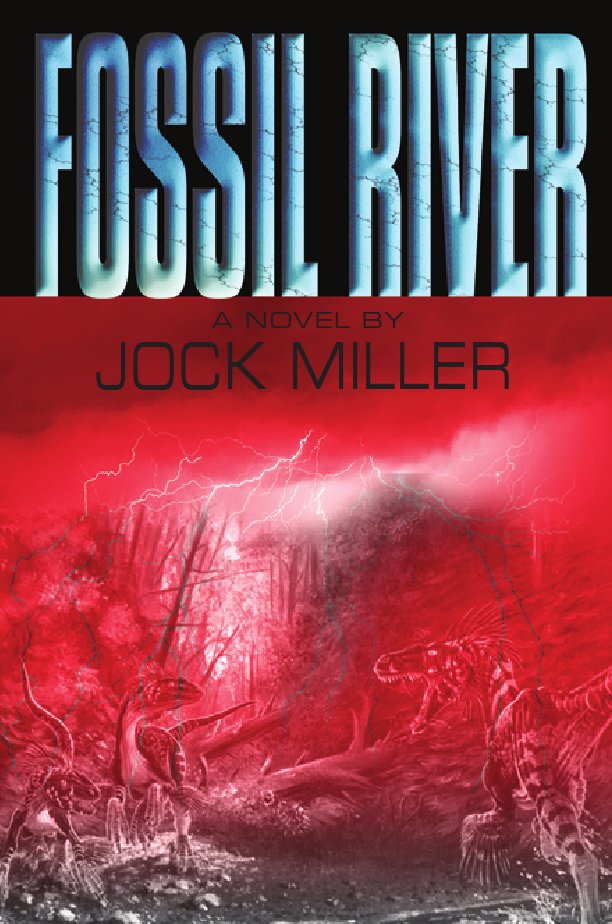
An action thriller by Jock Miller


Fossil fuel has an ageless affinity with dinosaurs. To create oil, dinosaurs died.


purchase on Amazon.com


The perfect energy storm is sweeping over the United States: Japan’s Fukushima nuclear plant meltdown has paralyzed nuclear expansion globally, BP’s Gulf of Mexico oil spill has stalled deep water drilling, Arab oil countries are in turmoil causing doubt about access to future oil, the intensity of hurricanes hitting the Gulf’s oil rigs and refineries has intensified due to global warming, and the nation’s Strategic Oil Supply is riding on empty.

As the energy storm intensifies, the nation’s access to Arab oil, once supplying over sixty percent of our fossil fuel, is being threatened causing people to panic for lack of gas at the pumps, stranding cars across the country and inciting riots.


The U.S. Military is forced to cut back air, land, and sea operations sucking up 58% of every barrel of oil to protect the nation; U.S. commercial airlines are forced to limit flights for lack of jet fuel; and businesses are challenged to power up their factories, and offices as the U.S. Department of Energy desperately tries to provide a balance of electric power from the network of aged power plants and transmission lines that power up the nation.

The United States must find new sources of domestic fossil fuel urgently or face an energy crisis that will plunge the nation into a deep depression worse than 1929.

The energy storm is very real and happening this very moment. But, at the last moment of desperation, the United States discovers the world’s largest fossil fuel deposit found in a remote inaccessible mountain range within Alaska’s Noatak National Preserve surrounding six and a half million acres.

Preventing access to the oil is a colony of living fossil dinosaurs that will protect its territory to the death.

Nobody gets out alive; nobody can identify the predator--until Dr. Kimberly Fulton, Curator of Paleontology at New York’s Museum of Natural History, is flown into the inaccessible area by Scott Chandler, the Marine veteran helicopter pilot who’s the Park’s Manager of Wildlife. All hell breaks loose when Fulton’s teenage son and his girlfriend vanish into the Park.


Will the nation’s military be paralyzed for lack of mobility fuel, and will people across America run out of gas and be stranded, or will the U.S. Military succeed in penetrating this remote mountain range in northwestern Alaska to restore fossil fuel supplies in time to save the nation from the worst energy driven catastrophe in recorded history?

______________________________________________________________________________________________________________________________________


Showing posts with label Gobi Desert. Show all posts

Gobi Desert of Inner Mongolia turns up evidence of a 90-million-year-old grave­yard

An expedition in the Gobi Desert of Inner Mongolia turns up evidence of a 90-million-year-old grave­yard, including the remains of more than a dozen fossilized ostrich like dinosaurs.
 
Professor Paul Sereno holds a plaque cast of two juvenile skeletons of the ostrich-mimic dinosaur Sinornithomimus that died when they were a little over one year in age. In their ribcages are stomach stones and the carbonized remains of their last plants they consumed. 


Evidence at the site points to a unique and rare conclusion: the dinosaur fossils were not deposited at the site over millennia. Instead the dinosaurs all met their fate at the same time.

The sudden death of the herd in a mud trap provides a rare snapshot of social behavior. Composed entirely of juveniles of a single species of ornithomimid dinosaur (Sinornithomimus dongi), the herd suggests that immature individuals were left to fend for themselves when adults were preoccupied with nesting or brooding.

Tarbosaurus Gangs: What Do We Know?

The proposal of pack-hunting dinosaurs is old news in paleontological circles, and the hard evidence to support the claims about Tarbosaurus has not yet been released


Paleontologist Philip Currie poses with a tyrannosaur skull. Photo courtesy Atlantic Productions.

Tarbosaurus, the great tyrannosaur of Cretaceous Mongolia, hunted in packs. That is the exceptional claim made by University of Alberta paleontologist Philip Currie in a press release, and news outlets all over the world have picked up the story. Just imagine rapacious tyrannosaur families tearing over the prehistoric countryside; it is a terrifying notion that the press release heralds as a “groundbreaking” discovery that will forever change paleontology.


But does the actual evidence live up to all the hype? Unfortunately, the answer is no. The proposal of pack-hunting dinosaurs is old news in paleontological circles, and the hard evidence to support the claims about Tarbosaurus has not yet been released.

Packaged under the theme “Dino Gangs,” the media release, book, and cable-network documentary arranged by Atlantic Productions hinge on a Tarbosaurus bonebed found in Mongolia’s Gobi Desert. The site was one of 90 Tarbosaurus localities surveyed by Currie and the Korea-Mongolia International Dinosaur Project, but it is unique in that it preserves the remains of six individual animals of different life stages. How the animals died and became buried is unknown. Even so, the press claims that these dinosaurs were a single family group that hunted together.


Read More Here

Inside China's Energy Machine

Capturing the Gobi’s Solar Power


Photograph by Toby Smith, Reportage by Getty Images

In Gansu Province, two people walk amid an array of solar panels designed to soak up the Gobi Desert's abundant sunshine.

China is only sixth or seventh among nations in solar capacity, but its installations are growing at breakneck pace, especially after a new feed-in tariff to encourage development. Installations doubled last year, and this year the country plans to add three gigawatts—double its current solar capacity.

By 2015, China aims to have installed solar generating capacity of at least 15 gigawatts. That goal, announced in December, ratcheted up the nation's previous solar target by 50 percent.

China already is the world leader in the manufacture of solar panels, with 51 percent of the market. The nation that developed solar technology in the 1950s, the United States, has about 6 percent of the market. And U.S. photovoltaic manufacturers are under pressure as their Chinese competitors drive down the price of the product.

President Barack Obama's administration is to weigh in next month on whether to take up the cause of a coalition of seven U.S. solar manufacturers that charge the Chinese producers of dumping large volumes of unfairly subsidized photovoltaic cells at undercut prices in an attempt to dominate the American market.


Read more

Gobi Desert of Inner Mongolia turns up evidence of a 90-million-year-old grave­yard

An expedition in the Gobi Desert of Inner Mongolia turns up evidence of a 90-million-year-old grave­yard, including the remains of more than a dozen fossilized ostrich like dinosaurs.


Evidence at the site points to a unique and rare conclusion: the dinosaur fossils were not deposited at the site over millennia. Instead the dinosaurs all met their fate at the same time.

The sudden death of the herd in a mud trap provides a rare snapshot of social behavior. Composed entirely of juveniles of a single species of ornithomimid dinosaur (Sinornithomimus dongi), the herd suggests that immature individuals were left to fend for themselves when adults were preoccupied with nesting or brooding.

Flaming Cliffs

A region of the Gobi Desert in the Ömnögovi Province of Mongolia, in which important fossil finds have been made. 


It was given this name by American paleontologist Roy Chapman Andrews, who visited in the 1920s. The area is most famous for yielding the first discovery of dinosaur eggs. Other finds in the area include specimens of Velociraptor, and eutherian mammals.

The red or orange color of the sandstone cliffs (especially at a sunset), hence the nickname.

Not all parts of the world had substantially different climates 85 million years ago than they do today, but Mongolia's Gobi Desert seems to have been as hot, dry and brutal as it's always been. We know this from the fact that so many of the dinosaur fossils unearthed at the Flaming Cliffs formation appear to have been buried in sudden sandstorms, and that very few large dinosaurs (which would have needed equally large amounts of vegetation to survive) lived here.
 

This site is also close to the region where researchers unearthed the tangled remains of a Protoceratops and a Velociraptor, which appear to have been locked in a death struggle at the time of their sudden demise.When dinosaurs died at Flaming Cliffs, they died quickly: burial by fierce sandstorms is the only way to account for the discovery of this dinosaur pair (as well as numerous, articulated Protoceratops skeletons found standing in the upright position).