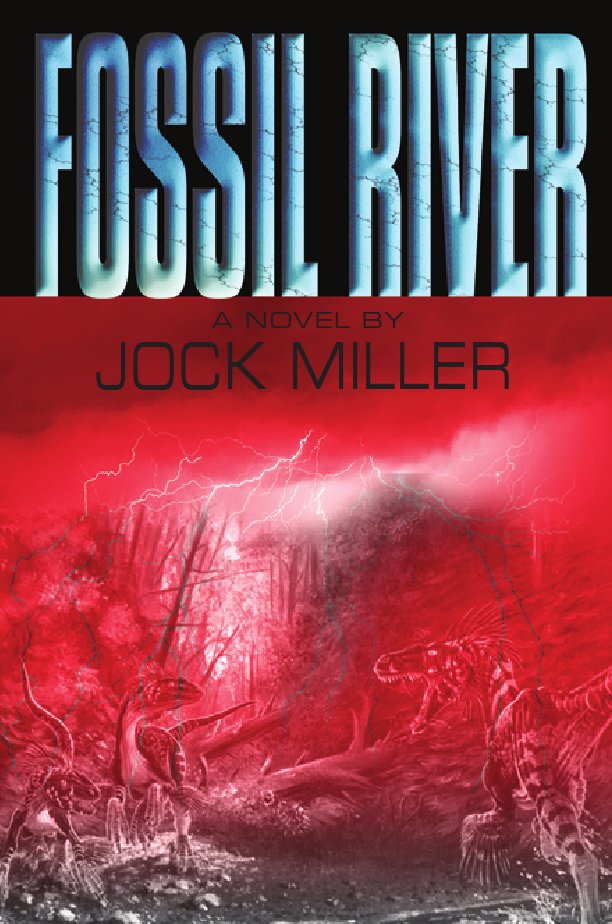
An action thriller by Jock Miller


Fossil fuel has an ageless affinity with dinosaurs. To create oil, dinosaurs died.


purchase on Amazon.com


The perfect energy storm is sweeping over the United States: Japan’s Fukushima nuclear plant meltdown has paralyzed nuclear expansion globally, BP’s Gulf of Mexico oil spill has stalled deep water drilling, Arab oil countries are in turmoil causing doubt about access to future oil, the intensity of hurricanes hitting the Gulf’s oil rigs and refineries has intensified due to global warming, and the nation’s Strategic Oil Supply is riding on empty.

As the energy storm intensifies, the nation’s access to Arab oil, once supplying over sixty percent of our fossil fuel, is being threatened causing people to panic for lack of gas at the pumps, stranding cars across the country and inciting riots.


The U.S. Military is forced to cut back air, land, and sea operations sucking up 58% of every barrel of oil to protect the nation; U.S. commercial airlines are forced to limit flights for lack of jet fuel; and businesses are challenged to power up their factories, and offices as the U.S. Department of Energy desperately tries to provide a balance of electric power from the network of aged power plants and transmission lines that power up the nation.

The United States must find new sources of domestic fossil fuel urgently or face an energy crisis that will plunge the nation into a deep depression worse than 1929.

The energy storm is very real and happening this very moment. But, at the last moment of desperation, the United States discovers the world’s largest fossil fuel deposit found in a remote inaccessible mountain range within Alaska’s Noatak National Preserve surrounding six and a half million acres.

Preventing access to the oil is a colony of living fossil dinosaurs that will protect its territory to the death.

Nobody gets out alive; nobody can identify the predator--until Dr. Kimberly Fulton, Curator of Paleontology at New York’s Museum of Natural History, is flown into the inaccessible area by Scott Chandler, the Marine veteran helicopter pilot who’s the Park’s Manager of Wildlife. All hell breaks loose when Fulton’s teenage son and his girlfriend vanish into the Park.


Will the nation’s military be paralyzed for lack of mobility fuel, and will people across America run out of gas and be stranded, or will the U.S. Military succeed in penetrating this remote mountain range in northwestern Alaska to restore fossil fuel supplies in time to save the nation from the worst energy driven catastrophe in recorded history?

______________________________________________________________________________________________________________________________________


Showing posts with label O.C. Marsh. Show all posts

Century-Old Bone Wars Fossil Dispute Unearthed From University Archives


Robert T. Hill
America has seen its share of wars, but did you hear about the Bone Wars? The late 1800s found archeologists digging furiously throughout the newly settled American west in a mad dash to find fossils. This lead to fighting in academic circles, and occasionally in the field itself, over disputes that became known as the Bone Wars.
Leading the search in western Texas were geologist Robert T. Hill, now acclaimed as the Father of Texas Geology, and naturalist Jacob Boll, who made many of the state´s earliest fossil discoveries, writes Margaret Alle for Southern Methodist University (SMU).
Jacob Boll


Both Hill and Boll had supporting roles in the Bone Wars through their work for one of the feud´s antagonists, Edward Drinker Cope, according to a new study by vertebrate paleontologist Louis L. Jacobs. The study by Jacobs expands knowledge about Cope´s work with Hill and Boll.


The study unveils new details about the Bone Wars in Texas that Jacobs deciphered from 13 letters written by Cope to Hill, discovered in an archive of Hill´s papers at SMU´s DeGolyer Library. The letters span seven years, from 1887 to 1894.

Working for the U.S. Geological Survey, Hill not only provided Cope with fossils of interest but also shared geological information about fossil locales. Boll, who was a paid collector for Cope – as was the practice at the time – supplied the well-known paleontologist with many fossils from Texas.

“Fossils collected by Boll and studied by Cope have become some of the most significant icons in paleontology,” said Jacobs, an SMU professor of earth sciences and president of SMU´s Institute for the Study of Earth and Man.

The Bone Wars were financed and driven by Cope and his archenemy, Othniel Charles Marsh, during a period of intense fossil collecting. The two were both giants of paleontology with a very public feud that brought the discovery of dinosaur fossils to the forefront of the American psyche.

The two began their scientific quests as a friendly endeavor to discover fossils. They each prospected the American frontier and also hired collectors to supply them with specimens. Over the years, Cope and Marsh identified and named hundreds of discoveries and published their results in scientific journals.

Their competition, however, evolved into a costly, self-destructive, vicious all-out war to see who could outdo the other. Despite their aggressive and sometimes unethical tactics to outwit one another and steal each other´s hired collectors, Cope and Marsh made major contributions to the field of paleontology, Jacobs said.

Born in 1858, Hill was a teenager when he left Tennessee as an orphan and arrived on the Texas frontier in 1874, eventually earning a Bachelor of Science in geology from Cornell and working as a field geologist for the U.S. Geological Survey (USGS).

Hill was the first to identify and map the distinct rock formations in North Texas that correspond to the Earth´s Cretaceous geologic period, Jacobs said. For much of the Cretaceous, a shallow sea cut North America in half from the Arctic to the Gulf of Mexico. Dinosaurs roamed the coastal shoreline and huge reptiles swam the waters.

Through his reading of the letters, Jacobs found that Cope disagreed with the way Hill named the Cretaceous rock units, and told him so. Cope counseled Hill: “You mustn´t mind criticism. We all get it and get used to it; but it isn´t comfortable at first.”

In subsequent letters, said Jacobs, it´s apparent Hill had changed his approach, for which Cope offered him high praise: “I wish to say definitely that your discovery of the lower Cretaceous series in this country is the most important addition to our geology that has been heard for a long time.”

Cope´s other Texas connection was through Jacob Boll, a much larger supplier to Cope who ultimately made significant contributions to the field of paleontology. Boll “is mentioned, usually in passing, in virtually every history of the subject,” according to Jacobs.

Born in 1828 in Switzerland, Boll was the first to discover vertebrate fossils in the Permian red beds along the drainages of the Wichita and Red rivers and their tributaries. “The discoveries opened up an entirely new chapter in vertebrate evolution some 280 million years old,” Jacobs said. “Boll´s finds include some of the oldest close relatives of mammals whose evolution eventually led to humans.”

While Hill and Boll were linked by their relationship to Cope, it isn´t known whether the two of them ever met, according to Jacobs. “Hill and Boll both made major contributions to frontier science at an important time in American history,” Jacobs said. “They may have been nearly forgotten, but their lives have influenced much that came later.”

At least one scholar has asserted that Cope – to keep the identity of his collectors secret from Marsh – never credited Boll for the Texan´s many fossil discoveries. Jacobs, however, found evidence that in 1878 Cope, in fact, did acknowledge Boll´s contribution, at least for the big-headed, semi-aquatic amphibian Eryops. Cope wrote that the fossil was “found “¦ by my friend Jacob Boll.”

During a break in his field labors, Boll´s fascination with ancient bones prompted him to write in his native German an ode to fossils. Jacobs found the poem in the American Museum of Natural History on a label on the back of Eryops specimen No. AMNH 4183.

SMU biology professor Pia Vogel translated the poem. Vogel and Jacobs worked with SMU English professor John M. Lewis to retain the essence of the poem in English.

“Now you will with some few others
Trek to the professor´s seat.
Awakened through his careful thought,
Be reassembled from your fragments,
To tell to others yet to come
From the sculpting of your teeth
How you lived and disappeared,
Name you he will, and what he found.”


Source: John Neumann for redOrbit.com – Your Universe Online


Reposted from RedOrbit

Steve Carell & James Gandolfini To Star In HBO Movie About Feuding Paleontologists


Nellie Andreeva

By NELLIE ANDREEVA

After recently co-starring together in The Incredible Burt Wonderstone, Steve Carell and James Gandolfini are reuniting for another comedic movie, this time on TV. Carell and Gandolfini are set to star and executive produce HBO Films‘ Bone Wars. The project, now in development, is based on the real-life Bone Wars (aka the Great Dinosaur Rush) between Edward Drinker Cope of the Academy of Natural Sciences in Philadelphia and Othniel Charles Marsh of the 

Peabody Museum of Natural History at Yale. Set during the post-Civil War birth of American science, the film is a sophisticated comedy about one of history’s most notorious feuds — the great dinosaur fossil race between paleontologists Marsh (Gandolfini) and Cope (Carell) — a decades-long competition that led to the discovery of more than 160 dinosaurs and their mutual downward spiral.

Where Dinosaurs Roamed


Footprints at one of the nation's oldest—and most fought over—fossil beds offer new clues to how the behemoths lived

By Genevieve Rajewski

Brontosaurus skeleton sketch (Historical Art Collection, National Museum of Natural History, SI)


Othniel Charles Marsh and Edward Drinker Cope were the two most prominent dinosaur specialists of the 1800s—and bitter enemies. They burned through money, funding expeditions to Western badlands, hiring bone collectors away from each other and bidding against one another for fossils in a battle of one-upmanship. They spied on each other's digs, had their minions smash fossils so the other couldn't collect them, and attacked each other in academic journals and across the pages of the New York Herald—making accusations of theft and plagiarism that tarnished them both. Yet between them they named more than 1,500 new species of fossil animals. They made Brontosaurus, Stegosaurus and Triceratops household names and sparked a dinomania that thrives today.

One of Marsh and Cope's skirmishes involved fossil beds in Morrison, Colorado, discovered in 1877 by Arthur Lakes, a teacher and geologist-for-hire. Lakes wrote in his journal that he had discovered bones "so monstrous...so utterly beyond anything I had ever read or conceived possible." He wrote to Marsh, at Yale, to offer his finds and services, but his letters met with vague replies and then silence. Lakes then sent some sample bones to Cope, the editor of American Naturalist. When Marsh got word that his rival was interested, he promptly hired Lakes. Under Marsh's control, the Morrison quarries yielded the world's first fossils of Stegosaurus and Apatosaurus, the long-necked plant eater more popularly known as Brontosaurus.

Lakes spent four field seasons chiseling the most easily reached bones out of the fossil beds. Before he left the area, he allegedly blew up one of the most productive sites—"Quarry 10"—to prevent Cope from digging there.

For 123 years, the site was lost, but in 2002 researchers from the Morrison Natural History Museum used Lakes' field notes, paintings and sketches to find the quarry, expose its original floor and support beams and begin digging once more.


 "The first things that we found were charcoal fragments: we were digging right below the campfire that Arthur Lakes had built," says Matthew Mossbrucker, director of the museum.

They quickly discovered that at least one misdeed attributed to the feud between Marsh and Cope was probably exaggerated. "It looks like [Lakes] just shoveled some dirt in there," says Mossbrucker. "I think he told people that he had dynamited it closed because he didn't want the competition up at the quarry—playing mind games with Cope's gang."

The reopened quarry is awash in overlooked fossils as well as relics that earlier paleontologists failed to recognize: dinosaur footprints that provide startling new clues about how the creatures lived.


Read More

Darwins Letter To O.C. Marsh


Aug 31 1880


In the mid-19th century, paleontologists scrambling for fossils focused more on the prehistoric ancestors of contemporary creatures than on dinosaurs. But after Charles Darwin published his On the Origin of Species in 1859, the theory of evolution became one of the most controversial topics of the time.

When American paleontologist O.C. Marsh identified the Equus parvulus (now Protohippus), many biologists considered the skeleton to be validation of Darwin's theory. In this brief letter from Charles Darwin to O.C. Marsh, Darwin expresses his thanks for Cope's work in the field.


 Yale Peabody Museum


My dear Prof. Marsh

I received some time ago your very kind note of July 28th, and yesterday the magnificent volume. I have looked with renewed admiration at the plates, and will soon read the text. Your work on these old birds on the many fossil animals of N. America has afforded the best support to the theory of evolution, which has appeared within the last 20 years. The general appearance of the copy which you have sent me is worthy of its contents, and I can say nothing stronger than this.

With cordial thanks, believe me yours very sincerely

Charles Darwin

http://www.pbs.org/wgbh/americanexperience