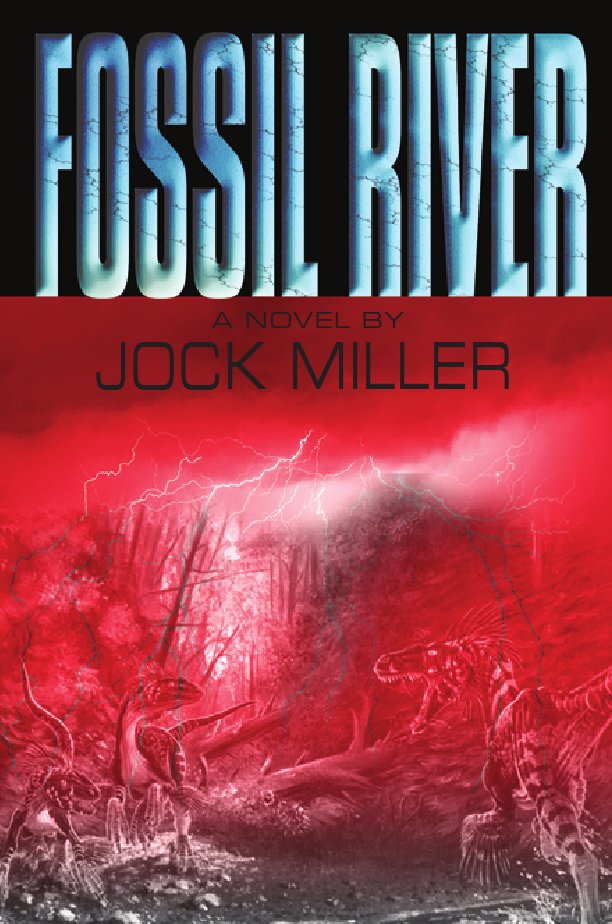
An action thriller by Jock Miller


Fossil fuel has an ageless affinity with dinosaurs. To create oil, dinosaurs died.


purchase on Amazon.com


The perfect energy storm is sweeping over the United States: Japan’s Fukushima nuclear plant meltdown has paralyzed nuclear expansion globally, BP’s Gulf of Mexico oil spill has stalled deep water drilling, Arab oil countries are in turmoil causing doubt about access to future oil, the intensity of hurricanes hitting the Gulf’s oil rigs and refineries has intensified due to global warming, and the nation’s Strategic Oil Supply is riding on empty.

As the energy storm intensifies, the nation’s access to Arab oil, once supplying over sixty percent of our fossil fuel, is being threatened causing people to panic for lack of gas at the pumps, stranding cars across the country and inciting riots.


The U.S. Military is forced to cut back air, land, and sea operations sucking up 58% of every barrel of oil to protect the nation; U.S. commercial airlines are forced to limit flights for lack of jet fuel; and businesses are challenged to power up their factories, and offices as the U.S. Department of Energy desperately tries to provide a balance of electric power from the network of aged power plants and transmission lines that power up the nation.

The United States must find new sources of domestic fossil fuel urgently or face an energy crisis that will plunge the nation into a deep depression worse than 1929.

The energy storm is very real and happening this very moment. But, at the last moment of desperation, the United States discovers the world’s largest fossil fuel deposit found in a remote inaccessible mountain range within Alaska’s Noatak National Preserve surrounding six and a half million acres.

Preventing access to the oil is a colony of living fossil dinosaurs that will protect its territory to the death.

Nobody gets out alive; nobody can identify the predator--until Dr. Kimberly Fulton, Curator of Paleontology at New York’s Museum of Natural History, is flown into the inaccessible area by Scott Chandler, the Marine veteran helicopter pilot who’s the Park’s Manager of Wildlife. All hell breaks loose when Fulton’s teenage son and his girlfriend vanish into the Park.


Will the nation’s military be paralyzed for lack of mobility fuel, and will people across America run out of gas and be stranded, or will the U.S. Military succeed in penetrating this remote mountain range in northwestern Alaska to restore fossil fuel supplies in time to save the nation from the worst energy driven catastrophe in recorded history?

______________________________________________________________________________________________________________________________________


Showing posts with label Confuciusornis. Show all posts

Ancient Ash Volcanoes Entombed Chinese Dinosaurs

The eruptions occurred across northern China from roughly 120 to 130 million years ago. In the study, the international team examined the ash encasing 14 well-preserved fossils from five bone beds, including the crow-size bird Confuciusornis and the parrot-faced dinosaur Psittacosaurus.


Confuciusornis


Ashes covering the fossils are fine-grained, covering charred bone, the researchers found, similar to pyroclastic ash seen in the massive 1883 eruption of the Indonesian volcano Krakatoa. The death poses of the creatures in the bone beds resemble those of other pyroclastic ash victims, with limbs extended. The bones have spiderweb cracks like those seen on the charred bones of Pompeii victims, according to the study.


 A cast of a Psittacosaurus skeleton. Photo by The Children's Museum of Indianapolis, distributed under a Creative Commons Attribution-Share Alike 3.0 Unported license. 
A cast of a Psittacosaurus skeleton. Photo by The Children’s Museum of Indianapolis


Read More

Fossils of the Cretaceous

Ancient bird - Confuciusornis


Roughly 130 million years ago, in what is now northeastern China, volcanoes repeatedly showered down fine-grained ash, capturing remarkable details of ancient animals and plants. The fossils have allowed scientists to reconstruct a vivid picture of the ecosystem and gain insights into how modern organisms evolved. Here, glimpse the creatures—some familiar, others entirely alien—that inhabited the region long ago. 

Read More

When feathered dinosaurs roamed the land, true birds soared through the Liaoning skies. Some were as big as albatrosses; others, such as this Confuciusornis, were more the size of pigeons. This fossil, dating to about 120 million years ago, reveals characteristics that make Confuciusornis a mix of primitive (more dinosaur-like) and advanced (modern bird-like) traits: Like dinosaurs and the oldest known bird, Archaeopteryx, it has three fingers that are not fused into a single element, but like modern birds, it has a toothless beak and a well-developed shoulder girdle to power flight. 

Dinosaur-Feather Doppelganger?


Photographs courtesy University of Bristol

The feather of an extinct Confuciusornis bird may have had colors similar to those in this modern feather from a zebra finch, according to the new study.

Feather color in Confuciusornis—an early beaked bird found in 120- to 130-million-year-old fossil beds in Liaoning Province, China—was inferred from microscopic melanosomes preserved in a fossil specimen.

Two types of melanosomes were found. Eumelanosomes (such as the finch eumelanosomes inset at left) are rodlike and associated with the colors black and grey in living birds. Phaeomelanosomes (inset right) are spherical and produce colors ranging from reddish brown to yellow. A lack of melanosomes makes white.

Using a scanning electron microscope, the researchers found that a fossil Confuciusornis feather contained both types of melanosomes and was likely multicolored in life.


Read More