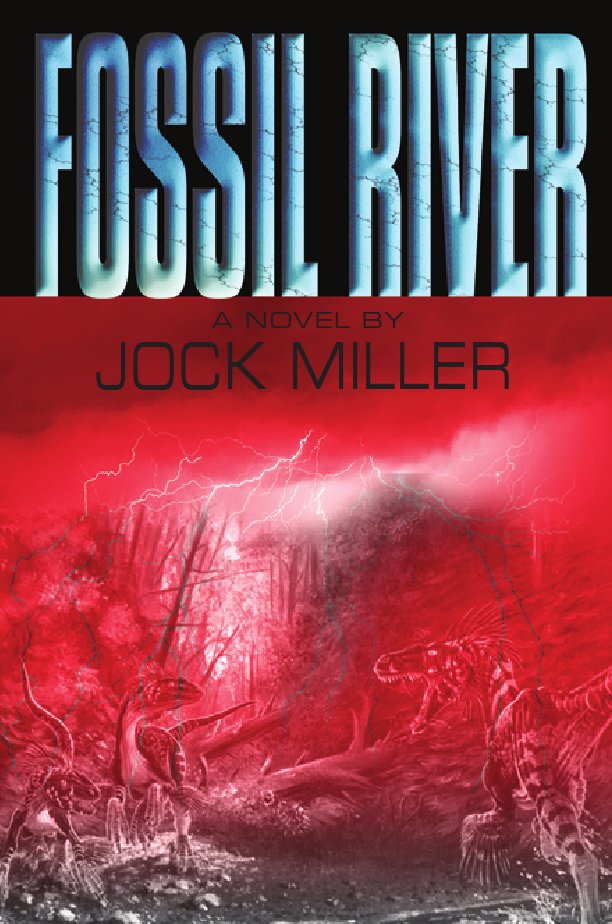
An action thriller by Jock Miller


Fossil fuel has an ageless affinity with dinosaurs. To create oil, dinosaurs died.


purchase on Amazon.com


The perfect energy storm is sweeping over the United States: Japan’s Fukushima nuclear plant meltdown has paralyzed nuclear expansion globally, BP’s Gulf of Mexico oil spill has stalled deep water drilling, Arab oil countries are in turmoil causing doubt about access to future oil, the intensity of hurricanes hitting the Gulf’s oil rigs and refineries has intensified due to global warming, and the nation’s Strategic Oil Supply is riding on empty.

As the energy storm intensifies, the nation’s access to Arab oil, once supplying over sixty percent of our fossil fuel, is being threatened causing people to panic for lack of gas at the pumps, stranding cars across the country and inciting riots.


The U.S. Military is forced to cut back air, land, and sea operations sucking up 58% of every barrel of oil to protect the nation; U.S. commercial airlines are forced to limit flights for lack of jet fuel; and businesses are challenged to power up their factories, and offices as the U.S. Department of Energy desperately tries to provide a balance of electric power from the network of aged power plants and transmission lines that power up the nation.

The United States must find new sources of domestic fossil fuel urgently or face an energy crisis that will plunge the nation into a deep depression worse than 1929.

The energy storm is very real and happening this very moment. But, at the last moment of desperation, the United States discovers the world’s largest fossil fuel deposit found in a remote inaccessible mountain range within Alaska’s Noatak National Preserve surrounding six and a half million acres.

Preventing access to the oil is a colony of living fossil dinosaurs that will protect its territory to the death.

Nobody gets out alive; nobody can identify the predator--until Dr. Kimberly Fulton, Curator of Paleontology at New York’s Museum of Natural History, is flown into the inaccessible area by Scott Chandler, the Marine veteran helicopter pilot who’s the Park’s Manager of Wildlife. All hell breaks loose when Fulton’s teenage son and his girlfriend vanish into the Park.


Will the nation’s military be paralyzed for lack of mobility fuel, and will people across America run out of gas and be stranded, or will the U.S. Military succeed in penetrating this remote mountain range in northwestern Alaska to restore fossil fuel supplies in time to save the nation from the worst energy driven catastrophe in recorded history?

______________________________________________________________________________________________________________________________________


Showing posts with label Sinosauropteryx. Show all posts

Dinosaur True Colors Revealed for First Time

"Dino fuzz" pigment discovery in feathers may strengthen dinosaur-bird link.

Sinosauropteryx is the first fossil dinosaur to have its color scientifically established.
Illustration courtesy James Robins


Chris Sloan


Pigments have been found in fossil dinosaurs for the first time, a new study says.

The discovery may prove once and for all that dinosaurs' hairlike filaments—sometimes called dino fuzz—are related to bird feathers, paleontologists announced today.

The finding may also open up a new world of prehistoric color, illuminating the role of color in dinosaur behavior and allowing the first accurately colored dinosaur re-creations, according to the study team, led by Fucheng Zhang of China's Institute for Vertebrate Paleontology.

The team identified fossilized melanosomes—pigment-bearing organelles—in the feathers and filament-like "protofeathers" of fossil birds and dinosaurs from northeastern China.

Found in the feathers of living birds, the nano-size packets of pigment—a hundred melanosomes can fit across a human hair—were first reported in fossil bird feathers in 2008.


Read more 

Fossils of the Cretaceous

Dinosaur with proto-feathers - Sinosauropteryx


Roughly 130 million years ago, in what is now northeastern China, volcanoes repeatedly showered down fine-grained ash, capturing remarkable details of ancient animals and plants. The fossils have allowed scientists to reconstruct a vivid picture of the ecosystem and gain insights into how modern organisms evolved. Here, glimpse the creatures—some familiar, others entirely alien—that inhabited the region long ago. 

Read More


The full name of this animal, Sinosauropteryx prima, means "first Chinese winged lizard." Its discovery in the mid-1990s delighted many paleontologists who suspected that birds are close kin to dinosaurs. This fossil offered evidence in the form of downy, short feathers all along the animal's head, back, and tail. A carnivorous dinosaur about the size of a greyhound, Sinosauropteryx likely ran swiftly on its two hind legs. With fuzzy feathers just a few millimeters long, it is unlikely that it ever flew. The feathers could, however, help keep the dinosaur warm through cool nights in the temperate forest.


Feathered Dinosaurs: Sinosauropteryx

Sinosauropteryx was the first dinosaur to have its life colouration described by scientists based on physical evidence. Some fossils of Sinosauropteryx show an alternation of lighter and darker bands preserved on the tail.

Digital illustration of the coelurosaurian dinosaur Sinosauropteryx prima, based on the holotype specimen. Coloration and pattern follows Zhang et al 2010.

All described specimens of Sinosauropteryx preserve integumentary structures (filaments arising from the skin) which most palaeontologists interpret as very primitive feathers. These short, down-like filaments are preserved along the back half of the skull, arms, neck, back, and top and bottom of the tail. Additional patches of feathers have been identified on the sides of the body, and palaeontologists Chen, Dong and Zheng proposed that the density of the feathers on the back and the randomness of the patches elsewhere on the body indicated the animals would have been fully feathered in life, with the ventral feathers having been removed by decomposition.

Fossils That Made History: Sinosauropteryx (1997)

The first of a spectacular series of "dino-bird" discoveries in China's Liaoning quarry, the well-preserved fossil of Sinosauropteryx betrays the unmistakable impression of primitive, hair-like feathers.

Fossil of Sinosauropteryx prima, the first “feathered” dinosaur. Its primitive feathers could be seen clearly on the head, back, and tail. The length of the fossil is about 130 cm.

The first genus of dinosaur outside of Avialae (birds and their immediate relatives) to be found with evidence of feathers. They were covered with "furry" coats of very simple filament-like feathers. Structures that indicate colouration have been preserved for some of the feathers, which also makes Sinosauropteryx the first non-avialian dinosaurs where colouration has been determined. Colouration includes a banded tail with reddish and light bands.