An action thriller by Jock Miller


Fossil fuel has an ageless affinity with dinosaurs. To create oil, dinosaurs died.


purchase on Amazon.com


The perfect energy storm is sweeping over the United States: Japan’s Fukushima nuclear plant meltdown has paralyzed nuclear expansion globally, BP’s Gulf of Mexico oil spill has stalled deep water drilling, Arab oil countries are in turmoil causing doubt about access to future oil, the intensity of hurricanes hitting the Gulf’s oil rigs and refineries has intensified due to global warming, and the nation’s Strategic Oil Supply is riding on empty.

As the energy storm intensifies, the nation’s access to Arab oil, once supplying over sixty percent of our fossil fuel, is being threatened causing people to panic for lack of gas at the pumps, stranding cars across the country and inciting riots.


The U.S. Military is forced to cut back air, land, and sea operations sucking up 58% of every barrel of oil to protect the nation; U.S. commercial airlines are forced to limit flights for lack of jet fuel; and businesses are challenged to power up their factories, and offices as the U.S. Department of Energy desperately tries to provide a balance of electric power from the network of aged power plants and transmission lines that power up the nation.

The United States must find new sources of domestic fossil fuel urgently or face an energy crisis that will plunge the nation into a deep depression worse than 1929.

The energy storm is very real and happening this very moment. But, at the last moment of desperation, the United States discovers the world’s largest fossil fuel deposit found in a remote inaccessible mountain range within Alaska’s Noatak National Preserve surrounding six and a half million acres.

Preventing access to the oil is a colony of living fossil dinosaurs that will protect its territory to the death.

Nobody gets out alive; nobody can identify the predator--until Dr. Kimberly Fulton, Curator of Paleontology at New York’s Museum of Natural History, is flown into the inaccessible area by Scott Chandler, the Marine veteran helicopter pilot who’s the Park’s Manager of Wildlife. All hell breaks loose when Fulton’s teenage son and his girlfriend vanish into the Park.


Will the nation’s military be paralyzed for lack of mobility fuel, and will people across America run out of gas and be stranded, or will the U.S. Military succeed in penetrating this remote mountain range in northwestern Alaska to restore fossil fuel supplies in time to save the nation from the worst energy driven catastrophe in recorded history?

______________________________________________________________________________________________________________________________________


Showing posts with label Feathered Dinosaurs. Show all posts

Feathered Dinosaurs: Moa


Joel Polack, a trader who lived on the East Coast of the North Island from 1834 to 1837, recorded in 1838 that he had been shown "several large fossil ossifications" found near Mt Hikurangi. He was certain that these were the bones of a species of emu or ostrich, noting that "the Natives add that in times long past they received the traditions that very large birds had existed, but the scarcity of animal food, as well as the easy method of entrapping them, has caused their extermination". Polack further noted that he had received reports from Māori that a "species of Struthio" still existed in remote parts of the South Island. Dieffenbach also refers to a fossil from the area near Mt Hikurangi, and surmises that it belongs to "a bird, now extinct, called Moa (or Movie) by the natives". In 1839 John W. Harris, a Poverty Bay flax trader who was a natural history enthusiast, was given a piece of unusual bone by a Māori who had found it in a river bank. He showed the 15 centimetres (6 in) fragment of bone to his uncle, John Rule, a Sydney surgeon, who sent it to Richard Owen, who at that time was working at the Hunterian Museum at the Royal College of Surgeons in London.

Owen puzzled over the fragment for almost four years. He established it was part of the femur of a big animal, but it was uncharacteristically light and honeycombed. Owen announced to a skeptical scientific community and the world that it was from a giant extinct bird like an ostrich, and named it Dinornis. His deduction was ridiculed in some quarters, but was proved correct with the subsequent discoveries of considerable quantities of moa bones throughout the country, sufficient to reconstruct skeletons of the birds.

In July 2004, the Natural History Museum in London placed on display the moa bone fragment Owen had first examined, to celebrate 200 years since his birth, and in memory of Owen as founder of the museum.

Sir Richard Owen holding the first discovered moa fossil and standing with a Dinornis skeleton

Preserved footprints of a D. robustus found in 1911
Since the discovery of the first moa bones in the late 1830s, thousands more have been found. They occur in a range of late Quaternary and Holocene sedimentary deposits, but are most common in three main types of site: caves, dunes, and swamps.  Approximately eight moa trackways, with fossilised moa footprint impressions in fluvial silts have been found.

Several remarkable examples of moa remains have been found which exhibit soft tissues (muscle, skin, feathers), that were preserved through desiccation when the bird died in a naturally dry site (for example, a cave with a constant dry breeze blowing through it).


Hitchcock’s Primeval Birds

Paleontologist Edward Hitchcock was one of the first dinosaur track experts, but why did he insist that birds left the footprints


Edward Hitchcock was one of America’s first dedicated dinosaur paleontologists. He just didn’t know it. In fact, during the latter part of his career, he explicitly denied the fact. To Hitchcock, the tracks skittering over red sandstone in the Connecticut Valley were the marks of prehistoric birds from when the Creation was new. Hitchcock could not be dissuaded. As new visions of dinosaurs and the notion of evolution threatened to topple his life’s work, the Amherst natural theologian remained as immutable as the fossil footprints he studied.

Hitchcock was not the first to wonder about the prehistoric imprints. Members of the Lenape, a Native American group in Canada and the northeastern United States, had seen the bizarre, three-toed tracks and ascribed them to monsters and other beings. These were the footsteps of creatures that ruled the world before humans came to dominance. European settlers and their descendants had to stretch their mythology a little more to accommodate the tracks. Some thought such tracks might have been left by Noah’s raven after the biblical deluge, although many simply called them “turkey tracks” and apparently were little concerned with where they had come from.

It wasn’t until 1835 that James Deane, a doctor with a curiosity for natural history, found out about a sample of the peculiar tracks near Greenfield, Massachusetts. He knew that they represented prehistoric organisms, but he wasn’t sure which ones. He wrote to Hitchcock, then a geology professor at Amherst, to inquire about what could have left such markings in stone. At first Hitchcock didn’t believe Deane. There might be some quirk of geological formation that could have created track-like marks. But Deane was persistent. Not only did he change Hitchcock’s mind, but the geologist became so enthusiastic that he quickly became the most prominent expert on the tracks—a fact that frustrated Deane and led to tussles in academic journals over who really was the rightful discoverer of the Connecticut Valley’s lost world.

Hitchcock began publishing about the peculiar trace fossils in 1836. He was confident from the very start that they must

have been created by prehistoric birds. (He was so enthused by the idea he even wrote poetry about the “sandstone birds.”) No variety of creature matched them better. The word “dinosaur” had not even been invented yet; the British anatomist Richard Owen would establish the term in 1842. The few dinosaurs that had been found, such as Iguanodon, Megalosaurus and Hylaeosaurus, were known only from paltry remains and all were believed to have been enormous variations of lizards and crocodiles. Dinosaurs were a poor fit for the tracks, and became even worse candidates when Owen gave them an anatomical overhaul. Owen not only named dinosaurs, he re-branded them as reptiles with mammal-like postures and proportions. The huge sculptures of the Crystal Palace exhibition, created with the help of artist Benjamin Waterhouse Hawkins, are a testament to Owen’s view of dinosaurs as reptiles that had taken on the anatomical attitudes of rhinoceros and elephants.

But Owen and other paleontologists did not agree with Hitchcock’s interpretation. They argued that the tracks could have been made by some unknown variety of amphibian or reptile. This was not so much because of the anatomy of the tracks—anyone could see that they were made by creatures with bird-like feet—but because no one thought that birds could have lived at so ancient a time or grown large enough to make the biggest, 18-inch tracks Hitchcock described. Even though early 19th century paleontologists recognized that life changed through the ages, they believed there was a comprehensible progression in which so-called “higher” types of creatures appeared later than others. (Mammals, for example, were thought to have only evolved after the “Secondary Era” when reptiles ruled since mammals were thought to be superior to mosasaurs, ichthyosaurs, and other creatures of that middle time.)
 
Hitchcock remained steadfast, and his persistence was eventually rewarded with the discovery of the moa. These huge, flightless birds recently lived on New Zealand—they were wiped out more than 500 years ago by humans—and in 1839 Richard Owen rediscovered the birds through a moa thigh bone. He hypothesized that the bone must have belonged to a large, ostrich-like bird, and this idea was soon confirmed by additional skeletal bits and pieces. Some of these ratites stood over nine feet tall. When the news reached Hitchcock in 1843, he was thrilled. If recent birds could grow to such sizes, then prehistoric ones could have been just as large. (And, though Hitchcock died before their discovery, preserved moa tracks have a general resemblance to some of the largest footprints from the Connecticut Valley.) Opinion about the New England tracks quickly changed. There was no longer any reason to doubt Hitchcock’s hypothesis, and paleontologists hoped that moa-like bones might eventually be found to conclusively identify the trackmakers.

Lacking any better hypotheses, Hitchcock prominently featured his avian interpretation of the three-toed tracks in his 1858 book The Ichnology of New England. It was a gorgeous fossil catalog, but it also came at almost precisely the wrong time. Gideon Mantell, the British doctor and paleontologist who discovered Iguanodon, was beginning to wonder if some dinosaurs primarily walked on their hind limbs in a bird-like fashion, and the Philadelphia polymath Joseph Leidy described Hadrosaurus, a dinosaur certainly capable of bipedal locomotion on account of having shorter forelimbs than hindlimbs, the same year that Hitchcock’s monograph came out. Dinosaurs were undergoing another major overhaul, and the few that were known at the time were being recast as relatively bird-like creatures. Even worse for Hitchcock, the following year another student of the Connecticut Valley tracks, Roswell Field, reinterpreted many of the footprints and associated traces as being made by prehistoric reptiles. Especially damning was the fact that deep tracks, left when the creatures sunk into the mud, were sometimes associated with drag marks created by a tail. Hitchcock’s tableau of ancient Massachusetts moas was becoming increasingly unrealistic.

If Hitchcock ever doubted his interpretation, he never let on. He reaffirmed his conclusions and modified his arguments in an attempt to quell dissent. In his last book, A Supplement of the Ichnology of New England, published in 1865, a year after his death, Hitchcock used the recently discovered Jurassic bird Archaeopteryx as a way to save his interpretation. Tail drags were no obstacle to the bird hypothesis, Hitchcock argued, because Archaeopteryx was generally regarded as being the primordial bird despite having a long, reptile-like tail. Perhaps such a bird could have been responsible for the trace fossils Hitchcock called Anomoepus, but the tail drags left by the animals that dwelled in Jurassic New England were also associated with tracks indicating that their maker walked on all fours. In response, Hitchcock cast Archaeopteryx as a quadrupedal bird—a representative of a new category different from the classic, bipedal bird tracks he had promoted for so long.

Other paleontologists took a different view. If Archaeopteryx looked so primitive and lived after the time when the red Connecticut sandstone was formed, then it was unreasonable to think that more specialized, moa-like birds created Hitchcock’s tracks. Furthermore, a few bones found in a Massachusetts quarry of roughly the same age in 1855 turned out to belong to a dinosaur—a sauropodomorph that Othniel Charles Marsh would later name Anchisaurus. The bird bones never turned up, and all the while dinosaur fossils were becoming more and more avian in nature. By the 1870s the general paleontological opinion had changed. New England’s early Jurassic was not filled with archaic birds, but was instead home to dinosaurs which were the forerunners of the bird archetype.

Our recent realization that birds are the direct descendants of one group of coelurosaurian dinosaurs has led some of Hitchcock’s modern day fans to suggest that he was really right all along. In an essay for the Feathered Dragons volume, paleontologist Robert Bakker extolled Hitchcock’s scientific virtues and cast the geologist’s avian vision for the tracks as essentially correct. Writer Nancy Pick, in her 2006 biography of the paleontologist, wondered, “What if Hitchcock clung to his bird theory because he was right?” But I think such connections are tenuous—it is a mistake to judge Hitchcock’s work by what we have come to understand a century and a half later.


Read more


The Extent of the Preserved Feathers on the Four-Winged Dinosaur Microraptor gui under Ultraviolet Light


Examination under ultraviolet light reveals that these feathers actually reach the body of the animal and were not disassociated from the bones. Instead they may have been chemically altered by the body tissues of the animal meaning that they did not carbonise close into the animal or more likely were covered by other decaying tissue, though evidence of their presence remains.

These UV images show that the feathers preserved on the slab are genuinely associated with the skeleton and that their arrangement and orientation is likely correct. The methods used here to reveal hidden features of the specimen may be applicable to other specimens from the fossil beds of Liaoning that produced Microraptor.


Figure 2: The holotype of Microraptor gui, IVPP V 13352 under UV light.

Different filters were employed for parts A and B, hence the difference in colour and appearance. A also is labeled to indicate the preserved feathers (grey arrows) and the ‘halo’ around the specimen where they appear to be absent (black arrows) as well as phosphatised tissues (white arrows). Scale bars are 5 cm in both A and B.


Figure 3: Close up of lower hindlimb of the holotype under UV light.

This shows that the feathers do indeed penetrate the halo (grey arrows) when seen in UV and approach or reach the bones. These are not seen in natural light due to the overlying soft tissues seen in figure 2. Scale bar at 5 cm.


Source: Plos One

Juravenator: Germany’s Other Feathered Dinosaur


The skeleton of Juravenator under UV light. If you look closely around the middle of the tail, you can see the traces of soft tissue. From Chiappe and Göhlich, 2010.

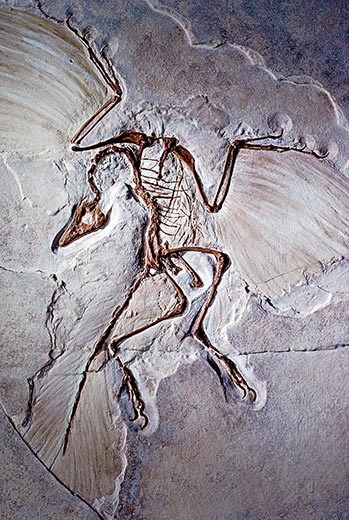
In 1861, as debates about evolution were brewing among naturalists, two important skeletons were discovered from the Late Jurassic limestone quarries of Germany. Both would be relevant to ideas about how birds evolved. Although not recognized as such until the late 20th century, Archaeopteryx was the first feathered dinosaur ever discovered and was a confirmation that birds had evolved from reptiles. The other creature, Compsognathus, represented a small, exceptionally bird-like dinosaur, and the anatomist T.H. Huxley took it as a proxy for the kind of animal from which birds originated. “There is no evidence that Compsognathus possessed feathers,” Huxley said during his 1877 American lecture tour, “but, if it did, it would be hard indeed to say whether it should be called a reptilian bird or an avian reptile.”


Now another feathered dinosaur has been discovered from the famous German limestone quarries. Named Juravenator starki in 2006, this dinosaur was a close relative of Compsognathus which lived just a little bit earlier on the same prehistoric archipelago. It is one of the most complete dinosaurs from these limestone deposits. From the tip of the snout to very nearly the end of the tail, the whole skeleton was preserved, but there was something special about this animal that could only be seen in the right light.

David Hone and colleagues published a paper showing how examining fossils under ultraviolet light can illuminate soft-tissue structures—like feathers—that would otherwise be hidden. Paleontologists Luis Chiappe and Ursula Göhlich applied the same technique to the Juravenator skeleton, and near the middle of the dinosaur’s tail they found an area of preserved soft tissue. The most easily seen parts of the soft tissue were patches of tiny bumps consistent with the skin impressions of other dinosaurs. Yet there were wispy protofeathers, too. Thanks to high-resolution photography, the remains of downy feathers were also detected, and these were similar to the structures that covered the body of a relative of Juravenator from China called Sinosauropteryx. 


Juravenator was a small bipedal predator. Size of the juvenile type specimen, with a human for scale - See more at: http://www.fossilriver-thenovel.com/#sthash.qRxbHFb9.dpuf
Juravenator was a small bipedal predator. Size of the juvenile type specimen, with a human for scale


The presence of both scaly skin and filamentous feathers makes Juravenator unique among feathered dinosaurs. This combination has not been seen before, but it is consistent with laboratory models of how feathers evolved from scaly skin. Furthermore, it appears that Juravenator was not wholly covered by a coat of fluffy feathers like baby chicks, perhaps indicating that feathery structures appeared on some parts of the bodies of dinosaurs before others. Frustratingly, the extent of soft-tissue preservation on the first Juravenator specimen is extremely limited, but further discoveries of this animal may help us better understand the origins of feathered dinosaurs.


Reposted from Smithsonian Magazine


Feathered Dinosaurs: Shenzhouraptor

Shenzhouraptor fossil. Shenzhouraptor was a prehistoric bird that resembled the famed Archaeopteryx. But even though it still had a long reptilian tail, Shenzhouraptor had evolved a greater flying ability.


The specimen is edentulous, its forelimb is distinctly longer than its hind limb, the tail is composed of over 20 caudals, the furcula is U-shaped, and flight feathers exceed torso length.  These characters express a genuine ability for flight, representing a missing link between theropod dinosaurs and birds.

Read more


Feathered Dinosaurs: Cryptovolans

Cryptovolans is extraordinary for being the first known dinosaur to have flight-capable feathers on its legs as well as on its arms. It also had feathers on the ending of its long tail, and probably on the rest of its body. It is supposed that Cryptovolans may have been able to fly better than Archaeopteryx, the animal usually referred as the earliest known bird. Possessing a keel and ribs with an uncinate procedure, Cryptovolans has modern bird skin which are absent in Archaeopteryx.


Cryptovolans, a four winged bird. The flight feathers on the hind legs gives Cryptovolans the appearance of being a bird equipped with four wings. It was originally thought that animals like Cryptovolans did not have any wings because they supposedly represented the ancestors of birds before flight had evolved. The discovery that Cryptovolans had the ability to fly revealed that dromaeosaurs were actually birds. Sculpture by Stephen Czerkas, © 2005. 


Cryptovolans head shot

Cryptovolans head shot. Cryptovolans means "hidden-flyer". It was a primitive bird that still had teeth. Sculpture by Stephen Czerkas, © 2005.


Read More


Dinosaurs' Living Descendants


China's spectacular feathered fossils have finally answered the century-old question about the ancestors of today's birds
  Zhou Zhonghe

A key Chinese discovery was a primitive bird called Confuciusornis, identified by Zhou Zhonghe.

Xu Xuing with Psittacosaurus fossil

Discoverer of more dinosaur species than any other living scientist, Xu Xing, with a cast of parrot-faced Psittacosaurus, says some dinosaurs have birdlike traits, including feathers.


Some paleontologists now say Archaeopteryx may have been a feathered non-avian dinosaur.

Microraptor


One of the most unexpected Chinese fossils in Microraptor. It had four feathered limbs and almost certainly could fly. But unlike birds, it did not escape extinction.

Sinosauropteryx

The Yixian Formation also yielded Sinosauropteryx, the first physical evidence of a feathered dinosaur.

Oviraptor
Some dinosaurs engaged in distinctly birdlike behaviors, such as nesting and brooding. Shown here is a partially reconstructed Oviraptor fossil from Mongolia with 20 eggs.

Read more


A real-life Jurassic Park?

Birds could be theoretically 'de-evolved' back to dinosaurs

Oxford biochemist says dinosaurs and Woolly Mammoths could be brought back to life - but dinosaurs could be trickier.


Artist's impression of a nesting site of the dinosaur Massospondylus


Dr Alison Woollard said it would be theoretically possible to recreate ancient animals, through the DNA of birds.

By identifying and altering certain genes found in the DNA of modern birds, she believes scientists may be able to “design” genomes of the prehistoric creatures.

The theory echoes the plot of Jurassic Park, but comes after a recent attempt to bring back the animals using techniques more faithful to those used in the 1993 film failed.
The Steven Spielberg production saw geneticists recreate dinosaurs using DNA recovered from bloodsucking insects which had been caught in sticky tree sap before it turned to amber.

 A mosquito was recently discovered which had the blood of another animal in its stomach dating from dating back 46 million years, not quite the age of dinosaurs, but tantalisingly close.

However, hope vanished when a team at Western Australia’s Murdoch University found that DNA cannot survive for more than 6.3 million years. Most dinosaurs died out about 65 million years ago, in the Cretaceous period.

However Dr Woollard, from Oxford University’s Department of Biochemistry, has suggested the feat could be achieved by “de-evolving” birds.

“We know that birds are the direct descendants of dinosaurs, as proven by an unbroken line of fossils which tracks the evolution of the lineage from creatures such as the velociraptor or T-Rex through to the birds flying around today,” said Dr Woollard.

“The most famous of these is the Archaeopteryx, a fossil which clearly shows the transition between feathered dinosaurs and modern birds.

“This evolution implies that buried deep within the DNA of today’s birds are switched-off genes that control dinosaur-like traits.  


Read more


Dinosaurs are alive and well

Ancient species have evolved over millions of years into birds, finds Oxford University study  


A Tyrannosaurus Rex

Dinosaurs are not extinct, but have simply shrunk to become the 10,000 species of birds that are alive today, academics at Oxford University have claimed.

A study of the evolution of 426 dinosaur species over millions of years revealed that dinosaurs gradually became smaller in size until they evolved into birds.

Researchers have shown that shrinking was key to their survival and allowed them to become one of the most diverse and abundant families of animals alive today.

Dr Roger Benson, from Oxford University, said: “We wanted to understand the evolutionary links between this exceptional living group, and their Mesozoic relatives, including well-known extinct species like T rex, triceratops, and stegosaurus.”

The scientists found that dinosaurs underwent rapid changes in body size shortly after they first appeared, around 220 million years ago. Thereafter only the evolutionary line leading to birds continued to change size at such a fast rate, and did so for a further 170 million years. The study was published in the online journal Public Library of Science Biology. 


Read more

Birds and Dinosaurs: Their Strangest Feature

A nifty bit of respiratory design goes back a very long way


It took an awful lot of clever adaptations to the produce common bird. It’s got to be light, so you give it hollow  bones. It’s got to be strong, so you give it less a breastbone than a keel, to which powerful wing muscles can be attached. And it’s got to have a prodigious respiratory system—flying ain’t easy—so you give it a peculiar system of multiple air sacs serve as lungs, with the air rushing through in one direction, making a tour of each of the chambers and then exiting, rather than rushing in and out, as in our lungs.

Now, a new study in Nature suggests that something else is at work in those lungs: avian respiratory architecture may be a feature left over from the long-ago days when birds were dinosaurs. That conclusion was announced by a group of scientists from the University of Utah, who did their work not by studying birds, but their distant cousins, monitor lizards. Earlier evidence had already shown that alligators have a four-chambered respiratory system, so it was no news that monitor lizards do too. But the researchers were less interested in what the architecture of the animals’ lungs is than in how the whole system works.


Read More


When Dinosaurs Came in Color

Scientists already knew that birds are descended from the dinosaurs. Now new research says that feathered dinosaurs also had surprisingly colorful plumage


It’s probably hard to believe, but there was a time, not that long ago, when scientists thought dinosaurs were extinct. No, seriously! That was before paleontologists began to understand the impressive anatomical similarities between fossil dinos and living birds. The icing on the cake: a series of discoveries, starting in the 1990s, showing that some dinosaurs even sported feathers. It’s no longer even slightly controversial to claim that birds are descended from dinosaurs, and even that they are dinosaurs—the only branch of the family that survived a massive comet strike 65 million years ago.

With that relationship firmly established, scientists have moved on to looking at some more finely grained questions, and a new paper in Nature is casting light on one of them: since the feathers of modern birds are often intensely colorful, how much color did their extinct cousins display? The answer, it turns out, is probably a lot. Feathers, says Julia Clarke, of the University of Texas, Austin, one of the paper’s co-authors, were brightly colored from the time they first appeared in Maniraptoran dinosaurs, including oviraptors and dromaeosaurs.

Read More 


Dinosaur True Colors Revealed for First Time

"Dino fuzz" pigment discovery in feathers may strengthen dinosaur-bird link.

Sinosauropteryx is the first fossil dinosaur to have its color scientifically established.
Illustration courtesy James Robins


Chris Sloan


Pigments have been found in fossil dinosaurs for the first time, a new study says.

The discovery may prove once and for all that dinosaurs' hairlike filaments—sometimes called dino fuzz—are related to bird feathers, paleontologists announced today.

The finding may also open up a new world of prehistoric color, illuminating the role of color in dinosaur behavior and allowing the first accurately colored dinosaur re-creations, according to the study team, led by Fucheng Zhang of China's Institute for Vertebrate Paleontology.

The team identified fossilized melanosomes—pigment-bearing organelles—in the feathers and filament-like "protofeathers" of fossil birds and dinosaurs from northeastern China.

Found in the feathers of living birds, the nano-size packets of pigment—a hundred melanosomes can fit across a human hair—were first reported in fossil bird feathers in 2008.


Read more 

One-Ton Feathered Dinosaur Found: Fluffy and Fierce


A newly discovered giant feathered dinosaur—a distant cousin of Tyrannosaurus rex—sported a fine down coat, making it the largest feathered animal known to have lived, scientists say.

Paleontologists already knew that some members of the group of dinosaurs to which T. rex belonged, called theropods, were feathered. But most of the known feathered dinos were relatively small.

The new dinosaur species, has been named Yutyrannus huali—a Latin-Mandarin mash-up that means "beautiful feathered tyrant."


The skull of Yutyrannus. Photo by Zang Hailong.

Read more


Ostrich Dinosaurs


The ostrich-like dinosaurs that roamed the Earth millions of years ago were adorned with feathers, used to attract a mate or protect offspring rather than for flight.

... 
 The ostrich-like dinosaurs, known as ornithomimids, were thought to be hairless, fleet-footed birds and were depicted as such in the Hollywood movie Jurassic Park.

But the researchers found evidence of feathers with a juvenile and two adult skeletons of ornithomimus, a species within the ornithomimid group.

"The discovery, the first to establish the existence of feathers in ornithomimids, suggests that all ostrich-like dinosaurs had feathers," according to a statement from the Alberta museum.   Read more


If you couldn’t deter the predators with your fearsome appearance and built-in weaponry then the other option was to outrun them.

The Ornithomimosaurs, or Ostrich dinosaurs as they were also known, were tall, fast and agile, with long slashing claws on their front legs. They could run at up to 40 mph and because they lacked teeth, probably swallowed their prey whole.

New dinosaur called the Chicken From Hell


By Joel Achenbach, Published: March 19 E-mail the writer

Scientists have discovered a freakish, birdlike species of dinosaur — 11 feet long, 500 pounds, with a beak, no teeth, a bony crest atop its head, murderous claws, prize-fighter arms, spindly legs, a thin tail and feathers sprouting all over the place. Officially, it’s a member of a group of dinosaurs called oviraptorosaurs.

Unofficially, it’s the Chicken From Hell.


That’s the nickname the scientists have been using. It’s the term in the news release associated with the discovery. This dino-bird is not literally a chicken, or even a bird. It’s definitely a dinosaur, and it lived at the end of the Cretaceous period, from about 68 million to 66 million years ago.

“It would look like a really absurd, stretched-out chicken,” said paleontologist Emma Schachner of the University of Utah, one of the scientists describing the new species.

“It would have been a cross between a chicken and a lizard,” said Tyler Lyson, a paleontologist at the Smithsonian’s National Museum of Natural History, who excavated some of the fossils on his uncle’s North Dakota ranch in 1999


 ... “When people think of a dinosaur, they think of something like a T. rex or a brontosaurus, and when they think of a bird, they think of something like a sparrow or a chicken. This animal, Anzu, has a mosaic of features of both of those groups, and so it basically provides a really nice link in the evolutionary chain.”


(Carnegie Museum of Natural History) - A reconstruction of the skeleton of the newly discovered dinosaur, Anzu wyliei. Scientists nicknamed the bird-like creature, the “chicken from hell.”


See Mor at The Washington Post


Dinosaur Feathers Perserved in Amber

Coiled For Diving


A feather accompanied by a microphysid plant bug. The coiling observed in the feather is directly comparable to coils found in modern bird feathers specialized for water uptake and are suggestive of diving behavior, but similar structures can be used to transport water to the nest. 


Read more

Ancient Ash Volcanoes Entombed Chinese Dinosaurs

The eruptions occurred across northern China from roughly 120 to 130 million years ago. In the study, the international team examined the ash encasing 14 well-preserved fossils from five bone beds, including the crow-size bird Confuciusornis and the parrot-faced dinosaur Psittacosaurus.


Confuciusornis


Ashes covering the fossils are fine-grained, covering charred bone, the researchers found, similar to pyroclastic ash seen in the massive 1883 eruption of the Indonesian volcano Krakatoa. The death poses of the creatures in the bone beds resemble those of other pyroclastic ash victims, with limbs extended. The bones have spiderweb cracks like those seen on the charred bones of Pompeii victims, according to the study.


 A cast of a Psittacosaurus skeleton. Photo by The Children's Museum of Indianapolis, distributed under a Creative Commons Attribution-Share Alike 3.0 Unported license. 
A cast of a Psittacosaurus skeleton. Photo by The Children’s Museum of Indianapolis


Read More

China's Jehol fossils


The oldest confuciusornithid bird, Eoconfuciusornis zhengi Zhang et al., 2008, from the Dabeigou Formation; skeleton and feather impressions on (a) the counterslab and (b) main slab. (Courtesy of IVPP.)


A series of papers in leading international journals, such as Nature and Science, astonished the palaeontological world in the 1990s. In these, ever-more amazing fossils were announced from the Jehol beds in NE China: examples of early birds, feathered dinosaurs, pterosaurs, early mammals, amphibians, pollinating insects and angiosperms. The specimens came from a time interval, the Early Cretaceous, whose faunas and floras were relatively poorly known from other locations and yet these specimens tended to be complete and they were often remarkably well preserved.

The Jehol beds are so extensive and so rich in fossils that it seems amazing that the remarkable birds, dinosaurs, and other fossils were not reported earlier.


One of the most spectacular fossils of all time from the Yixian Formation, two specimens, a presumed male (with long tail plumes) and female of Confuciusornis sanctus, a species now known from more than 2000 specimens. (Courtesy of IVPP.)


The type specimen of Microraptor gui Xu et al., 2003, a remarkable small dromaeosaurid dinosaur with fully developed 'wings' of flight feathers on both arms and both hind limbs, from the Jiufotang Formation. (a) the specimen; (b) CT scan of the skeleton, (c) reconstruction. (Courtesy of IVPP.)


Read More 


Ancient Feathered Friends: Images of Feathers in Amber

Simple Protofeathers


Numerous individual filaments in Late Cretaceous Canadian amber. These filaments are similar to the protofeathers that have been found as fossils with some dinosaurs. These filaments range from clear to near-black. 

"All the feathers are preserved down to micron scale, showing indentations and pigmentation," study researcher Ryan McKellar, of the University of Alberta, told LiveScience. "It’s also the first time we've found protofeathers [feathers thought to belong to nonavian dinosaurs] preserved in amber."


Read More

Ancient Feathered Friends: Images of Feathers in Amber

Web-Entangled feather


An isolated piece of feather, trapped within a tangled mass of spider’s web in Late Cretaceous Canadian amber. The feather branches may have been gray or black.