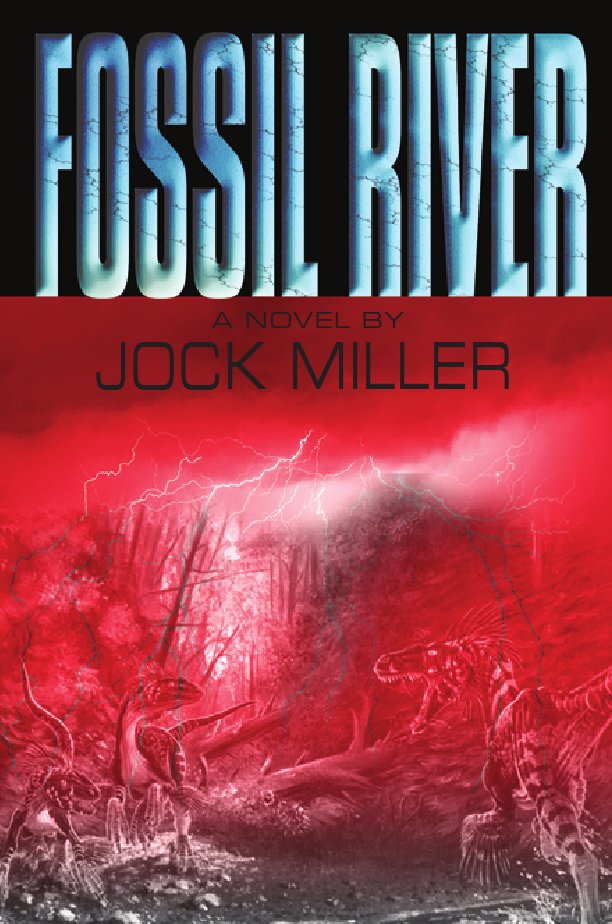
An action thriller by Jock Miller


Fossil fuel has an ageless affinity with dinosaurs. To create oil, dinosaurs died.


purchase on Amazon.com


The perfect energy storm is sweeping over the United States: Japan’s Fukushima nuclear plant meltdown has paralyzed nuclear expansion globally, BP’s Gulf of Mexico oil spill has stalled deep water drilling, Arab oil countries are in turmoil causing doubt about access to future oil, the intensity of hurricanes hitting the Gulf’s oil rigs and refineries has intensified due to global warming, and the nation’s Strategic Oil Supply is riding on empty.

As the energy storm intensifies, the nation’s access to Arab oil, once supplying over sixty percent of our fossil fuel, is being threatened causing people to panic for lack of gas at the pumps, stranding cars across the country and inciting riots.


The U.S. Military is forced to cut back air, land, and sea operations sucking up 58% of every barrel of oil to protect the nation; U.S. commercial airlines are forced to limit flights for lack of jet fuel; and businesses are challenged to power up their factories, and offices as the U.S. Department of Energy desperately tries to provide a balance of electric power from the network of aged power plants and transmission lines that power up the nation.

The United States must find new sources of domestic fossil fuel urgently or face an energy crisis that will plunge the nation into a deep depression worse than 1929.

The energy storm is very real and happening this very moment. But, at the last moment of desperation, the United States discovers the world’s largest fossil fuel deposit found in a remote inaccessible mountain range within Alaska’s Noatak National Preserve surrounding six and a half million acres.

Preventing access to the oil is a colony of living fossil dinosaurs that will protect its territory to the death.

Nobody gets out alive; nobody can identify the predator--until Dr. Kimberly Fulton, Curator of Paleontology at New York’s Museum of Natural History, is flown into the inaccessible area by Scott Chandler, the Marine veteran helicopter pilot who’s the Park’s Manager of Wildlife. All hell breaks loose when Fulton’s teenage son and his girlfriend vanish into the Park.


Will the nation’s military be paralyzed for lack of mobility fuel, and will people across America run out of gas and be stranded, or will the U.S. Military succeed in penetrating this remote mountain range in northwestern Alaska to restore fossil fuel supplies in time to save the nation from the worst energy driven catastrophe in recorded history?

______________________________________________________________________________________________________________________________________


Showing posts with label Impact Studies. Show all posts

Ten New Studies Show Impact on Coast

Communities: Deep Ties, Deeper Pain

A man on a dock on Bayou La Batre, Alabama

 Photograph by Meggan Haller, Keyhole Photo/Corbis

A man takes a break from refurbishing a boat in Bayou La Batre, Alabama—one of the fishing communities deeply affected by the Gulf spill.

Although community attachment is generally seen as a positive that aids in resilience, researchers from Louisiana State University found the negative mental health impacts of the spill were greatest for longtime residents with complex social networks of relatives, friends, and acquaintances. This sense of connectedness, and the accompanying pain, was underscored as people also depended on local resources for their livelihood.

The study is one of the first to systematically collect and analyze public health data on coastal populations affected by the spill. In a late June 2010 telephone survey of 935 households living in the coastal portions of Plaquemines, La Fourche, and Terrebonne parishes, the study found individuals with stronger community attachment exhibited higher self-reported levels of anxiety, worry, nervousness and fear.

Under normal circumstances, community attachment promotes better physical and mental health, but in times of crisis it can be problematic as people's way of life is threatened, the researchers noted.

"In crisis conditions, among those whose resources are threatened, we find that community attachment is associated with higher levels of negative affect," said the study, published in October 2011 in the journal American Behavioral Scientist.

This held true even for people who were not directly employed by the fishing and oil industries, suggesting that community attachment is strong in this area, and that people felt concerned about others whose livelihoods were directly affected.

But attachment may aid in recovery in the long run. Study lead author Matthew Lee, associate vice chancellor in the Office of Research and Economic Development at LSU, said that follow-up surveys have demonstrated that residents who had high community attachment and increased distress early on, "over time, they also recovered more quickly than those who were not highly attached to their communities." He said the findings are consistent with survey results of people recovering from Hurricane Katrina.

—Stacey Schultz

Ten New Studies Show Impact on Coast

Dead Zone: Mixed Views

 Satellite view of Gulf of Mexico dead zone

 Photograph by NASA-GSFC, Science Faction/Corbis

 
Each September, a giant low-oxygen "dead zone" forms in the Gulf of Mexico as nutrients from agricultural runoff into the Mississippi River support the growth of oxygen-hungry algae, which can choke out other sea life. It can be seen here as the teal blue area along the Louisiana coastline.

A major question was whether this hypoxic area would be worsened by the assault of crude oil from the BP spill.

Researchers from Louisiana State University and the Louisiana Universities Marine Consortium concluded in a study published in February in Marine Pollution Bulletin that the net effect of the spill on the dead zone's size appeared to be "negligible."  The hypoxic area was 20,000 square kilometers in 2010, close to the size predicted in a new model the researchers developed. (The dead zone has ranged between 40 square kilometers and 22,000 square kilometers from 1985 through 2010, and has averaged 13,600 square kilometers, or 5,200 square miles.)

But the Louisiana researchers cautioned that Tropical Storm Bonnie, which crossed the Gulf during July 2010, may have had a great enough impact to disguise the impact of the crude oil on the Gulf dead zone.

When oil spilled into the Gulf from the Macondo well, that zone expanded, leading scientists to study the situation and offer a number of explanations.

Other scientists have noted impact from the BP spill on Gulf  oxygen levels. A study from the University of California, Santa Barbara, which appeared in the January 2012 issue of the journal Science indicated that abnormally large blooms of methane-consuming bacteria had reduced the Gulf of Mexico's methane and oxygen levels.

Barbara Mulligan

Ten New Studies Show Impact on Coast

Northern Gannet: Delayed Impact 
A northern gannet gliding above Cape Cod Bay

Photograph by Brian Skerry, National Geographic

A northern gannet coasts on the water. Among the 102 species of birds harmed in the wake of the Deepwater Horizon explosion and oil spill, this long-distance migrating bird, known by the scientific name Morus bassanus, suffered the highest levels of oil damage. New research indicates much greater impact on immature birds than traditional counting methods would suggest, with long-term effects that remain to be seen.

"Seabirds are among the most obvious and immediate indicators of wildlife and environmental damage during marine pollution events," said William Montevecchi  of Memorial University, Newfoundland, Canada. He led a study published in Biology Letters, a journal of the Royal Society, that took advantage of advances in tracking technology to focus on the northern gannet, the largest seabird that breeds in the North Atlantic, and the only species of solely Canadian origin to be significantly affected by the spill. Using bird-borne global location sensors (GLS) and satellite tags to assess migration patterns, the researchers concluded the gannet population saw a much higher level of "oiling" than traditional assessment methods—bird "banding" or body counts—would suggest.
The Memorial University scientists extrapolated from GLS and satellite tags that the number of gannets of all age classes that winter in the Gulf of Mexico was 118,633 birds, more than double the number (54,905) estimated by traditional banding techniques.

In addition, the study authors stated that researchers traditionally assess seabird mortality by counting dead and dying animals along coasts, so they see only a fraction of those affected.
Most mature gannets had already returned to their breeding colonies in Canada before the Gulf spill in April, but the study concluded more than 50,000 immature gannets were in the Gulf during the spill and suffered oil-related mortality. The long-term effects of those gannet deaths will not show up until those birds would have reached sexual maturity—at about five or six years of age.

—Barbara Mulligan


Ten New Studies Show Impact on Coast

Dolphins: Signs of Serious Illness


Bottlenose dolphins


Photograph courtesy Reuters

In the depths of the ocean and on shore, science is only beginning to measure the long-term impact of the worst oil spill in U.S. history.

On the second anniversary of the Deepwater Horizon drilling rig explosion, a slew of new studies paint a complex picture of how the Gulf of Mexico's ecosystems absorbed the insult of 4.9 million barrels of crude oil.

The catastrophic failure of BP's Macondo well off the coast of Louisiana on April 20, 2010, triggered a blast and fire that took the lives of 11 rig workers and sent oil spewing from the deep sea bed for 87 days. Unprecedented steps were taken to minimize the amount of oil that reached shore, including the application of some 800,000 gallons (3,028,000 liters) of dispersants directly at the wellhead nearly a mile (1,500 meters) below the surface. Still, the oil left its mark, scientists now say, on marine mammals, salt marshes, corals, tiny organisms and coastal communities. The new studies track both lingering harm and recovery.

Bottlenose dolphins in oil-contaminated Barataria Bay off the coast of Louisiana are showing signs of serious illness, including extremely low weight, anemia, low blood sugar, and some symptoms of liver and lung disease, according to a health assessment conducted by U.S. National Oceanic and Atmospheric Administration (NOAA) scientists and their partners.

The scientists, who performed comprehensive physicals last summer on 32 dolphins from the bay, also found that half of the tested dolphins showed abnormally low levels of hormones that regulate stress response, metabolism, and immune function, indicating adrenal insufficiency. One of the dolphins in the survey was found dead on Grand Isle in January.

Lori Schwacke of NOAA, the project's lead investigator, said the findings were preliminary and could not be conclusively linked to the oil spill. But she added that control groups of dolphins living along the Atlantic coast and in other areas that were not affected by the 2010 spill did not manifest those symptoms.

"The findings that we have are consistent with other studies that have looked at the effects of oil exposure in other mammals," she said.

The study is a part of an ongoing examination of the U.S. government-led Natural Resource Damage Assessment process and the Gulf of Mexico Dolphin Unusual Mortality Event. Since February 2010, more than 675 dolphins have stranded in the northern Gulf of Mexico—a much higher rate than the usual average of 74 dolphins per year.

BP's Houston office did not respond to requests for comment on this research or the other scientific studies related to the Gulf Oil Spill.


—Barbara Mulligan

This story is part of a special series that explores energy issues. For more, visit The Great Energy Challenge.

New Studies Show Impact on Coast

Phytoplankton: Oil Sensitivity 

A group of the phytoplankton Ditylum brightwellii


Photograph by Bill Curtsinger, National Geographic

Phytoplankton, whose name literally means "plant drifter," are a presence just beneath the surface of the Gulf, detectable only by the green gloss they lend to the water due to the chlorophyll in their cells. as seen above. But they provide an important base in the aquatic food chain. And following the Gulf spill, researchers from the University of South Carolina (USC) found that even small exposures to oil can have large impacts on these microscopic algae.

"Exposure to very small concentrations of crude oil can result in major shifts in phytoplankton community composition as well as a reduction in total phytoplankton biomass," said James Pinckney, associate professor at USC and a co-author of a study published in January in the journal Estuaries and Coasts.

The researchers attempted to simulate oil spill conditions to examine short-term, two-day changes in phytoplankton community composition and total biomass. In Nalgene polycarbonate bottles, they combined water from Clambake Landing in North Inlet near Georgetown, South Carolina, a National Estuarine Research Reserve, with two separate oil samples, one obtained from the Deepwater Horizon spill and the other a mixture of Texas crude oils. They analyzed a control and six replicated experimental treatments of crude oil at various concentrations.

"Crude oil spills may impact many marsh organisms," the researchers wrote. "But phytoplankton represent a major food source for many larval, juvenile, and adult fish and shellfish species."

There is concern that the changes the researchers observed could lead to a decrease in overall marsh productivity. Continued research is needed on the longer-term impacts of crude oil exposure to phytoplankton and whether the community composition will return to pre-exposure composition after the crude oil is removed, Pinckney says.


—Stacey Schultz

Gulf Spill New Studies Show Impact on Coast

Microorganisms: Life Cycles Disrupted 


Fishermen inspect cane grass damaged by oil


Photograph by David Snyder, ZUMApress. com/Alamy
Fishermen inspect damaged cane grass soon after the Gulf spill, knowing that the oil has killed the small organisms upon which fish and crabs of the wetlands depend for food. By now, everyone knows of the oil-eating microorganisms that helped Gulf recovery. But as is clear in this marsh grass and elsewhere, some of the Gulf's tiniest denizens did not fare well.

The Deepwater Horizon oil spill inhibited  microorganisms' nitrogen cycle, which is critical to ecosystem development and decomposition, according to research by Florida Gulf Coast University.


While some bacteria served as "glorious brave fighters" to help clean up the spill by breaking down the oil, other groups of microorganisms such as archaea were victims, Hidetoshi Urakawa, the lead researcher and assistant professor of the university's department of marine and ecological sciences, said by email.
"The important finding of our study was that oil spills not only damage marine animals and entire food webs, but also the nitrogen cycle, which is one of the major bloodstreams of our planet," Urakawa said.
The data, published in February in the journal Environmental Pollution, found that one common archae bacterium called Nitrosopumilus maritimus showed a particularly high sensitivity to crude oil.
That susceptibility may have an ecological significance, even leading to a shift to bacterial dominance in the aftermath of a major oil spill, the researchers said. But they also cautioned that the variation in petroleum toxicity might be explained in part by the different sizes of microorganisms.

Urakawa said it also might be possible to take the most sensitive archaea and develop a bioassay to measure and monitor petroleum toxicity in the seawater and "help map a future spill."
To conduct their study, the researchers collected tar balls that had drifted ashore in nearby Panama City, Florida, and tested the toxicity responses of bacteria and archaea to oil contamination.
The Deepwater Horizon oil spill provided an opportunity to "think about some of the unseen damages of nature" in the deep ocean, Urakawa said. Jose Barreto, professor of Florida Gulf Coast University's department of chemistry and mathematics, collaborated on the project.

—Jeff Smith

New Studies Show Impact on Coast

Deep-Sea Corals: Widespread Stress

  A fish swims near an artificial reefPhotograph by Charles Fisher, PSU


As the Deepwater Horizon disaster unfolded, images of oiled birds and slick coastlines made headlines while the fate of seafloor ecosystems remained hidden beneath the waves.
But recent research has provided compelling evidence of the spill's impact on deep sea corals, seen clearly in the specimen above, which is now likely dead despite the orange branch tips. "Because of the magnitude of this spill, and because of the fact that it happened so deep, rather than at the surface, it had significant impacts on these biological communities that we've just been beginning to understand," said Haverford College geochemist 
Helen White.

White was lead author on one of the first studies ever to explore the impacts of an oil spill on deep-sea ecosystems, which are separated from the brunt of a typical oil tanker spill by thousands of feet of water.
White and colleagues used a fleet of underwater vehicles to examine distressed Gulf of Mexico corals that Pennsylvania State University's Charles Fisher, the team's science leader, had spotted back in 2010—three months after the leaking Macondo well had been capped. White also employed two-dimensional gas chromatography techniques that fingerprinted the oil residue found on the reefs to the Macondo well some 7 miles (11 kilometers) to the northeast.

"Parts of the corals that had a heavy covering of brown, flocculent material had died when we went back a month later while other parts that had lighter coatings exhibited some signs of recovery," White explained. "Will these coral communities rebound? If so how? Right now we just don't know." Ongoing work will provide vital information about how corals cope with oil from both catastrophic events and natural seeps.

—Brian Handwerk

Read More Here