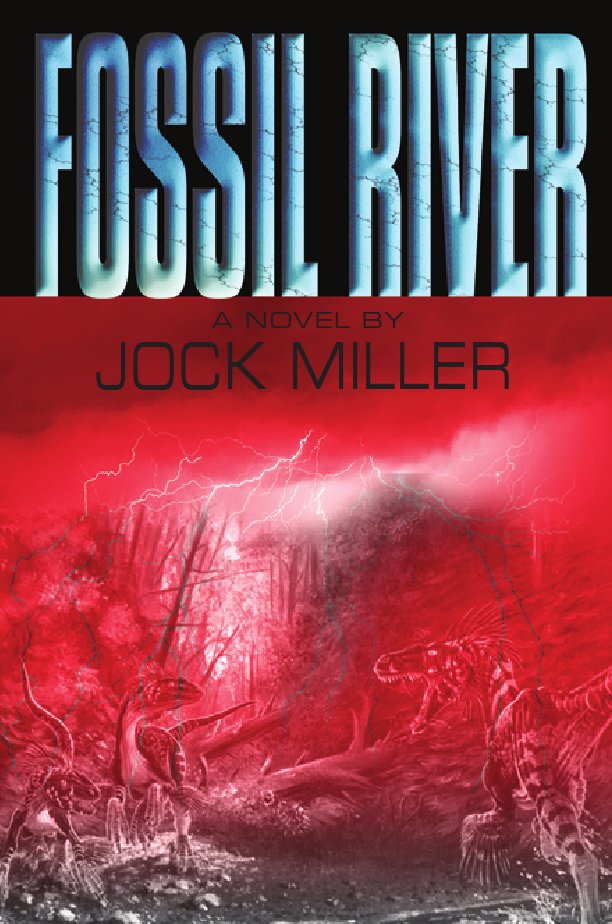
An action thriller by Jock Miller


Fossil fuel has an ageless affinity with dinosaurs. To create oil, dinosaurs died.


purchase on Amazon.com


The perfect energy storm is sweeping over the United States: Japan’s Fukushima nuclear plant meltdown has paralyzed nuclear expansion globally, BP’s Gulf of Mexico oil spill has stalled deep water drilling, Arab oil countries are in turmoil causing doubt about access to future oil, the intensity of hurricanes hitting the Gulf’s oil rigs and refineries has intensified due to global warming, and the nation’s Strategic Oil Supply is riding on empty.

As the energy storm intensifies, the nation’s access to Arab oil, once supplying over sixty percent of our fossil fuel, is being threatened causing people to panic for lack of gas at the pumps, stranding cars across the country and inciting riots.


The U.S. Military is forced to cut back air, land, and sea operations sucking up 58% of every barrel of oil to protect the nation; U.S. commercial airlines are forced to limit flights for lack of jet fuel; and businesses are challenged to power up their factories, and offices as the U.S. Department of Energy desperately tries to provide a balance of electric power from the network of aged power plants and transmission lines that power up the nation.

The United States must find new sources of domestic fossil fuel urgently or face an energy crisis that will plunge the nation into a deep depression worse than 1929.

The energy storm is very real and happening this very moment. But, at the last moment of desperation, the United States discovers the world’s largest fossil fuel deposit found in a remote inaccessible mountain range within Alaska’s Noatak National Preserve surrounding six and a half million acres.

Preventing access to the oil is a colony of living fossil dinosaurs that will protect its territory to the death.

Nobody gets out alive; nobody can identify the predator--until Dr. Kimberly Fulton, Curator of Paleontology at New York’s Museum of Natural History, is flown into the inaccessible area by Scott Chandler, the Marine veteran helicopter pilot who’s the Park’s Manager of Wildlife. All hell breaks loose when Fulton’s teenage son and his girlfriend vanish into the Park.


Will the nation’s military be paralyzed for lack of mobility fuel, and will people across America run out of gas and be stranded, or will the U.S. Military succeed in penetrating this remote mountain range in northwestern Alaska to restore fossil fuel supplies in time to save the nation from the worst energy driven catastrophe in recorded history?

______________________________________________________________________________________________________________________________________


Showing posts with label Feathers in Amber. Show all posts

Ancient Feathers in Amber: A clear example


An isolated, unpigmented feather barb and a mite preserved in Canadian Late Cretaceous amber. 

Read more


Ancient Feathers in Amber: Color-Producing Cells


A feather barb that shows some indication of original coloration. The oblong brown masses within the image are regions of color within the barbules. In this specimen, the overall feather color appears to have been medium- or dark-brown. 


Read more

Ancient Feathers in Amber: Modern Equivalent


An isolated barb from a white belly feather of a modern grebe (Aechmophorus occidentalis), illustrating coiled barbule bases comparable to those in the Cretaceous specimen. In both cases, the coiling is a structural adaptation that allows the feather to absorb water. 

Read more 


Dinosaur Feathers Preserved in Amber: Curly Coils


The cork-screw shaped structures in the image are the tightly coiled bases of feather barbules.

Read More

Dinosaur Feathers Perserved in Amber

 Brown Feathers


Pigmentation in these feathers gives it a beaded appearance. Pigment in the feather suggests it would have been medium- or dark-brown in color.


Read more

Dinosaur Feathers Perserved in Amber

Coiled For Diving


A feather accompanied by a microphysid plant bug. The coiling observed in the feather is directly comparable to coils found in modern bird feathers specialized for water uptake and are suggestive of diving behavior, but similar structures can be used to transport water to the nest. 


Read more

Ancient Feathered Friends: Images of Feathers in Amber

Simple Protofeathers


Numerous individual filaments in Late Cretaceous Canadian amber. These filaments are similar to the protofeathers that have been found as fossils with some dinosaurs. These filaments range from clear to near-black. 

"All the feathers are preserved down to micron scale, showing indentations and pigmentation," study researcher Ryan McKellar, of the University of Alberta, told LiveScience. "It’s also the first time we've found protofeathers [feathers thought to belong to nonavian dinosaurs] preserved in amber."


Read More

Ancient Feathered Friends: Images of Feathers in Amber

Web-Entangled feather


An isolated piece of feather, trapped within a tangled mass of spider’s web in Late Cretaceous Canadian amber. The feather branches may have been gray or black. 


Feathers Preserved in Amber Reveal Colorful, Web-Entangled feather


 About 80 million years ago, the flap of wings in a conifer forest let loose feathers that floated through the air before sticking to globs of shining tree sap.

Researchers in Western Canada have discovered these slicks of solidified sap, known as amber, contain a great variety of dinosaur and bird feathers from the Late Cretaceous period.

They found 11 sets of feathers after screening more than 4,000 amber deposits in different museum collections. The feathers were so well-preserved that the researchers were even able to guess at what colors they might have been. They also contained samples of each of the four stages of feather evolution.


Read More