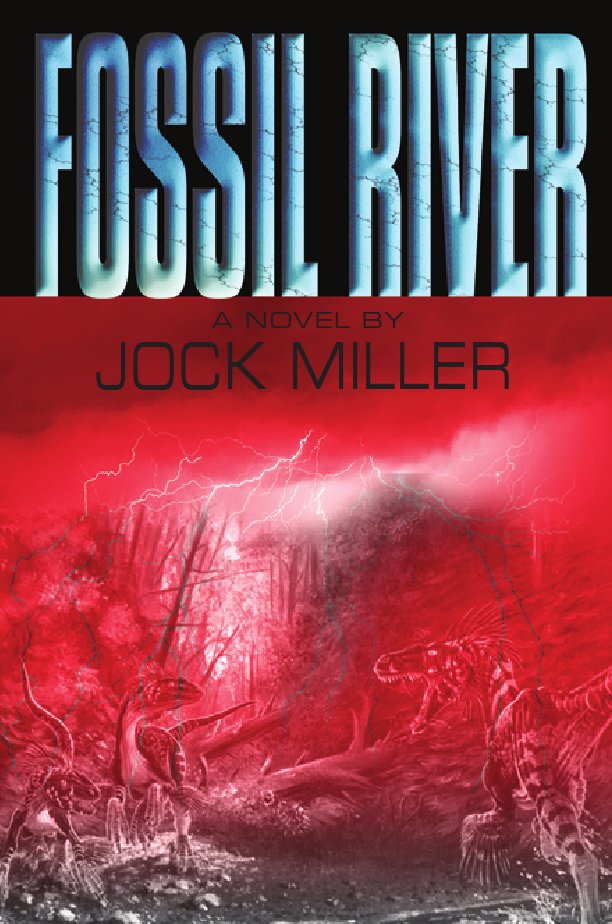
An action thriller by Jock Miller


Fossil fuel has an ageless affinity with dinosaurs. To create oil, dinosaurs died.


purchase on Amazon.com


The perfect energy storm is sweeping over the United States: Japan’s Fukushima nuclear plant meltdown has paralyzed nuclear expansion globally, BP’s Gulf of Mexico oil spill has stalled deep water drilling, Arab oil countries are in turmoil causing doubt about access to future oil, the intensity of hurricanes hitting the Gulf’s oil rigs and refineries has intensified due to global warming, and the nation’s Strategic Oil Supply is riding on empty.

As the energy storm intensifies, the nation’s access to Arab oil, once supplying over sixty percent of our fossil fuel, is being threatened causing people to panic for lack of gas at the pumps, stranding cars across the country and inciting riots.


The U.S. Military is forced to cut back air, land, and sea operations sucking up 58% of every barrel of oil to protect the nation; U.S. commercial airlines are forced to limit flights for lack of jet fuel; and businesses are challenged to power up their factories, and offices as the U.S. Department of Energy desperately tries to provide a balance of electric power from the network of aged power plants and transmission lines that power up the nation.

The United States must find new sources of domestic fossil fuel urgently or face an energy crisis that will plunge the nation into a deep depression worse than 1929.

The energy storm is very real and happening this very moment. But, at the last moment of desperation, the United States discovers the world’s largest fossil fuel deposit found in a remote inaccessible mountain range within Alaska’s Noatak National Preserve surrounding six and a half million acres.

Preventing access to the oil is a colony of living fossil dinosaurs that will protect its territory to the death.

Nobody gets out alive; nobody can identify the predator--until Dr. Kimberly Fulton, Curator of Paleontology at New York’s Museum of Natural History, is flown into the inaccessible area by Scott Chandler, the Marine veteran helicopter pilot who’s the Park’s Manager of Wildlife. All hell breaks loose when Fulton’s teenage son and his girlfriend vanish into the Park.


Will the nation’s military be paralyzed for lack of mobility fuel, and will people across America run out of gas and be stranded, or will the U.S. Military succeed in penetrating this remote mountain range in northwestern Alaska to restore fossil fuel supplies in time to save the nation from the worst energy driven catastrophe in recorded history?

______________________________________________________________________________________________________________________________________


Showing posts with label photo gallery. Show all posts

Working on THE LOST WORLD (1925) Willis O'Brien with puppet by Marcel Charles R. Knight Delgado...

Working on THE LOST WORLD (1925) 

Willis O'Brien with puppet by Marcel Delgado ...


...which was based on painting by Charles R. Knight

Jock's Bone Fish

Fly fishing at the Ocean Reef Club in Kay Largo Florida, I landed this beautiful Bone Fish in a fly rod. Love that sport! 


More on Barum Brown

Brown in 1914 doing field work in Montana


Brown lived at the tail end of an unprecedented age of scientific discovery, and surely he was one of its more colorful practitioners. He was affectionately known as Mr. Bones by his admirers. At dig sites in Canada Barnum was frequently photographed wearing a large fur coat—as in the photo above. Later during World War I and II, he worked as an "intelligence asset." During his many trips abroad he wasn't above picking up spare cash acting as a corporate spy for oil companies.

Feathered Dinosaurs: Sinosauropteryx

Sinosauropteryx was the first dinosaur to have its life colouration described by scientists based on physical evidence. Some fossils of Sinosauropteryx show an alternation of lighter and darker bands preserved on the tail.

Digital illustration of the coelurosaurian dinosaur Sinosauropteryx prima, based on the holotype specimen. Coloration and pattern follows Zhang et al 2010.

All described specimens of Sinosauropteryx preserve integumentary structures (filaments arising from the skin) which most palaeontologists interpret as very primitive feathers. These short, down-like filaments are preserved along the back half of the skull, arms, neck, back, and top and bottom of the tail. Additional patches of feathers have been identified on the sides of the body, and palaeontologists Chen, Dong and Zheng proposed that the density of the feathers on the back and the randomness of the patches elsewhere on the body indicated the animals would have been fully feathered in life, with the ventral feathers having been removed by decomposition.

More on the Diplodocus

Caudal vertebrae of D. carnegii showing the double-beamed chevron bones that the genus name refers to, Natural History Museum, London.


D. longus skull from Bone-Cabin Quarry

Famous Dinosaurs: Iguanodon

The largest find of Iguanodon remains to that date occurred on 28 February 1878 in a coal mine at Bernissart in Belgium, at a depth of 322 m (1056 ft),[5] when two mineworkers, Jules Créteur and Alphonse Blanchard, accidentally hit on a skeleton that they initially took for petrified wood.


Workmen mounting the first Iguanodon bernissartensis skeleton in the St. George Chapel in Brussels, 1882. Because Belgium did not really possess a tradition in mounting vertebrate specimens, Dollo’s men had to invent their own method. Although they successfully mounted a great number of specimens (who are now on display in the Brussels Museum of Natural History), their solution meant that unmounting the animals was near to impossible without physically damaging them. These days, the Brussels Iguanodons have become museum specimens in more than one way, illustrating the evolution of mounting such animals in museums in the nineteenth century.

Dinosaur Eggs

Dinosaur eggs are known from about 200 sites around the world, the majority in Asia and mostly in terrestrial (nonmarine) rocks of Cretaceous age.


Technically speaking, dinosaur eggs are trace fossils, the category that also includes fossil footprints. Very rarely, fossil embryos are preserved inside dinosaur eggs. Another piece of information derived from dinosaur eggs is their arrangement in nests—sometimes they are laid out in spirals, sometimes in heaps, sometimes they are found alone.

We don't always know what species of dinosaur an egg belongs to. Dinosaur eggs are assigned to paraspecies, similar to the classifications of animal tracks, pollen grains or phytoliths. This gives us a convenient way to talk about them without trying to assign them to a particular "parent" animal.

These dinosaur eggs, like most on the market today, come from China, where thousands have been excavated. 


It may be that dinosaur eggs date from the Cretaceous because thick calcite eggshells evolved during the Cretaceous (145 to 66 million years ago). Most dinosaur eggs have one of two forms of eggshell that are distinct from the shells of related modern animal groups, such as turtles or birds. However, some dinosaur eggs closely resemble bird eggs, particularly the type of eggshells in ostrich eggs. A good technical introduction to the subject is presented on the University of Bristol "Palaeofiles" site.

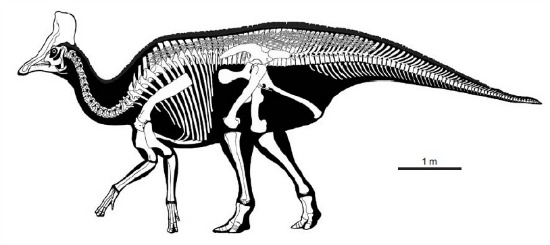
Outlining Olorotitan


The reconstructed skeleton of Olorotitan, from Godefroit et al., 2012.


Olorotitan was one of the most elegant dinosaurs of all time. The 26-foot-long hadrosaur, found in the Late Cretaceous rocks of eastern Russia, had the typical deep tail, beefy legs and slender arms of its kin, but a fan-shaped crest jutting out of the back of the dinosaur’s skull gave it a striking profile. As with its North American cousins Corythosaurus and Lambeosaurus, the hollow head ornament is what makes this dinosaur stand out.


Read More

Dinosaur-Feather Doppelganger?


Photographs courtesy University of Bristol

The feather of an extinct Confuciusornis bird may have had colors similar to those in this modern feather from a zebra finch, according to the new study.

Feather color in Confuciusornis—an early beaked bird found in 120- to 130-million-year-old fossil beds in Liaoning Province, China—was inferred from microscopic melanosomes preserved in a fossil specimen.

Two types of melanosomes were found. Eumelanosomes (such as the finch eumelanosomes inset at left) are rodlike and associated with the colors black and grey in living birds. Phaeomelanosomes (inset right) are spherical and produce colors ranging from reddish brown to yellow. A lack of melanosomes makes white.

Using a scanning electron microscope, the researchers found that a fossil Confuciusornis feather contained both types of melanosomes and was likely multicolored in life.


Read More

Oil Spill Photo Gallery


MATTHEW HINTON / THE TIMES-PICAYUNE Wildlife Rehabilitator Christina Schilleci, of Louisiana State Animal Response, left, holds an oiled pelican impacted from the Deepwater Horizon oil spill, as she admits the bird to a triage facility at Fort Jackson in Buras, La.


BRETT DUKE / THE TIMES-PICAYUNE An oiled pelican is cleaned inside the Fort Jackson Bird Rehabilitation Center near Buras.