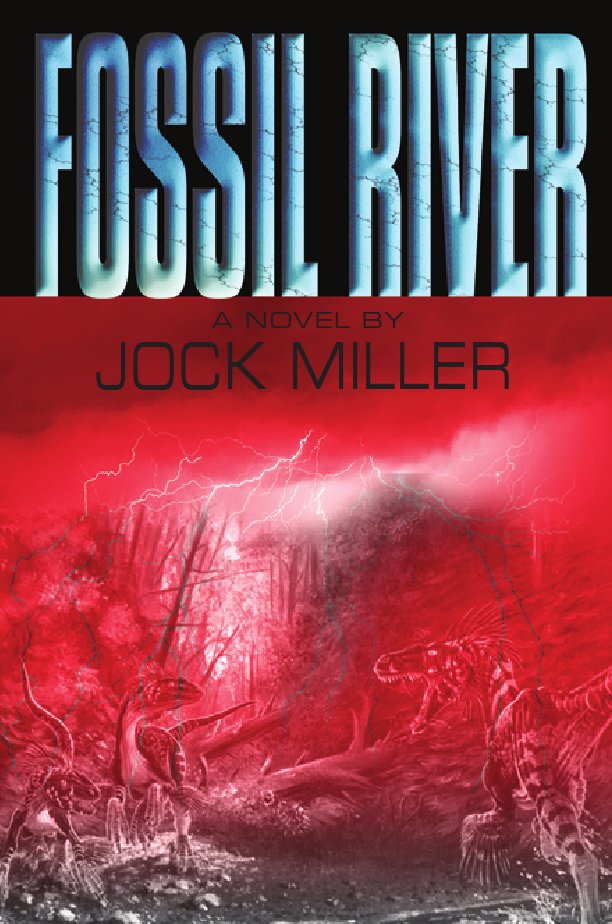
An action thriller by Jock Miller
Fossil fuel has an ageless affinity with dinosaurs. To create oil, dinosaurs died.
The perfect energy storm is sweeping over the United States: Japan’s Fukushima nuclear plant meltdown has paralyzed nuclear expansion globally, BP’s Gulf of Mexico oil spill has stalled deep water drilling, Arab oil countries are in turmoil causing doubt about access to future oil, the intensity of hurricanes hitting the Gulf’s oil rigs and refineries has intensified due to global warming, and the nation’s Strategic Oil Supply is riding on empty.As the energy storm intensifies, the nation’s access to Arab oil, once supplying over sixty percent of our fossil fuel, is being threatened causing people to panic for lack of gas at the pumps, stranding cars across the country and inciting riots.
The U.S. Military is forced to cut back air, land, and sea operations sucking up 58% of every barrel of oil to protect the nation; U.S. commercial airlines are forced to limit flights for lack of jet fuel; and businesses are challenged to power up their factories, and offices as the U.S. Department of Energy desperately tries to provide a balance of electric power from the network of aged power plants and transmission lines that power up the nation.
The United States must find new sources of domestic fossil fuel urgently or face an energy crisis that will plunge the nation into a deep depression worse than 1929.The energy storm is very real and happening this very moment. But, at the last moment of desperation, the United States discovers the world’s largest fossil fuel deposit found in a remote inaccessible mountain range within Alaska’s Noatak National Preserve surrounding six and a half million acres.
Preventing access to the oil is a colony of living fossil dinosaurs that will protect its territory to the death.Nobody gets out alive; nobody can identify the predator--until Dr. Kimberly Fulton, Curator of Paleontology at New York’s Museum of Natural History, is flown into the inaccessible area by Scott Chandler, the Marine veteran helicopter pilot who’s the Park’s Manager of Wildlife. All hell breaks loose when Fulton’s teenage son and his girlfriend vanish into the Park.
Will the nation’s military be paralyzed for lack of mobility fuel, and will people across America run out of gas and be stranded, or will the U.S. Military succeed in penetrating this remote mountain range in northwestern Alaska to restore fossil fuel supplies in time to save the nation from the worst energy driven catastrophe in recorded history?
Toothless 'dragon' pterosaurs once ruled skies
Ancient winged reptiles called pterosaurs were so successful that they ruled Earth's skies for tens of millions of years, according to a study published in the journal ZooKeys.
The fearsome fliers, part of a family of pterosaurs named Azhdarchidae, get their name from azdarha, the Persian word for "dragon." Unlike earlier pterosaurs, they had no teeth, and they dominated from late in the Cretaceous period (around 90 million years ago) until the extinction event that also killed off the dinosaurs some 66 million years ago.
“This shift in dominance from toothed to toothless pterodactyloids apparently reflects some fundamental changes in Cretaceous ecosystems, which we still poorly understand,” study author Alexander Averianov of the Russian Academy of Sciences wrote in the paper.
Pterosaurs are not dinosaurs, and they're definitely not ancient birds, which are the living descendants of the dinosaurs. But understanding these large predators can give insight into the ancient ecosystem as well as the origins of flight, as pterosaurs are thought to be the first animals after insects to develop powered flight.
Pterosaur fossils are tough to find, the study authors point out, because their fragile bones haven’t survived as well as dinosaur remains have.
“Pterosaur bones were thin and fragile, much like bird bones, and they often drifted apart, shattered, or became scrambled before they could be preserved,” according to the American Museum of Natural History.
Thus, it’s often pretty difficult to tell how the few fossils that do exist are related to one another, according to the paper.
“Azhdarchidae currently represents a real nightmare for pterosaur taxonomists: Most taxa are known from few fragmentary bones, which often do not overlap between named taxa, the few articulated skeletons are poorly preserved,” Averianov wrote, and some of the best material “has remained undescribed for 40 years.”
For the ZooKeys study, Averianov surveyed and analyzed the known research to help straighten out the fossil record. The findings also showed that although their bones are challenging to find, the pterosaurs were probably quite successful in a wide variety of habitats, but were more commonly found near large lakes and rivers and especially in near-shore marine environments.
Reposted Copyright © 2014, Los Angeles Times
Complete pterosaur eggs discovered in China.
![]() |
| The eggs are three-dimensional and extremely well-preserved (Picture: Rex) |
According to the famous scientific journal Current Biology on June 6, 2014, the world's largest and most well-preserved three-dimensional fossil cluster of pterosaur and its eggs were found in Hami, western China's Xinjiang Uygur Autonomous Region. The discovery was based on the field research of researcher Wang Youlin and his team of Institute of Vertebrate Paleontology and Paleoanthropology, Chinese Academy of Sciences, over the past 10 years. The specimens are named Hamipterus tianshanensis. "Hami" refers to the region where the specimens were found.The pterosaurs are thought to have perished in a large storm.
The discovery in the Xinjiang Uygur Region, western China, is the world’s largest and most well-preserved cluster of three-dimensional fossils ever found with a nest containing eggs.
![]() |
Photo by HAP/Quirky China News/REX (3792156c) Artist's impression of Crested Pterosaurs |
Pterosaurs were flying reptiles with wingspans ranging from 25 cm to 12 metres, and they lived together in large colonies.
The discovery represents a new genus and species known as Hamipterus tianshanensis.
Speaking to the journal Current Biology, field researcher Wang Youlin described the eggs as ‘three-dimensionally’ preserved.
![]() |
| Photo by HAP/Quirky China News/REX (3792156b) Artist's impression of Crested Pterosaur |
The fossils were unearthed during a study conducted by a team from the Chinese Academy of Sciences, who have been excavating the fossil-rich region for the past 10 years.
Wang says that sediment samples in the area suggest the pterosaurs died in a large storm about 120million years ago.
Reposted from Metro
Baby Dinosaurs Discovered
Robert Reisz from the University of Toronto and his fellow paleontologists working in the Yunnan province of China discovered a cluster of 200 tiny fossils bones left behind by ancient dinosaur embryos. Upon further inspection it turned out to be the oldest remnants of dinosaur embryos ever discovered by human beings.
The scientists discovered the embryos in a layer of sedimentary rock. They date them to the early Jurassic Era, making them approximately 190 million years old. The fossils’ importance extends beyond their age, though. They are probably unhatched embryos of Lufengosaurus at different developmental stages, providing a unique opportunity to investigate the embryonic development of a prehistoric species.
The research team focused their analysis on the most prevalent and best-preserved bones: femurs, or thigh bones. These little leg bones ranged from 0.5 to 0.9 inches in length, shorter than matchsticks. The bones were porous, filled with cavities that would have once allowed blood to flow to the growing tissue. The size of the cavities is determined by how fast the animal grows — which made researchers realize these embryos got big quickly. The researchers also found an asymmetrical thickening in the femurs associated with muscle action on the bone. The finding suggests the baby dines were kicking and twitching inside their eggs.
'World's largest dinosaur' discovered in Argentina
The largest creature to have ever walked the earth - a dinosaur measuring 130 feet and weighing 77 tonnes - has been discovered in Argentina, palaeontologists have said.
Its gigantic bones were found by a local farm worker in a desert in Patagonia, the southern Argentine region that has yielded many important dinosaur discoveries.
Based on the size of the thigh bones – taller than an average man – the dinosaur would have been 130 feet long and 65ft tall, scientists said.
Its calculated 77-tonne weight would have made it as heavy as 14 African elephants, beating the previous record holder, Argentinosaurus, by some seven tonnes.
The palaeontologists say the find is thought to be a new species of titanosaur – a huge herbivore of the long-necked sauropod group that lived in the Late Cretaceous period.
The bones were initially discovered a year ago in the desert near La Flecha, about 135 miles west of the Patagonian town of Trelew, and were this week excavated by a team of palaeontologists from Argentina’s Museum of Palaeontology Egidio Feruglio, headed by Dr Jose Luis Carballido and Dr Diego Pol.
![]() |
| Scientists unearth unique, long-necked dinosaur in Argentina |
They have retrieved some 150 bones said to come from seven individuals, all in “remarkable condition”.
“Given the size of these bones, which surpass any of the previously known giant animals, the new dinosaur is the largest animal known to have walked on Earth,” the researchers told BBC News.
“Its length, from its head to the tip of its tail, was 40 metres.
“Standing with its neck up, it was about 20 metres high – equal to a seven-storey building.”
The gargantuan dinosaur is said to have lived in the forests of Patagonia between 95 and 100 million years ago, based on the age of the rocks in which the bones were embedded.
Read more
'Littlest giant' dinosaur found in Argentina
At 30 meters long, the newly discovered Leinkupal laticauda (shown here in Buenos Aires on Thursday, May 15) is not exactly small, but could also called the 'littlest giant.' Scientists in Argentina announced the discovery of the fossilized remains of this unique member of the famous long-necked, plant-munching dinosaurs known as sauropods, the largest land creatures in Earth's history. It lived about 140 million years ago.
Raptor Dinosaur Found In China
The nearly-complete skeleton of the birdlike dinosaur was found in inner Mongolia
![]() |
| A British scientist doing his PhD discovered a dinosaur which had a huge claw and could run at more than 30mph while digging for fossils in the Gobi desert. |
Linheraptor was about six feet long, probably weighed around 50 pounds, and lived approximately 75 million years ago. Like most other dromaeosaurids (the scientific name for raptor dinosaurs), it has a large claw on the second toe of its foot and a tail stiffened by long bony rods that project from the vertebrae.
Linheraptor is important because it preserves almost every bone in the body. Scientists can get information from its skeleton that they can't get from the incomplete fossil skeletons of other dromaeosaurids.
Read more
Gobi Desert of Inner Mongolia turns up evidence of a 90-million-year-old graveyard
Evidence at the site points to a unique and rare conclusion: the dinosaur fossils were not deposited at the site over millennia. Instead the dinosaurs all met their fate at the same time.
The sudden death of the herd in a mud trap provides a rare snapshot of social behavior. Composed entirely of juveniles of a single species of ornithomimid dinosaur (Sinornithomimus dongi), the herd suggests that immature individuals were left to fend for themselves when adults were preoccupied with nesting or brooding.
The Extent of the Preserved Feathers on the Four-Winged Dinosaur Microraptor gui under Ultraviolet Light
Examination under ultraviolet light reveals that these feathers actually reach the body of the animal and were not disassociated from the bones. Instead they may have been chemically altered by the body tissues of the animal meaning that they did not carbonise close into the animal or more likely were covered by other decaying tissue, though evidence of their presence remains.
These UV images show that the feathers preserved on the slab are genuinely associated with the skeleton and that their arrangement and orientation is likely correct. The methods used here to reveal hidden features of the specimen may be applicable to other specimens from the fossil beds of Liaoning that produced Microraptor.
Figure 2: The holotype of Microraptor gui, IVPP V 13352 under UV light.
Different filters were employed for parts A and B, hence the difference in colour and appearance. A also is labeled to indicate the preserved feathers (grey arrows) and the ‘halo’ around the specimen where they appear to be absent (black arrows) as well as phosphatised tissues (white arrows). Scale bars are 5 cm in both A and B.
Figure 3: Close up of lower hindlimb of the holotype under UV light.
This shows that the feathers do indeed penetrate the halo (grey arrows) when seen in UV and approach or reach the bones. These are not seen in natural light due to the overlying soft tissues seen in figure 2. Scale bar at 5 cm.
Source: Plos One
‘Biggest Dinosaur Ever’ Unearthed in Argentina
Move over, Godzilla.
The largest dinosaur ever known to walk the earth has been unearthed in Argentina, and it really is a monster.
Based on its thigh bones, the dinosaur was 130 feet long and 65 feet tall, and at 85 tons, it was the weight of 14 African elephants. Basically, picture a seven-story building as long as a large yacht, and then add a set of teeth.
Scientists believe it is a previously undiscovered species of titanosaur — a herbivore, luckily for other dinosaurs who lived during the Late Cretaceous period.
The remains were discovered in the desert La Flecha about 135 miles west of Patagonia by a local farm worker, and excavated by paleontologists from Museum of Palaeontology Egidio Feruglio. About 150 bones have been found “in remarkable condition,” researchers said.
The huge herbivore lived in the forests of Patagonia between 95 and 100 million years ago, the team said.
Read more
A real-life Jurassic Park?
Birds could be theoretically 'de-evolved' back to dinosaurs
Oxford biochemist says dinosaurs and Woolly Mammoths could be brought back to life - but dinosaurs could be trickier.Dr Alison Woollard said it would be theoretically possible to recreate ancient animals, through the DNA of birds.
By identifying and altering certain genes found in the DNA of modern birds, she believes scientists may be able to “design” genomes of the prehistoric creatures.
The theory echoes the plot of Jurassic Park, but comes after a recent attempt to bring back the animals using techniques more faithful to those used in the 1993 film failed.
The Steven Spielberg production saw geneticists recreate dinosaurs using DNA recovered from bloodsucking insects which had been caught in sticky tree sap before it turned to amber.
A mosquito was recently discovered which had the blood of another animal in its stomach dating from dating back 46 million years, not quite the age of dinosaurs, but tantalisingly close.
However, hope vanished when a team at Western Australia’s Murdoch University found that DNA cannot survive for more than 6.3 million years. Most dinosaurs died out about 65 million years ago, in the Cretaceous period.
However Dr Woollard, from Oxford University’s Department of Biochemistry, has suggested the feat could be achieved by “de-evolving” birds.
“We know that birds are the direct descendants of dinosaurs, as proven by an unbroken line of fossils which tracks the evolution of the lineage from creatures such as the velociraptor or T-Rex through to the birds flying around today,” said Dr Woollard.
“The most famous of these is the Archaeopteryx, a fossil which clearly shows the transition between feathered dinosaurs and modern birds.
“This evolution implies that buried deep within the DNA of today’s birds are switched-off genes that control dinosaur-like traits.
Read more
Dinosaurs are alive and well
Ancient species have evolved over millions of years into birds, finds Oxford University study
Dinosaurs are not extinct, but have simply shrunk to become the 10,000 species of birds that are alive today, academics at Oxford University have claimed.
A study of the evolution of 426 dinosaur species over millions of years revealed that dinosaurs gradually became smaller in size until they evolved into birds.
Researchers have shown that shrinking was key to their survival and allowed them to become one of the most diverse and abundant families of animals alive today.
Dr Roger Benson, from Oxford University, said: “We wanted to understand the evolutionary links between this exceptional living group, and their Mesozoic relatives, including well-known extinct species like T rex, triceratops, and stegosaurus.”
The scientists found that dinosaurs underwent rapid changes in body size shortly after they first appeared, around 220 million years ago. Thereafter only the evolutionary line leading to birds continued to change size at such a fast rate, and did so for a further 170 million years. The study was published in the online journal Public Library of Science Biology.
Read more
Dinosaur Chase!
The most famous dinosaur chase scene outside of those in “Jurassic Park” was found at the Paluxy River dinosaur tracksite in Dinosaur Valley Sate Park near Glen Rose, Texas. The 110 million-year-old tracks appear to be made by a theropod chasing a sauropod. Because of the way they were removed and stored, some of the tracks have been lost. Recently, a team of researchers used 3D imaging software, 17 old photographs and what’s left of the fossils to digitally recreate the chase tracks.
In 1940, Dr. Roland T. Bird, paleontologist and dinosaur track expert from the American Museum of Natural History in New York, photographed the tracks, mapped the area using string and then removed the 30-foot-long trackway from the Paluxy River by breaking up the foot-or-more-thick sheet of limestone. He numbered the pieces and shipping them back to New York by rail. Some of the trackway was reassembled and is on display in the dinosaur hall of the museum. The remaining pieces are deteriorating, which prompted the idea to recreate the original digitally.
Deadly Dinosaur Chase Reconstructed

A set of prehistoric footprints, said to show meat-eating dinosaurs hunting vegetarian dinos, has just been recreated in a detailed 3-D model.
The frozen-in-time event, dated to at least 112 million years ago, happened at what is now the Paluxy River site in Dinosaur Valley State Park near the town of Glen Rose, Texas — just southwest of Fort Worth.
The chase involved 20 to 30-foot-long predatory dinosaurs going after 30 to 50-foot-long dinosaur prey. While paleontologists aren’t yet certain of the species, Acrocanthosaurus (aka “High-spined Lizard”) is considered the likely hunter and Pleurocoelus (a hefty and impressively huge plant eater) the hunted.
Read more
New dinosaur called the Chicken From Hell
By Joel Achenbach, Published: March 19 E-mail the writer
Scientists have discovered a freakish, birdlike species of dinosaur — 11 feet long, 500 pounds, with a beak, no teeth, a bony crest atop its head, murderous claws, prize-fighter arms, spindly legs, a thin tail and feathers sprouting all over the place. Officially, it’s a member of a group of dinosaurs called oviraptorosaurs.
Unofficially, it’s the Chicken From Hell.
That’s the nickname the scientists have been using. It’s the term in the news release associated with the discovery. This dino-bird is not literally a chicken, or even a bird. It’s definitely a dinosaur, and it lived at the end of the Cretaceous period, from about 68 million to 66 million years ago.
“It would look like a really absurd, stretched-out chicken,” said paleontologist Emma Schachner of the University of Utah, one of the scientists describing the new species.
“It would have been a cross between a chicken and a lizard,” said Tyler Lyson, a paleontologist at the Smithsonian’s National Museum of Natural History, who excavated some of the fossils on his uncle’s North Dakota ranch in 1999
... “When people think of a dinosaur, they think of something like a T. rex or a brontosaurus, and when they think of a bird, they think of something like a sparrow or a chicken. This animal, Anzu, has a mosaic of features of both of those groups, and so it basically provides a really nice link in the evolutionary chain.”
(Carnegie Museum of Natural History) - A reconstruction of the skeleton of the newly discovered dinosaur, Anzu wyliei. Scientists nicknamed the bird-like creature, the “chicken from hell.”
See Mor at The Washington Post
Britain's oldest dinosaur set to rise from its rocky tomb
A specimen of Thecodontosaurus antiquus was discovered by excavators at a quarry in Bristol in 1834, and at the time was only the fourth dinosaur to be found anywhere in the world.
These remains were displayed in the Bristol City Museum but were mostly destroyed during second world war bombing raids. Further specimens of the same species were found in 1975 encased in rock at the nearby Tytherington quarry and became known as the "Bristol Dinosaur".
Until now the bones have been trapped in the limestone-like rock but, thanks to a £295,000 grant from the Heritage Lottery Fund, scientists will be able to extract and study the fossils for the first time.
"It's one of the most primitive plant-eating dinosaurs, at the base of the group that gave rise to the long-necked plant-eaters like brachiosaurus and diplodocus," said Mike Benton of the University of Bristol, who will lead the project. "Internationally, it's very important as one of the very earliest plant-eating dinosaurs. It was quite small, about a metre and a half in length and a great deal of that is a long, thin tail. It's a biped, about the height of a 10-year-old child."
The project will last three years and Benton hopes to reconstruct the complete skeleton of the dinosaur, which would have fed on the lush vegetation growing in the Bristol area during the Triassic period, hundreds of millions of years ago.
![]() |
| Palaeontology student Judyth Sassoon inspects the fossilised remains of the Bristol Dinosaur. Photograph: Ben Birchall/PA |
"The main aim is to establish the anatomy in detail of this beast because hitherto we've only looked at bits and pieces," said Benton. "The purpose of that is to discover what the very first plant-eating dinosaurs were like early in their evolution. It's part of the question of why were the dinosaurs so successful in their world. To understand that you need to go right back to the roots of the dinosaurs, the very earliest ones."
The scientists hope to raise further funds to build a permanent exhibit at the Bristol City Museum and Art Gallery.
Nerys Watts, head of Heritage Lottery Fund South West, said: "The remains of the Bristol Dinosaur are of international scientific and heritage importance, offering a chance for us to further understand what our world was like 200 million years ago. Alongside the scientific research, this project will enable local people to learn about one of the city's most important but least well known residents."
Reposted from The Guardian
Ancient Ash Volcanoes Entombed Chinese Dinosaurs
Pompeii-style eruptions preserved ancient beasts in mass-death disasters.
![]() |
| Photos show entombing poses typical of victims of pyroclastic flows (a, Psittacosaurus; b and c, Confuciusornis). |
Now researchers say they were likely killed by a series of volcanic eruptions more than 120 million years ago. The ash entombed and preserved them, much like the doomed victims of Pompeii.
The finding explains why so many creatures would come to be buried on lake floors, and how they remained well preserved enough to retain signs of soft tissue features, such as feathers, tens of millions of years later.
Dinosaur Fossil With Fleshy Rooster's Comb Is First of Its Kind
Mummified fossil represents first description of a soft-tissue crest atop a dinosaur's head.
![]() |
| Illustration courtesy Phil R. Bell, Federico Fanti, Philip J. Currie, and Victoria M. Arbour, Current Biology |
A rare, mummified specimen of the duck-billed dinosaur Edmontosauraus regalis shows for the first time that those dinosaurs' heads were adorned with a fleshy comb, most similar to the roosters' red crest.
The structure above the fossil's head was so unexpected that Phil Bell put his chisel straight through the middle of it. "I was just expecting there to be rock, and all of a sudden there was skin underneath, and I thought to myself, 'Whoops,'" he said. What Bell had found was the first dinosaur fossil with a fleshy crest atop its head.
"We know that lots of dinosaurs had different kinds of head ornaments, but these are all made of bones," said Bell, a paleontologist at the University of New England, Australia. "There's never been any indication that any dinosaurs had something like this, so this was totally out of left field," he said.
Read More
Canadian paleontologist finds new species of flying reptile
A Canadian researcher has identified a new species of flying reptile from fossilized remains found on Hornby Island off the coast of Vancouver Island, British Columbia.
The fossil, a small piece of jawbone, is about 70 million years old.
"The teeth of our fossil were small and set close together," said Victoria Arbour, the University of Alberta paleontology researcher who worked on identifying the species. "It had a wing span of about 3 meters and patrolled the sky and set down to feed on the leftover kills made by predator dinosaurs of the time such as Albertosaurus."
Arbour reported on her research in the Canadian Journal of Earth Sciences.
The fossil is from a new species of pterosaur, a flying reptile. During the time it roamed the skies, the islands on the coast of British Columbia were about 2,500 kilometers to the south. They were part of what is now California.
Reposted from Paleontology Network
Flying Texas reptile: World’s oldest Pteranodon?
Fossilized bones discovered in Texas from a flying reptile that died 89 million years ago may be the earliest occurrence of the prehistoric creature known as Pteranodon.
Pteranodon was a type of pterosaur that lived about the same time as some dinosaurs, about 100 million to 65 million years ago. The only reptiles to dominate the ancient skies, pterosaurs had broad leathery wings and slim torsos.
The specimen identified by Myers is an adult pterosaur of the toothless variety and while larger than most birds, wasn’t among the largest pterosaurs, Myers said, noting it had a wing span between 12 and 13 feet, or 3.6 to 4 meters. It was discovered in the Austin Group, a prominent rock unit in Texas that was deposited around 89 million years ago, early in the geological time period called the Late Cretaceous.
Key to identifying the SMU fossils as Pteranodon is a humerus of 5.7 inches, or 14.5 centimeters. The humerus is the uppermost bone in the wing and attaches to the torso. The humerus of the SMU specimen, while complete, did suffer some damage during fossilization when it became compressed and distorted through millions of years of compaction.
“If it wasn’t crushed so badly, it would be possible to determine if it really is Pteranodon,” Myers said. “These bones are easily flattened. They are hollow inside, because they have to be lightweight to allow a pterosaur to fly. So they compress like a pancake as they’re embedded in layers of rock.”
While it’s difficult to narrow the humerus definitively to a specific genus and species, some features clearly identify the specimen as part of the Pteranodontidae family, most likely the genus Pteranodon. It exhibits, for example, the prominent warped deltopectoral crest that is characteristic of members of the Pteranodontidae family, called pteranodontids, he said.
Discovered along with the humerus were parts of the elongated fourth finger that in pterosaurs forms the wing. The SMU specimen’s metacarpal — at 20 centimeters — is incomplete, missing an estimated 37 percent of its length.
Read more
New Feathered Dino May Be World's First Bird
![]() |
| A birdlike dinosaur from the Middle/Late Jurassic of China could be the first of the bird group. Credit |
The skeleton of a Jurassic dinosaur from China could also be the oldest known bird, scientists report.
The fossil of Aurornis xui was found last year in a museum at the Fossil and Geology Park in Yizhou, China, long after a farmer first dug it up in the Liaoning Province. The feathery specimen represents the most ancient of the avialans, the group that includes birds and their relatives since their split from nonavian dinosaurs.
The research also reconfirms the birdlike fossil Archaeopteryx as an avialan, a classification that was challenged by some recent research.
Reposted from Live Science


