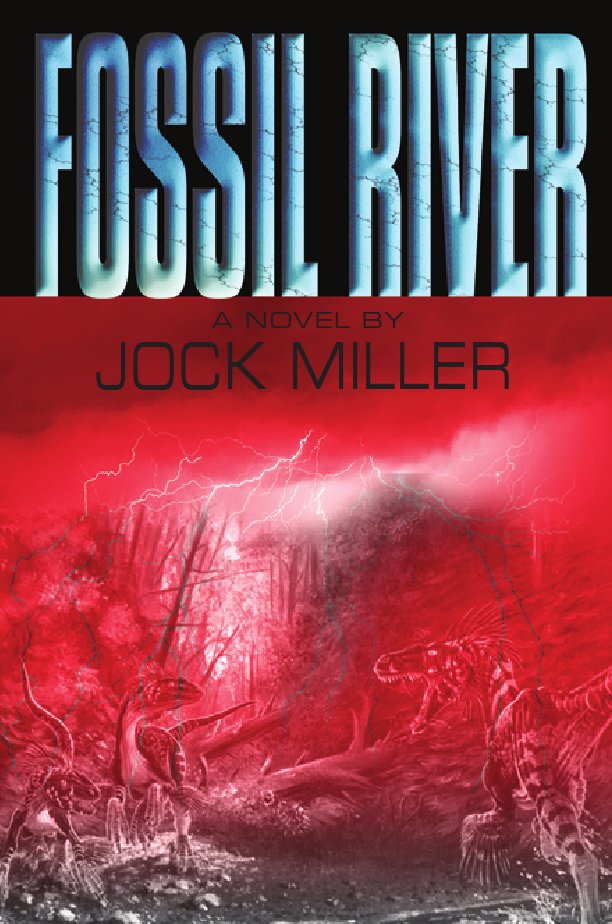
An action thriller by Jock Miller


Fossil fuel has an ageless affinity with dinosaurs. To create oil, dinosaurs died.


purchase on Amazon.com


The perfect energy storm is sweeping over the United States: Japan’s Fukushima nuclear plant meltdown has paralyzed nuclear expansion globally, BP’s Gulf of Mexico oil spill has stalled deep water drilling, Arab oil countries are in turmoil causing doubt about access to future oil, the intensity of hurricanes hitting the Gulf’s oil rigs and refineries has intensified due to global warming, and the nation’s Strategic Oil Supply is riding on empty.

As the energy storm intensifies, the nation’s access to Arab oil, once supplying over sixty percent of our fossil fuel, is being threatened causing people to panic for lack of gas at the pumps, stranding cars across the country and inciting riots.


The U.S. Military is forced to cut back air, land, and sea operations sucking up 58% of every barrel of oil to protect the nation; U.S. commercial airlines are forced to limit flights for lack of jet fuel; and businesses are challenged to power up their factories, and offices as the U.S. Department of Energy desperately tries to provide a balance of electric power from the network of aged power plants and transmission lines that power up the nation.

The United States must find new sources of domestic fossil fuel urgently or face an energy crisis that will plunge the nation into a deep depression worse than 1929.

The energy storm is very real and happening this very moment. But, at the last moment of desperation, the United States discovers the world’s largest fossil fuel deposit found in a remote inaccessible mountain range within Alaska’s Noatak National Preserve surrounding six and a half million acres.

Preventing access to the oil is a colony of living fossil dinosaurs that will protect its territory to the death.

Nobody gets out alive; nobody can identify the predator--until Dr. Kimberly Fulton, Curator of Paleontology at New York’s Museum of Natural History, is flown into the inaccessible area by Scott Chandler, the Marine veteran helicopter pilot who’s the Park’s Manager of Wildlife. All hell breaks loose when Fulton’s teenage son and his girlfriend vanish into the Park.


Will the nation’s military be paralyzed for lack of mobility fuel, and will people across America run out of gas and be stranded, or will the U.S. Military succeed in penetrating this remote mountain range in northwestern Alaska to restore fossil fuel supplies in time to save the nation from the worst energy driven catastrophe in recorded history?

______________________________________________________________________________________________________________________________________


Showing posts with label New Offshore Drilling Frontiers. Show all posts

New Offshore Drilling Frontiers: Farther, Deeper Into the Gulf of Mexico


Photograph by Mike Duhon

Shell's Perdido project 200 miles (322 kilometers) off the Texas coast in the Gulf of Mexico is the deepest of the world's deepwater drilling sites and the farthest from the shore. It began retrieving oil and gas from beneath more than 8,000 feet (2,438 meters) of water just three weeks before BP's Deepwater Horizon accident closer to shore.

Perdido became the first project to produce oil from the Gulf of Mexico's next big oil frontier—the Lower Tertiary Trend. Pulling oil from that band of 60 million-year-old rock requires going further offshore than conventional Gulf rigs and drilling far deeper—delving below the seafloor to depths greater than the height of Mount Everest.

Tapping Lower Tertiary oil requires evolving knowledge and technology to deal with novel problems like poor imagery, scorching temperatures, and enormous pressures at depth. But the rewards appear to be well worth it for energy companies—billions of barrels of oil are believed to lie in the formation.


Read More


New Offshore Drilling Frontiers: In Africa, Turning the Valve on a New Era


Photograph courtesy Tunlow Oil

Ghana's President John Atta Mills opens the valve for Anadarko Petroleum Corporation's Jubilee project on December 15, 2010. The offshore well in some 3,300 feet (1,000 meters) of water may produce as much as 2 billion barrels of oil and 800 billion cubic feet of natural gas.

Partnering with Anadarko and other petroleum companies, Ghana's national oil concern has a 13.75 percent stake in the project and hopes to usher in a new era of prosperity for the African country—if its growing oil industry can be managed without corruption, violence, and environmental degradation.

Jubilee and another Anadarko well (Venus) near the Sierra Leone-Liberia border may bookend a 700-mile (1,100-kilometer) undersea basin with an active petroleum system and hundreds of millions of barrels of deepwater oil. These and other projects are helping a new group of West African nations join established giants like Angola and Nigeria as the continent's major petroleum exporters.

New Offshore Drilling Frontiers: Beneath Melting Arctic Ice, Stores of Oil


Photograph by Paul Nicklen, National Geographic

Ice floats on the surface of Alaska's Beaufort Sea—and oil lies beneath. The U.S. Geological Survey estimates that the Arctic holds 13 percent of the world's undiscovered oil, some 90 billion barrels that might be produced with existing technologies. But extreme conditions here will put conventional petroleum practices to the test.

Most of the Arctic's undiscovered oil is thought to lie offshore under less than 1,640 feet (500 meters) of water in some of the most remote places on Earth. The closest U.S. Coast Guard Air Station to the Beaufort Sea is some 950 miles (1,530 kilometers) away and the nearest major port lies 1,300 nautical miles (2,400 kilometers) distant.

Drilling will be difficult in this remote realm of frigid temperatures, high seas, shrieking winds, darkness, sea ice, and minimal visibility. And environmentalists worry that responding to spills here will be difficult or impossible, putting the region's unique ecosystem at lasting risk.

After a legal challenge by Native Alaskans and environmentalists delayed necessary federal clean air permits, Shell* postponed plans to drill in the Beaufort Sea this summer and is now aiming to explore the area in 2012. Outside U.S. waters, Arctic oil exploration is already under way.


—Brian Handwerk

Read More