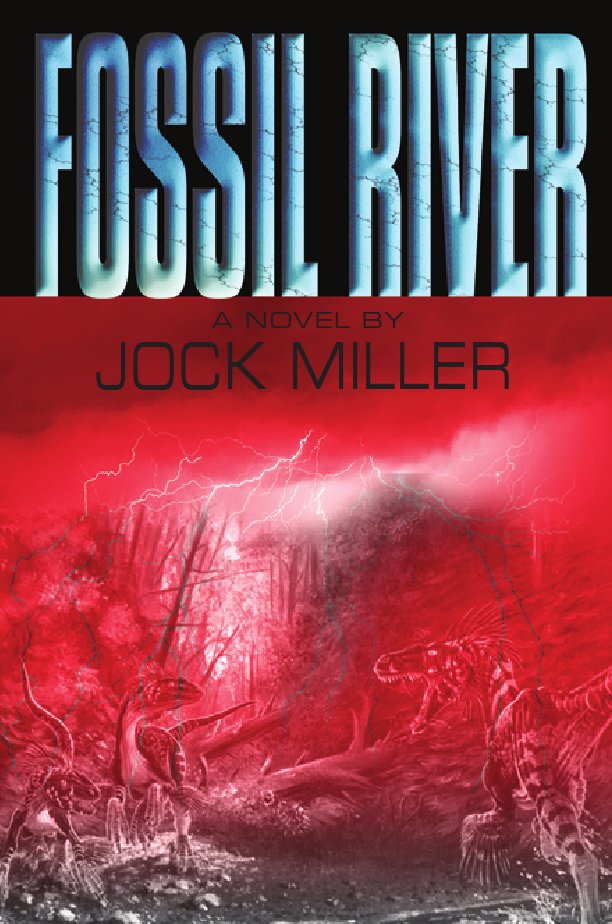
An action thriller by Jock Miller


Fossil fuel has an ageless affinity with dinosaurs. To create oil, dinosaurs died.


purchase on Amazon.com


The perfect energy storm is sweeping over the United States: Japan’s Fukushima nuclear plant meltdown has paralyzed nuclear expansion globally, BP’s Gulf of Mexico oil spill has stalled deep water drilling, Arab oil countries are in turmoil causing doubt about access to future oil, the intensity of hurricanes hitting the Gulf’s oil rigs and refineries has intensified due to global warming, and the nation’s Strategic Oil Supply is riding on empty.

As the energy storm intensifies, the nation’s access to Arab oil, once supplying over sixty percent of our fossil fuel, is being threatened causing people to panic for lack of gas at the pumps, stranding cars across the country and inciting riots.


The U.S. Military is forced to cut back air, land, and sea operations sucking up 58% of every barrel of oil to protect the nation; U.S. commercial airlines are forced to limit flights for lack of jet fuel; and businesses are challenged to power up their factories, and offices as the U.S. Department of Energy desperately tries to provide a balance of electric power from the network of aged power plants and transmission lines that power up the nation.

The United States must find new sources of domestic fossil fuel urgently or face an energy crisis that will plunge the nation into a deep depression worse than 1929.

The energy storm is very real and happening this very moment. But, at the last moment of desperation, the United States discovers the world’s largest fossil fuel deposit found in a remote inaccessible mountain range within Alaska’s Noatak National Preserve surrounding six and a half million acres.

Preventing access to the oil is a colony of living fossil dinosaurs that will protect its territory to the death.

Nobody gets out alive; nobody can identify the predator--until Dr. Kimberly Fulton, Curator of Paleontology at New York’s Museum of Natural History, is flown into the inaccessible area by Scott Chandler, the Marine veteran helicopter pilot who’s the Park’s Manager of Wildlife. All hell breaks loose when Fulton’s teenage son and his girlfriend vanish into the Park.


Will the nation’s military be paralyzed for lack of mobility fuel, and will people across America run out of gas and be stranded, or will the U.S. Military succeed in penetrating this remote mountain range in northwestern Alaska to restore fossil fuel supplies in time to save the nation from the worst energy driven catastrophe in recorded history?

______________________________________________________________________________________________________________________________________


Showing posts with label Sea Turtles. Show all posts

Gulf Turtle Nests Abound, But Worries Remain

Watch National Geographics Video Here


Sea turtle nesting season is underway on Gulf of Mexico beaches, and observers say activity seems normal. But these aren't the same animals that nested during last year's Gulf oil spill, and scientists are concerned about a continued rise in turtle deaths.

UNEDITED TRANSCRIPT

The first sea turtle nesting season after the 2010 BP oil spill was contained is underway in the northern Gulf of Mexico. And biologists and turtle conservation groups report a good nesting season so far.

Last summer, as the ruptured well spewed an estimated 5 million barrels of oil into the Gulf, scientists and volunteers launched a risky rescue– moving fragile turtle eggs away from the oil danger.

Biologists and volunteers moved about 28,000 eggs , mostly loggerhead turtles, from Alabama and Florida’s Panhandle to NASA’s Kennedy Space Center. The goal was to spare the vulnerable hatchlings an encounter with the oil. It’s estimated around 14,000 hatchlings were released on Florida’s Atlantic coast.

The tiny turtles were not tagged, so no one really knows where they are now. And if they were spotted, they couldn’t be accurately identified.

Back on the Gulf Coast, it’s nesting season once again, and conservation groups like Alabama’s Share the Beach are finding new nests almost daily– an encouraging sign. But they caution not to read too much into the finds.

SOT: Mike Reynolds, Share the Beach Director

“The nests look normal, the turtles seem normal. So, all in all it seems like a pretty good year. Of course, the turtles that are nesting this year are not the turtles that nested last year. Turtles nest every other year or thereabout and so these turtles nested two years ago. What we will be really interested in seeing is a year from now when last year’s turtles that were here during the oil spill that had the greatest effect from the oil come back and nest on our beaches next year.

There are 5 species of sea turtles that nest on the beaches of the Gulf Coast, and all of them are protected, so, every morning Share the Beach volunteers comb Alabama’s coast, just as they’ve done every nesting season since 2001, looking for telltale signs of a turtle nest – crawl marks and churned up area near a nest site.

And biologists are doing a study as part of the Natural Resource Damage Assessment – attaching satellite tags to incoming mother turtles to monitor their movements.

When the patrols spot a fresh nest too close to the waterline, they move the eggs before they set and become more sensitive to movement. They carefully put the eggs in a new nest and cordon it off. Read More

© 2011 National Geographic; partially funded by NSF; field producing and videography by Fritz Faerber

Sea Turtle Populations Drop Following Spill


http://www.ecoworld.com


The BP oil spill was especially unkind to sea turtles, experts say. A new report finds that more turtles were killed or injured in the Gulf of Mexico in the time after the April 20th disaster than in any similar period in the past twenty years.

Researchers with the National Wildlife Federation, the Sea Turtle Conservancy, and the Florida Wildlife Federation say there were four to six times more turtles found dead, disabled, and diseased in the months after the Deepwater Horizon oil spill than average.

The analysis did not pinpoint cause of death, although researchers said that many of the 600 creatures certainly died of exposure to crude. But while many turtles could have died from other factors such as entanglement in fishing nets and cold weather, the spike in deaths following the spill is still significant – and troubling.

“Of all the species affected by the oil spill, those for which I have the greatest concern are the sea turtles,” said study co-author Doug Inkley, senior scientist at the National Wildlife Federation.

Inkley believes the oil spill was at least partially responsible for the above-average deaths, although necropsies performed by the National Oceanic and Atmospheric Association indicate that most of the turtles drowned in fishing gear.

Sea turtles are especially vulnerable because it takes them 10 to 30 years to reach adulthood, so it could take decades to restore dwindling populations to healthy numbers.

Four of the turtle species dwelling along the Florida coast – green, hawksbill, leather back, and Kemp’s ridley – are endangered.