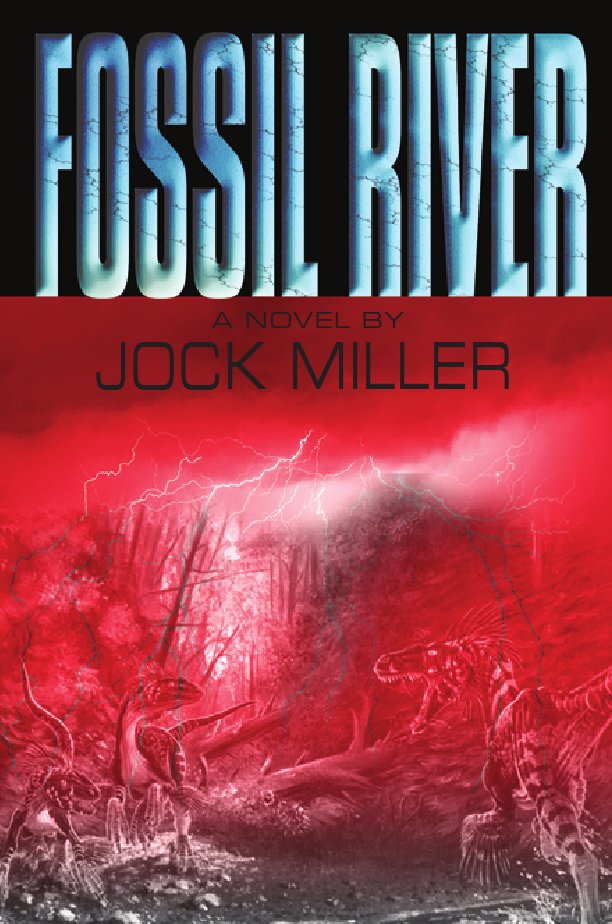
An action thriller by Jock Miller


Fossil fuel has an ageless affinity with dinosaurs. To create oil, dinosaurs died.


purchase on Amazon.com


The perfect energy storm is sweeping over the United States: Japan’s Fukushima nuclear plant meltdown has paralyzed nuclear expansion globally, BP’s Gulf of Mexico oil spill has stalled deep water drilling, Arab oil countries are in turmoil causing doubt about access to future oil, the intensity of hurricanes hitting the Gulf’s oil rigs and refineries has intensified due to global warming, and the nation’s Strategic Oil Supply is riding on empty.

As the energy storm intensifies, the nation’s access to Arab oil, once supplying over sixty percent of our fossil fuel, is being threatened causing people to panic for lack of gas at the pumps, stranding cars across the country and inciting riots.


The U.S. Military is forced to cut back air, land, and sea operations sucking up 58% of every barrel of oil to protect the nation; U.S. commercial airlines are forced to limit flights for lack of jet fuel; and businesses are challenged to power up their factories, and offices as the U.S. Department of Energy desperately tries to provide a balance of electric power from the network of aged power plants and transmission lines that power up the nation.

The United States must find new sources of domestic fossil fuel urgently or face an energy crisis that will plunge the nation into a deep depression worse than 1929.

The energy storm is very real and happening this very moment. But, at the last moment of desperation, the United States discovers the world’s largest fossil fuel deposit found in a remote inaccessible mountain range within Alaska’s Noatak National Preserve surrounding six and a half million acres.

Preventing access to the oil is a colony of living fossil dinosaurs that will protect its territory to the death.

Nobody gets out alive; nobody can identify the predator--until Dr. Kimberly Fulton, Curator of Paleontology at New York’s Museum of Natural History, is flown into the inaccessible area by Scott Chandler, the Marine veteran helicopter pilot who’s the Park’s Manager of Wildlife. All hell breaks loose when Fulton’s teenage son and his girlfriend vanish into the Park.


Will the nation’s military be paralyzed for lack of mobility fuel, and will people across America run out of gas and be stranded, or will the U.S. Military succeed in penetrating this remote mountain range in northwestern Alaska to restore fossil fuel supplies in time to save the nation from the worst energy driven catastrophe in recorded history?

______________________________________________________________________________________________________________________________________


Showing posts with label How Did Dinosaurs Sleep. Show all posts

More on Why do two dragons sleep soundly?


The little crow-sized troodontid dinosaur, Mei long (meaning “soundly sleeping dragon”) was more aptly named than Xu and Norell (2004) originally realized. Now, Chunling Gao and colleages (2012) have reported their discovery of a second fully articulated specimen preserved in the posture characteristically adopted by many modern birds while they sleep: neck curved around sideways, head tucked in behind a wing, legs folded under body and (something of which modern birds are incapable, with their truncated pygostyle) long tail wrapped around the body. The only significant difference in posture between the two animals is that the new one’s (DNHM D2154) neck is bent in the opposite direction to that in the first specimen (IVPP V12733). Xu and Norell (2004) had suggested that as in modern birds, this compact body configuration minimizes the ratio of surface area to volume, thereby enhancing body heat retention, which is a significant challenge to such small homeothermic (warm blooded) animals.

Despite the fact that these fossils were found in the volcaniclastic (volcanic ash deposit) sediments of the Yixian formation, which facilitate extremely fine preservation, fossilization is a very spotty process (only two such beautiful Mei specimens are known so far). So it seems statistically unlikely that both specimens (and a partial Sinornithoides) would be found in this sleeping posture unless death and the posture were somehow related. But how?

Gao et al. (2012) point out that not all the victims of Pompei (who were similarly covered by ash as Mei) display the hyperflexion (clenching) of muscles that results from death by high temperature ash falls and fire. Therefore, (assuming that theropods such as Mei display similar neuromuscular responses to heat as do mammals) it isn’t unreasonable to surmise that the specimens of Mei died by asphyxiation from toxic volcanic gases while sleeping instead of being roasted. In this scenario, the volcanic eruptions that killed and buried the animals may have occurred during the sleeping period, and therefore represents a kind of snapshot of ‘normal’ life in this prehistoric ecosystem.

Alternatively, Gao et al. (2012) have suggested that perhaps the preserved brooding posture of Mei represents either (1) sheltering behaviour within a burrow (which may have constrained the position of the body and prevented the kind of opisthotonic neck-twisted-up-over-back posture that characterizes many dinosaur skeletons and which has been proposed to results from either a neurolomuscular response to toxins or agony, or postmortem contraction of neck ligaments), or (2) a defensive postural response to volcanic events such as ash fall. In this last case, the volcanic event may have directly influenced the preserved postures of some of the fossils that are found in its resulting sediments. In the sketch above, I have chosen to illustrate Mei curled up under a relatively cooler ash fall, and the hapless creature has been asphyxiated, either in its sleep or in a defensive posture.

The multiplicity of possible explanations for the brooding posture of Mei and the likelihood of the fossilization process to influence the behaviour of the animals that it preserves underscores the daunting and complex task facing paleontologists who strive to piece together the puzzle of prehistoric ecosystems from relatively few pieces left to them sometimes by catastrophic events.


Reposted from Evolutionary Routes

How Did Dinosaurs Sleep?

A second specimen of the troodontid Mei, preserved in a bird-like sleeping position. From Gao et al., 2012.

Bone by bone and study by study, paleontologists are learning more than ever before about dinosaurs. But there are still many aspects about prehistoric biology that we know little about. In fact, some of the simplest facets of dinosaur lives remain elusive.

For one thing, we don’t know much at all about how dinosaurs slept. Did Apatosaurus doze standing up or kneel down to rest? Did tyrannosaurs use their tiny, muscular arms to push themselves off the ground after a nap? And, given the discovery of so many enfluffled dinosaurs, did fuzzy dinosaurs ever cuddle up together to stay warm on chilly Mesozoic nights?

Since we can’t observe living non-avian dinosaurs directly, some of these questions have to remain in the realm of speculation. But a handful of fossils have shown us that at least some dinosaurs curled up just like birds. In 2004, Xing Xu and Mark Norell described the tiny, early Cretaceous dinosaur Mei long–a feathery troodontid dinosaur with big eyes and a little switchblade claw on each foot. What made Mei special, though, was the way the dinosaur was preserved.

Many articulated dinosaur skeletons are found in the classic dinosaur death pose, with their tails tilted up and their necks thrown over their backs. The nearly-complete skeleton of Mei was different. The foot-long dinosaur rested its head over its folded arms, and its tail wrapped around the dinosaur’s torso. Mei died sleeping in a roosting position similar to that of modern birds. The dinosaur’s name, which means “sleeping dragon,” is a tribute to the behavior.

Now another Mei specimen has confirmed that the first find was not a fluke. Last week, paleontologist Chunling Gao, of the Dalian Natural History Museum in China, and colleagues described a second, slightly smaller Mei that was preserved in a nearly identical sleeping position. Much like the first, this Mei probably died in a prehistoric ashfall that both killed and preserved the dinosaur in delicate detail without jarring the snoozing troodontid out of position. Some feathery, non-avian dinosaurs not only looked like birds, but they slept like them, too.

The two Mei specimens aren’t the only dinosaurs found in such positions. Gao and colleagues also point out that a specimen of another troodontid found in the Cretaceous rock of Mongolia, Sinornithoides youngi, was found in the same sort of sleeping position. And while not mentioned by the authors of the new study, the sleeping positions of Mei and Sinornithoides remind me of the early Jurassic dinosaur Segisaurus. Described in 1936, the partial skeleton of Segisaurus was found with its legs tucked beneath its body and arms apparently in a resting position. Perhaps this dinosaur, too, died while dozing, and records an even older record of how dinosaurs rested. Such glimpses are rare, but they help fill in some of the most elusive moments in Mesozoic history.


Reposted from Smithsonian Magazine