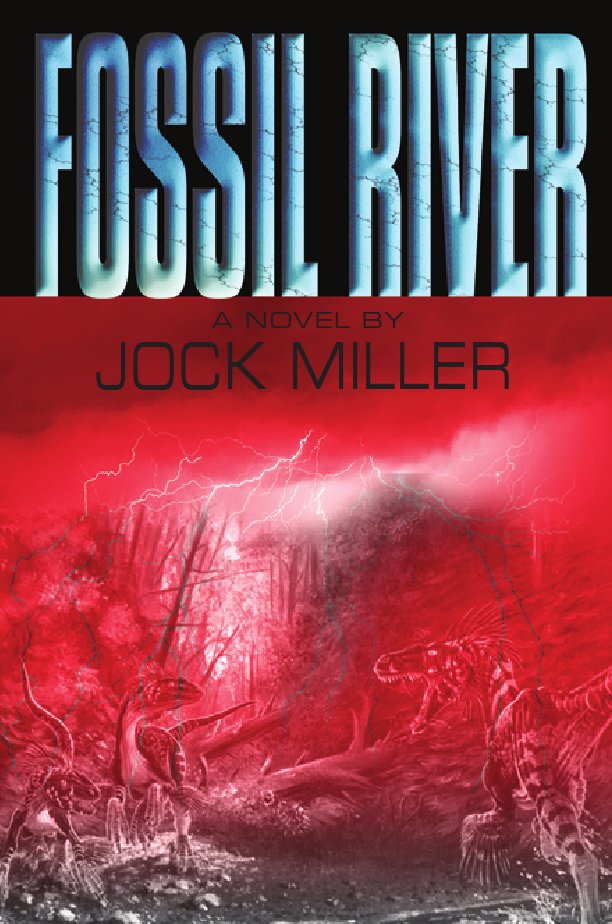
An action thriller by Jock Miller


Fossil fuel has an ageless affinity with dinosaurs. To create oil, dinosaurs died.


purchase on Amazon.com


The perfect energy storm is sweeping over the United States: Japan’s Fukushima nuclear plant meltdown has paralyzed nuclear expansion globally, BP’s Gulf of Mexico oil spill has stalled deep water drilling, Arab oil countries are in turmoil causing doubt about access to future oil, the intensity of hurricanes hitting the Gulf’s oil rigs and refineries has intensified due to global warming, and the nation’s Strategic Oil Supply is riding on empty.

As the energy storm intensifies, the nation’s access to Arab oil, once supplying over sixty percent of our fossil fuel, is being threatened causing people to panic for lack of gas at the pumps, stranding cars across the country and inciting riots.


The U.S. Military is forced to cut back air, land, and sea operations sucking up 58% of every barrel of oil to protect the nation; U.S. commercial airlines are forced to limit flights for lack of jet fuel; and businesses are challenged to power up their factories, and offices as the U.S. Department of Energy desperately tries to provide a balance of electric power from the network of aged power plants and transmission lines that power up the nation.

The United States must find new sources of domestic fossil fuel urgently or face an energy crisis that will plunge the nation into a deep depression worse than 1929.

The energy storm is very real and happening this very moment. But, at the last moment of desperation, the United States discovers the world’s largest fossil fuel deposit found in a remote inaccessible mountain range within Alaska’s Noatak National Preserve surrounding six and a half million acres.

Preventing access to the oil is a colony of living fossil dinosaurs that will protect its territory to the death.

Nobody gets out alive; nobody can identify the predator--until Dr. Kimberly Fulton, Curator of Paleontology at New York’s Museum of Natural History, is flown into the inaccessible area by Scott Chandler, the Marine veteran helicopter pilot who’s the Park’s Manager of Wildlife. All hell breaks loose when Fulton’s teenage son and his girlfriend vanish into the Park.


Will the nation’s military be paralyzed for lack of mobility fuel, and will people across America run out of gas and be stranded, or will the U.S. Military succeed in penetrating this remote mountain range in northwestern Alaska to restore fossil fuel supplies in time to save the nation from the worst energy driven catastrophe in recorded history?

______________________________________________________________________________________________________________________________________


Showing posts with label Paleontologist. Show all posts

Hitchcock’s Primeval Birds

Paleontologist Edward Hitchcock was one of the first dinosaur track experts, but why did he insist that birds left the footprints


Edward Hitchcock was one of America’s first dedicated dinosaur paleontologists. He just didn’t know it. In fact, during the latter part of his career, he explicitly denied the fact. To Hitchcock, the tracks skittering over red sandstone in the Connecticut Valley were the marks of prehistoric birds from when the Creation was new. Hitchcock could not be dissuaded. As new visions of dinosaurs and the notion of evolution threatened to topple his life’s work, the Amherst natural theologian remained as immutable as the fossil footprints he studied.

Hitchcock was not the first to wonder about the prehistoric imprints. Members of the Lenape, a Native American group in Canada and the northeastern United States, had seen the bizarre, three-toed tracks and ascribed them to monsters and other beings. These were the footsteps of creatures that ruled the world before humans came to dominance. European settlers and their descendants had to stretch their mythology a little more to accommodate the tracks. Some thought such tracks might have been left by Noah’s raven after the biblical deluge, although many simply called them “turkey tracks” and apparently were little concerned with where they had come from.

It wasn’t until 1835 that James Deane, a doctor with a curiosity for natural history, found out about a sample of the peculiar tracks near Greenfield, Massachusetts. He knew that they represented prehistoric organisms, but he wasn’t sure which ones. He wrote to Hitchcock, then a geology professor at Amherst, to inquire about what could have left such markings in stone. At first Hitchcock didn’t believe Deane. There might be some quirk of geological formation that could have created track-like marks. But Deane was persistent. Not only did he change Hitchcock’s mind, but the geologist became so enthusiastic that he quickly became the most prominent expert on the tracks—a fact that frustrated Deane and led to tussles in academic journals over who really was the rightful discoverer of the Connecticut Valley’s lost world.

Hitchcock began publishing about the peculiar trace fossils in 1836. He was confident from the very start that they must

have been created by prehistoric birds. (He was so enthused by the idea he even wrote poetry about the “sandstone birds.”) No variety of creature matched them better. The word “dinosaur” had not even been invented yet; the British anatomist Richard Owen would establish the term in 1842. The few dinosaurs that had been found, such as Iguanodon, Megalosaurus and Hylaeosaurus, were known only from paltry remains and all were believed to have been enormous variations of lizards and crocodiles. Dinosaurs were a poor fit for the tracks, and became even worse candidates when Owen gave them an anatomical overhaul. Owen not only named dinosaurs, he re-branded them as reptiles with mammal-like postures and proportions. The huge sculptures of the Crystal Palace exhibition, created with the help of artist Benjamin Waterhouse Hawkins, are a testament to Owen’s view of dinosaurs as reptiles that had taken on the anatomical attitudes of rhinoceros and elephants.

But Owen and other paleontologists did not agree with Hitchcock’s interpretation. They argued that the tracks could have been made by some unknown variety of amphibian or reptile. This was not so much because of the anatomy of the tracks—anyone could see that they were made by creatures with bird-like feet—but because no one thought that birds could have lived at so ancient a time or grown large enough to make the biggest, 18-inch tracks Hitchcock described. Even though early 19th century paleontologists recognized that life changed through the ages, they believed there was a comprehensible progression in which so-called “higher” types of creatures appeared later than others. (Mammals, for example, were thought to have only evolved after the “Secondary Era” when reptiles ruled since mammals were thought to be superior to mosasaurs, ichthyosaurs, and other creatures of that middle time.)
 
Hitchcock remained steadfast, and his persistence was eventually rewarded with the discovery of the moa. These huge, flightless birds recently lived on New Zealand—they were wiped out more than 500 years ago by humans—and in 1839 Richard Owen rediscovered the birds through a moa thigh bone. He hypothesized that the bone must have belonged to a large, ostrich-like bird, and this idea was soon confirmed by additional skeletal bits and pieces. Some of these ratites stood over nine feet tall. When the news reached Hitchcock in 1843, he was thrilled. If recent birds could grow to such sizes, then prehistoric ones could have been just as large. (And, though Hitchcock died before their discovery, preserved moa tracks have a general resemblance to some of the largest footprints from the Connecticut Valley.) Opinion about the New England tracks quickly changed. There was no longer any reason to doubt Hitchcock’s hypothesis, and paleontologists hoped that moa-like bones might eventually be found to conclusively identify the trackmakers.

Lacking any better hypotheses, Hitchcock prominently featured his avian interpretation of the three-toed tracks in his 1858 book The Ichnology of New England. It was a gorgeous fossil catalog, but it also came at almost precisely the wrong time. Gideon Mantell, the British doctor and paleontologist who discovered Iguanodon, was beginning to wonder if some dinosaurs primarily walked on their hind limbs in a bird-like fashion, and the Philadelphia polymath Joseph Leidy described Hadrosaurus, a dinosaur certainly capable of bipedal locomotion on account of having shorter forelimbs than hindlimbs, the same year that Hitchcock’s monograph came out. Dinosaurs were undergoing another major overhaul, and the few that were known at the time were being recast as relatively bird-like creatures. Even worse for Hitchcock, the following year another student of the Connecticut Valley tracks, Roswell Field, reinterpreted many of the footprints and associated traces as being made by prehistoric reptiles. Especially damning was the fact that deep tracks, left when the creatures sunk into the mud, were sometimes associated with drag marks created by a tail. Hitchcock’s tableau of ancient Massachusetts moas was becoming increasingly unrealistic.

If Hitchcock ever doubted his interpretation, he never let on. He reaffirmed his conclusions and modified his arguments in an attempt to quell dissent. In his last book, A Supplement of the Ichnology of New England, published in 1865, a year after his death, Hitchcock used the recently discovered Jurassic bird Archaeopteryx as a way to save his interpretation. Tail drags were no obstacle to the bird hypothesis, Hitchcock argued, because Archaeopteryx was generally regarded as being the primordial bird despite having a long, reptile-like tail. Perhaps such a bird could have been responsible for the trace fossils Hitchcock called Anomoepus, but the tail drags left by the animals that dwelled in Jurassic New England were also associated with tracks indicating that their maker walked on all fours. In response, Hitchcock cast Archaeopteryx as a quadrupedal bird—a representative of a new category different from the classic, bipedal bird tracks he had promoted for so long.

Other paleontologists took a different view. If Archaeopteryx looked so primitive and lived after the time when the red Connecticut sandstone was formed, then it was unreasonable to think that more specialized, moa-like birds created Hitchcock’s tracks. Furthermore, a few bones found in a Massachusetts quarry of roughly the same age in 1855 turned out to belong to a dinosaur—a sauropodomorph that Othniel Charles Marsh would later name Anchisaurus. The bird bones never turned up, and all the while dinosaur fossils were becoming more and more avian in nature. By the 1870s the general paleontological opinion had changed. New England’s early Jurassic was not filled with archaic birds, but was instead home to dinosaurs which were the forerunners of the bird archetype.

Our recent realization that birds are the direct descendants of one group of coelurosaurian dinosaurs has led some of Hitchcock’s modern day fans to suggest that he was really right all along. In an essay for the Feathered Dragons volume, paleontologist Robert Bakker extolled Hitchcock’s scientific virtues and cast the geologist’s avian vision for the tracks as essentially correct. Writer Nancy Pick, in her 2006 biography of the paleontologist, wondered, “What if Hitchcock clung to his bird theory because he was right?” But I think such connections are tenuous—it is a mistake to judge Hitchcock’s work by what we have come to understand a century and a half later.


Read more


Palentologist: Annie M. Alexander


Annie Alexander (1867 – 1950)  Annie M. Alexander was born in Hawaii into a wealthy family of sugarcane growers and refiners, was educated in California and Europe, and spent much of her life adventuring across the globe. After sitting in on some lectures given by Berkeley paleontologist John Merriam, Alexander became acutely interested in the subject and funded several fossil hunting expeditions across the United States, on the condition that she could join the parties.

Alexander’s importance as a patron of the sciences could hardly be over-exaggerated.  She endowed what would ultimately become the University of California Museum of Paleontology, as well as the Museum of Vertebrate Zoology both located on the Berkeley campus of the University of California and both which remain important research institutions. In addition to her philanthropic work, Alexander was a talented naturalist and collected numerous fossil, zoological and botanical specimens for the museums that she founded. Some 17 species or subspecies, extinct and extant, bear her name including three marine reptiles Thalattosaurus alexandrae , (see below) Hydrotherosaurus alexadrae and Shastasaurus alexandrae (though the later is now considered to be a junior synonym of S. pacificus).


Thalattosaurus alexandrae


Thalattosaurus


Thalattosaurs (meaning "ocean lizards") are a group of prehistoric marine reptiles which lived during the mid-late Triassic Period. Some species of thalattosaur grew to over 4 metres (13 feet) in length, including a long, flattened tail used in underwater propulsion. While they bore a superficial resemblance to lizards.

Feathery Ostrich Mimics Enfluffle the Dinosaur Family Tree

Not only was Ornithomimus feathered, but the dinosaur’s fluffy coat changed as it aged. Lovely art by Julius Csotonyi.


University of Calgary paleontologist Darla Zelenitsky adds another enfluffled species to the dinosaurian ranks. Even better, the specimens raise hopes that many more dinosaurs might be preserved with their feathery coats intact.

Zelenitsky’s downy dinosaurs are not newly discovered species. Ornithomimus edmontonicus was initially described by famed bone hunter C.H. Sternberg in 1933, and it is one of the characteristic Late Cretaceous species found in Alberta, Canada’s fossil-rich Horseshoe Canyon Formation. In Sternberg’s time, these dinosaurs were thought to be scaly, but recent finds of so many feathery dinosaurs has raised the likeliehood that the “ostrich mimic” dinosaur was at least coated in some sort of dinofuzz.


Read more


Paleontologist: John H. Ostrom


 Nowadays, pretty much all paleontologists agree that modern birds descended from dinosaurs. However, that wasn’t the case in the 1960's, when John H. Ostrom was the first researcher to propose that dinosaurs had more in common with big, flightless birds like ostriches than with contemporary reptiles (to be fair, the heavyweight paleontologist Othniel C. Marsh had proposed this idea in the late 19th century, but he didn't have enough proof at his disposal to carry the weight of scientific opinion).

Ostrom's theory about the dinosaur-bird evolutionary link was inspired by his 1964 discovery of Deinonychus, a large, bipedal raptor that had some uncannily birdlike characteristics. Today, it's (nearly) an established fact that Deinonychus and its fellow raptors were covered with feathers, not a popular image a generation ago. (In case you were wondering, those "Velociraptors" in Jurassic Park were really Deinonychus, disregarding the fact that they were portrayed with reptilian skin.)

In discovering Deinonychus, Ostrom smashed open the dinosaur equivalent of a hornet's nest. Paleontologists weren't used to dealing with muscular, man-sized, predatory dinosaurs, which prompted speculation about whether an ostensibly cold-blooded reptile could engage in such energetic behavior. In fact, Ostrom's student Robert Bakker was the first paleontologist to forcefully propose that all theropod dinosaurs were warm-blooded, a theory that's currently on slightly shakier ground than the dinosaur-bird connection.


 ____________________________________________________________________


Check out
Bob's Dinosaur Blog !
Bob Strauss is a freelance writer and book author; one of his specialties is explaining scientific concepts and discoveries to both a lay and professional audience.
Bob Strauss is the author of two best-selling question-and-answer books that range across the expanse of science, biology, history and culture: The Big Book of What, How and Why (Main Street, 2005) and Who Knew? Hundreds & Hundreds of Questions & Answers for Curious Minds (Sterling Innovation, 2007).

Paleontologist: Mary Anning


Mary Anning was a British fossil collector, dealer, and paleontologist who became known around the world for a number of important finds she made in the Jurassic marine fossil beds at Lyme Regis in Dorset, where she lived. Her work contributed to fundamental changes that occurred during her lifetime in scientific thinking about prehistoric life and the history of the Earth.

At the time Mary Anning lived, scientists were just beginning to appreciate the significance of fossils--recognizing them as the remains of long-extinct creatures, rather than the rare skeletons of still-living animals. Not a trained scientist herself, Anning got into fossil collecting as a way of making money: when she was 12 years old, she found an ichthyosaur skeleton on the English coast, and she discovered the first-ever plesiosaur fossil ten years later. By this time she had come to the attention of the British scientific establishment, which must not have been surprised when she managed to dig up a Dimorphodon (a genus of pterosaur that, until then, had never been identified outside Germany).

Mary Anning's upbringing had a lot to do with her later notoriety. Even when she was a child, the English town of Lyme Regis was known for its unusual fossils, mostly of marine animals like ammonites and belemnites dating to the early Jurassic period. During the Napoleonic Wars, before Mary had reached her teens, her father took her and her brother out to collect fossils and sell them to curious visitors, since the upheavals across the English Channel had a dismal effect on the local economy (in fact, Anning's father was himself involved in organizing protests against food shortages).

By the time she died, at the age of 47, Mary Anning had received a lifetime annuity from the British Association for the Advancement of Science--not a small honor at a time when women weren't expected to be literate, much less capable of making scientific discoveries. Anning was memorialized even more effectively by a popular tongue-twister written by Terry Sullivan in the late nineteenth century: "She sells sea shells by the sea shore."

Paleontologist: Edward Hitchcock


PortraitHitchcock's assumption might seem quaint today, but it's important to remember the times in which he worked. He delivered his report several years before Richard Owen even named the Dinosauria, when the only known dinosaur fossils were fragmentary. The prevailing view of ancient reptiles was that they were like today's lizards, just many times the size. Only with later discoveries, such as the first relatively complete dinosaur skeleton of Hadrosaurus foulkii did paleontologists realize that some dinosaurs were bipedal. And when Hitchcock published another report in 1858, Ichnology of New England, he considered the possibility, based on occasional tail impressions, that the "giant birds" who made the tracks might have had some reptilian characteristics.

 
From Hunting Dinosaurs by Louie Psihoyos
 

In 1836, Edward Hitchcock delivered a report to the American Journal of Science about "remarkable footmarks in stone in the valley of Connecticut River, which have since awakened so much interest among intelligent men." Throughout his life he collected over 20,000 fossil footprints and established a footprint museum at Amherst College. To this day it remains the world's largest fossil footprint museum.

Hitchcock, professor of geology and theology, and president of Amherst College, devoted his life to reconciling scientific discoveries with the Bible. He believed the footprints had been made by giant birds, and he carried this belief to his grave. We now know the fossil footprints were made by bipedal dinosaurs.


Illustration
From The Dinosaur Papers edited by Weishampel and White
Even if he refused to accept a dinosaur as the track maker, Hitchcock did demonstrate some impressive logic. He undertook extensive comparisons between the fossil tracks and those of modern birds, and he identified several potential species among the track makers. He speculated (correctly) that many more fossil tracks might be found if quarries were to be opened. He also reasoned that tracks on inclined rocks were probably originally made of level ground, remarking, "There is no appearance as if the animal had scrambled upwards, or slid downwards, except in one or two tracks of great size, where the mud appears to have been rolled up a few inches before the feet."

Digging for Dragons — Dong Zhiming


Dong is among the most successful dinosaur hunters in the world, and has helped to uncover the scientific treasure trove of dinosaurs that lay hidden under the badlands of western and central China.

Thousands of years ago, the people of China first discovered huge bones in their fields. They assumed that the bones came from dragons, the source of rain and good luck in Chinese traditional thought. Many of the "dragon bones" were ground up and used as medicine -- a practice that continues to this day in some areas of China.

Today, however, the traditional pharmacists have competition for dragon bones.

Chinese paleontologists like Dong Zhiming are recovering precious fossils that show the links between dinosaurs and birds, offer clues about the social behavior of dinosaurs, and provide insight into dinosaur parenting techniques. Who knows what the dragons of China will teach us next?


Paleontologist: Dinosaur hunter Dong Zhiming

Unearthing China's Real Dragons


Dong Zhiming, 26, walked atop a low cliff of red and yellow sandstone in China's Xinjiang autonomous region, his eyes scanning the ground. He was oblivious to the intense summer heat and the desolate, even forbidding landscape of this corner of the region, some 180 miles from the city of Ürümqi. To the young paleontologist it represented rich hunting grounds for one of the world's rarest treasures — dinosaur bones.

This was his first expedition, and he'd already spotted fossils of prehistoric fish and amphibians, but he had yet to discover any remains of the creatures that most fascinated him. He knew that even experienced field paleontologists could spend months on a dig without uncovering anything significant. Nevertheless, Dong felt strangely confident. He scanned the baked earth for a telltale sign — an unusual mounding of the landscape, an odd protuberance.


Dong and six colleagues from the Institute of Vertebrate Paleontology and Paleoanthropology (IVPP) in Beijing had set out from camp after breakfast. A half-hour later they'd halted their truck in the barren stretch he now searched. Then he saw it. Halfway down the slope was a dark, rounded shape like the rim of a buried football.


Looks interesting, Dong thought. Maybe ... Carving out steps with his hammer, he climbed down and carefully loosened debris around the object. I was right! he thought. "It's a big one!" he shouted to an IVPP technician. By late afternoon, they had excavated a vertebra from a sauropod, the most gigantic of dinosaurs, whose members include the Brontosaurus (=Apatosaurus).


China's Mr Dinosaur

Since that day in 1963, the man National Geographic Science Editor Rick Gore calls "China's Mr. Dinosaur" has found countless other fossils. Now head of IVPP dinosaur research, Dong is acclaimed as the world's most prolific dinosaur hunter. According to Peter Dodson, vice-president of The Dinosaur Society, Dong's finds include 18 new genera, or groups of species, three more than his closest competitor. His discoveries have shed light on dinosaur evolution and focused attention on China as a preeminent place to study the creatures.


Dong's fascination with dinosaurs began early. He was born in 1937 in the east coast town of Weihai. His father was a bus controller, his mother a housewife. As a child, he found no outlet for his surging energy in the classroom but loved the outdoors, especially running, swimming and fishing. Then when he was 13, he saw an exhibit about dinosaurs, which the Chinese call konglong — "terrible dragons." But unlike the dragons of mythology, he learned, dinosaurs were real. On display was a five-foot leg bone of a hadrosaur, a duck-billed plant-eater. It had an electrifying effect on the boy. He began searching out everything he could read about dinosaurs. Over the next decade he learned that China is incredibly rich in fossils; its valleys and flood plains preserved them from erosion, enabling them to weather the ages.


After Dong graduated from university with a biology degree in 1962, he entered the IVPP. Director Yang Zhong-jian, called the father of Chinese vertebrate paleontology, had studied in Munich, then worked in China alongside Western colleagues until 1949, when the Communists came to power and cooperation with the West ended. Now too old to do much fieldwork, he wrote papers, supervised research and taught, hoping for a promising student to carry on his dinosaur work.


Meeting Dong for the first time, Yang asked the alert, strongly built youth, "What do you want to study?" He expected it to be small fossils, which are easily carried and scrutinized in the lab. Dong replied, "Dinosaurs."


Read More

PALEONTOLOGIST: Edwin H. Colbert


Edwin H. Colbert had already made his mark as a working paleontologist (discovering the early dinosaurs Coelophysis and Staurikosaurus, among others) when he made his most influential discovery: a skeleton of the mammal-like reptile Lystrosaurus in Antarctica, which proved that Africa and the southern continent used to be joined in one gigantic land mass. Since then, the theory of continental drift during the Mesozoic Era has done much to advance our understanding of dinosaur evolution.

In 1969, just before retiring from the American Museum of Natural History in New York, Dr. Colbert traveled to Antarctica as part of a field expedition sponsored by the National Science Foundation.

While there, he was part of a team that discovered and identified a 220-million-year-old fossil of a Lystrosaurus, an early relative of mammals. Similar fossils had previously been found in South Africa. Since Lystrosaurus was not a swimmer, the discovery lent evidence to the theory that the present-day continents must have once been part of a large land mass or supercontinent that slowly separated over millions of years.


The continental drift theory, originally proposed in 1912 by Alfred Wegener, a German meteorologist, had long been debated by scientists, but the discovery was a crucial piece of evidence. Dr. Laurence M. Gould, the scientific leader of Adm. Richard E. Byrd's first expedition to Antarctica, in 1928, described the discovery in an article in The New York Times as ''one of the truly great fossil finds of all time.''  


PALEONTOLOGIST: Roy Chapman Andrews


Although he had a long, active career in paleontology--he was director of the prestigious American Museum of Natural History from 1935 to 1942--Roy Chapman Andrews is best known for his fossil-hunting excursions to Mongolia in the early 1920's. At this time, Mongolia was a truly exotic destination, not yet dominated by China and rife with political instability. For his expeditions, Andrews used both automobiles and camels, and he had a number of narrow escapes that added to his reputation as a dashing adventurer (he was later said to have been the inspiration for Steven Spielberg's Indiana Jones).

Andrews discovered numerous dinosaur fossils at the formation known as Flaming Cliffs, including specimens of Oviraptor and Velociraptor, but today he's most famous for unearthing the first indisputable evidence of dinosaur eggs (before then, scientists were unsure if dinosaurs laid eggs or gave birth to live young). Even still, he made a huge (if understandable) mistake: Andrews believed he had found an Oviraptor that had stolen the eggs of Protoceratops, but in fact this supposed "egg thief" turned out to be hatching its own young!

Paleontologists - Barnum Brown

The AMNH scow Mary Jane in 1911. Left to right: Henry Fairfield Osborn (AMNH); Fred Saunders (cook from Stettler, Alberta) and Barnum Brown (AMNH)

Barnum Brown (yes, he was named after P.T. Barnum of traveling circus fame) wasn't much of an egghead or innovator; rather, he made his name early in the 20th century as the chief fossil hunter for New York's American Museum of Natural History, for which purposes he preferred dynamite to pickaxes. Brown's exploits whetted the American public's appetite for dinosaur displays, especially at his own institution, now the most famous dinosaur depository in the entire world.

Barnum Brown  discovered the first documented remains of Tyrannosaurus rex during a career that made him one of the most famous fossil hunters working from the late Victorian era into the early
20th century.

Paleontologists - Robert Bakker

An American paleontologist who helped reshape modern theories about dinosaurs. Bakker has been a major proponent of the theory that dinosaurs were "warm-blooded", smart, fast, and adaptable.


His evidence for which includes:

  • Almost all animals that walk upright today are warm-blooded, and dinosaurs walked upright.
  • The hearts of warm-blooded animals can pump much more effectively than the hearts of cold-blooded animals. Therefore, the giant Brachiosaurus must have had the type of hearts associated with warm-blooded animals, in order to pump blood all the way up to its head.
  • Dinosaurs such as Deinonychus led a very active life, which is much more compatible with a warm-blooded animal.
  • Some dinosaurs lived in northern latitudes where it would be impossible for cold-blooded dinosaurs to keep warm.
  • The rapid rate of speciation and evolution found in dinosaurs is typical of warm blooded animals and atypical of cold blooded animals.
  • The predator/prey ratio of predatory dinosaurs to their prey is a signature trait of warm-blooded predators rather than cold-blooded ones.
  •  Birds are warm-blooded. Birds evolved from dinosaurs, therefore a change to a warm-blooded metabolism must have taken place at some point; there is far more change between dinosaurs and their ancestors, the archosaurs, than between dinosaurs and birds.
  • Warm-blooded metabolisms are evolutionary advantages for top predators and large herbivores; if the dinosaurs had not been warm-blooded there should be fossil evidence showing mammals evolving to fill these ecological niches. No such evidence exists; in fact mammals by the end of the Cretaceous had become smaller and smaller from their mammal-like-reptile ancestors.
  • Dinosaurs grew rapidly, evidence for which can be found by observing cross-sections of their bones. Warm-blooded animals grow at a similar rate.

Paleontologists - Luis Alvarez


Luis Alvarez is a good example of how an "amateur" can have a profound impact on paleontology. The word "amateur" is in quotation marks because, before he turned his attention to the extinction of the dinosaurs, Alvarez was a highly accomplished physicist (in fact, he won the Nobel Prize in Physics in 1968 for his discovery of the "resonance states" of fundamental particles). He was also a lifelong inventor, and was responsible for (among other things) the Synchrotron, one of the first particle accelerators.
Luis and Walter Alvarez at the K-T Boundary in Gubbio, Italy 1981 (Photo: LBNL)

In paleontology circles, though, Alvarez is best known for his late 1970's investigation (conducted with his geologist son, Walter) into the K/T Extinction, the mysterious event 65 million years ago that killed the dinosaurs. His theory--that the explosion of a large comet or meteor threw up tons of dust, blotted out the sun, and caused the earth’s vegetation to wither, with the herbivorous and then the carnivorous dinosaurs following in its wake--was greeted with skepticism at first, but is now accepted by most scientists.


Read More

PALEONTOLOGISTS: Jack Horner


Jack Horner is an American paleontologist who discovered and named Maiasaura, providing the first clear evidence that some dinosaurs cared for their young. He is one of the best-known paleontologists in the United States. In addition to his many paleontological discoveries, Horner served as the technical advisor for all of the Jurassic Park films, and even served as partial inspiration for one of the lead characters, Dr. Alan Grant.


In Montana during the mid-1970s, Horner and his research partner Bob Makela discovered a colonial nesting site of a new dinosaur genus which they named Maiasaura, or "Good Mother Lizard". It contained the first dinosaur eggs in the Western hemisphere, the first dinosaur embryos, and settled questions of whether some dinosaurs were sociable, built nests and cared for their young. The discovery established his career. Horner has named several other species of dinosaur (including Orodromeus makelai in memory of his late friend Bob Makela) and has had two named after him: Achelousaurus horneri and Anasazisaurus horneri.

PALEONTOLOGISTS: Edward Drinker Cope


An American paleontologist and comparative anatomist. Born to a wealthy Quaker family, Cope distinguished himself as a child prodigy interested in science; he published his first scientific paper at the age of nineteen.

Cope had little formal scientific training, and he eschewed a teaching position for field work. He made regular trips to the American West prospecting in the 1870s and 1880s, often as a member of United States Geological Survey teams. 


One of the last photographs taken of Cope (third from right), during his attendance at the 1896 American Association for the Advancement of Science meeting in Buffalo


A personal feud between Cope and paleontologist Othniel Charles Marsh led to a period of intense fossil-finding competition now known as the Bone Wars. In the late 19th century, paleontologists Edward Cope and O.C. Marsh uncovered the remains of hundreds of prehistoric animals in the American West, including dozens of previously undiscovered dinosaur species. But the rivalry that developed between them would spiral out of control, permanently damaging their careers and threatening the future of American paleontology.


Cope's cluttered study in 1897. The Pine Street home was filled with Cope's papers, bones, stuffed and mounted animals, and specimens preserved in alcohol that covered his desks and an improvised shelf in his bathroom.
 
Though Cope's scientific pursuits nearly bankrupted him, his contributions helped to define the field of American paleontology.