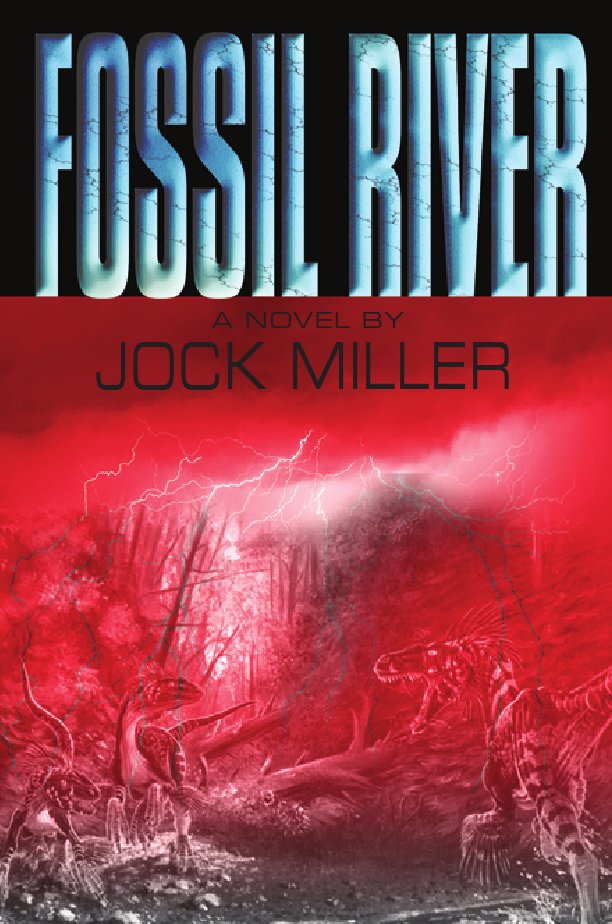
An action thriller by Jock Miller


Fossil fuel has an ageless affinity with dinosaurs. To create oil, dinosaurs died.


purchase on Amazon.com


The perfect energy storm is sweeping over the United States: Japan’s Fukushima nuclear plant meltdown has paralyzed nuclear expansion globally, BP’s Gulf of Mexico oil spill has stalled deep water drilling, Arab oil countries are in turmoil causing doubt about access to future oil, the intensity of hurricanes hitting the Gulf’s oil rigs and refineries has intensified due to global warming, and the nation’s Strategic Oil Supply is riding on empty.

As the energy storm intensifies, the nation’s access to Arab oil, once supplying over sixty percent of our fossil fuel, is being threatened causing people to panic for lack of gas at the pumps, stranding cars across the country and inciting riots.


The U.S. Military is forced to cut back air, land, and sea operations sucking up 58% of every barrel of oil to protect the nation; U.S. commercial airlines are forced to limit flights for lack of jet fuel; and businesses are challenged to power up their factories, and offices as the U.S. Department of Energy desperately tries to provide a balance of electric power from the network of aged power plants and transmission lines that power up the nation.

The United States must find new sources of domestic fossil fuel urgently or face an energy crisis that will plunge the nation into a deep depression worse than 1929.

The energy storm is very real and happening this very moment. But, at the last moment of desperation, the United States discovers the world’s largest fossil fuel deposit found in a remote inaccessible mountain range within Alaska’s Noatak National Preserve surrounding six and a half million acres.

Preventing access to the oil is a colony of living fossil dinosaurs that will protect its territory to the death.

Nobody gets out alive; nobody can identify the predator--until Dr. Kimberly Fulton, Curator of Paleontology at New York’s Museum of Natural History, is flown into the inaccessible area by Scott Chandler, the Marine veteran helicopter pilot who’s the Park’s Manager of Wildlife. All hell breaks loose when Fulton’s teenage son and his girlfriend vanish into the Park.


Will the nation’s military be paralyzed for lack of mobility fuel, and will people across America run out of gas and be stranded, or will the U.S. Military succeed in penetrating this remote mountain range in northwestern Alaska to restore fossil fuel supplies in time to save the nation from the worst energy driven catastrophe in recorded history?

______________________________________________________________________________________________________________________________________


Showing posts with label Fracking. Show all posts

Energy Trends: U.S. energy boom is unique, has risks.


Thanks to "fracking," the United States is reaching the top spot among world oil producers sooner than expected, and is "well on its way to realizing the American dream" of energy independence, the International Energy Agency (IEA) said.

"But this does not mean that the world is on the cusp of a new era of oil abundance," the IEA warned in its closely watched annual World Energy Outlook. Instead, the agency predicted that no other country will replicate the United States' success with hydraulic fracturing and other unconventional technologies that have led to the North American boom in oil and natural gas production.


IEA notes that there is a steep decline rate for shale oil and natural gas wells tapped by hydraulic fracturing, the unconventional technology that has been key to U.S. success. Maintaining high output will require continuous investment in drilling new wells to compensate for declines at existing ones, the agency said.

IEA notes that many nations hope to replicate U.S. success in fracking, and areas of Argentina, Russia, China, and the Middle East seem  promising. But "good geology alone is not sufficient to replicate the U.S. experience," the agency said. Outside of the United States, there's neither the legal environment nor the oil services industry capacity to make shale oil and gas development worth the cost. More than 6,000 wells were drilled for unconventional oil in the United States and Canada in 2012, and only 100 outside of North America.

Read more 

Shale Oil Boom Takes Hold on the Plains

An oil well in Cheyenne, Wyoming.
An oil rig on ranchland west of Cheyenne is among the first to tap into the Niobrara shale beneath Wyoming and Colorado, one of a score of new and renewed oil plays made possible through a combination of horizontal drilling and hydraulic fracturing.

Photograph by Mead Gruver, AP

The rolling high plains east of Colorado Springs saw plenty of change before the "landmen" came. Ranchland that once stretched three or four miles between homes filled in with residential developments on multi-acre lots, bringing more people and paved roads.
Then, about two years ago, came a rush of real estate negotiators, snapping up leases for potential shale oil drilling. "I've never seen anything like it," says Rick Davis, 53, whose grandfather started buying ranchland in the early 1900s in Colorado's eastern El Paso County.  "Turns out that land was right in the center of all the activity."

And it has thrust the Davis family into the middle of a boom in U.S. oil production. Oil exploration is moving to new corners of the country as drillers use a combination of technologies to tap crude that was always known to be there, but only now can be produced economically.

El Paso County, which had plenty of cattle but never a producing well, sits on the Niobrara shale. The geologic formation stretches from Colorado into Wyoming, while also touching parts of Nebraska and Kansas. The Niobrara is one of about a score of new and renewed oil plays made possible  through a combination of horizontal drilling and hydraulic fracturing.
Also called fracking, the sometimes controversial fracturing process mixes water with sand and chemicals to break up underground shale and release hydrocarbons. Gas producers early last decade combined fracking and horizontal drilling with outstanding results, significantly altering the U.S. energy picture and touching off major gas drilling booms in Texas, Louisiana, Colorado, Pennsylvania, and elsewhere.
Read More

Breaking Fuel From the Rock


Geologists long knew there was natural gas in the Marcellus shale formation, but thought it impossible to unlock. But producers in the last decade learned to mine this huge resource by drilling horizontally to reach a large surface area, then fracturing the rock with high-pressure water, sand, and lubricant chemicals.


View Interactive Here

U.S. Oil Fields Stage “Great Revival,” But No Easing Gas Prices

Mason Inman


Rigs like this one near Stanley, North Dakota, are an increasingly familiar sight in some parts of the United States, where the pace of oil drilling is at a 25-year high.  Photograph by Karen Bleier, AFP/Getty Images


The United States has long been seen as a nation in its twilight as an oil producer, facing a relentless decline that began when President Richard Nixon was in the White House. He and every president since pledged to halt the U.S. slide into greater dependence on foreign oil, but the trend seemed irreversible—until now. Forty-one years later, U.S. oil production is on the rise.

U.S. oil fields yielded an estimated 5.68 million barrels per day in 2011—their highest output since 2003, thanks largely to a surge of new production from shale oil that lies beneath the Great Plains. The rush so far is centered in North Dakota, where oil production has quadrupled since 2005, but drilling is set to spread across the prairie and beyond.

Read More