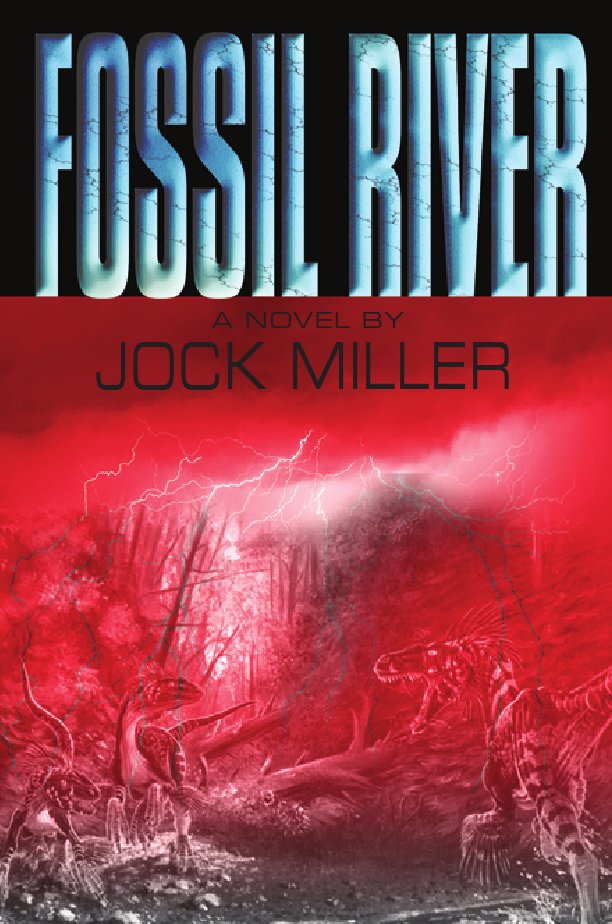
An action thriller by Jock Miller


Fossil fuel has an ageless affinity with dinosaurs. To create oil, dinosaurs died.


purchase on Amazon.com


The perfect energy storm is sweeping over the United States: Japan’s Fukushima nuclear plant meltdown has paralyzed nuclear expansion globally, BP’s Gulf of Mexico oil spill has stalled deep water drilling, Arab oil countries are in turmoil causing doubt about access to future oil, the intensity of hurricanes hitting the Gulf’s oil rigs and refineries has intensified due to global warming, and the nation’s Strategic Oil Supply is riding on empty.

As the energy storm intensifies, the nation’s access to Arab oil, once supplying over sixty percent of our fossil fuel, is being threatened causing people to panic for lack of gas at the pumps, stranding cars across the country and inciting riots.


The U.S. Military is forced to cut back air, land, and sea operations sucking up 58% of every barrel of oil to protect the nation; U.S. commercial airlines are forced to limit flights for lack of jet fuel; and businesses are challenged to power up their factories, and offices as the U.S. Department of Energy desperately tries to provide a balance of electric power from the network of aged power plants and transmission lines that power up the nation.

The United States must find new sources of domestic fossil fuel urgently or face an energy crisis that will plunge the nation into a deep depression worse than 1929.

The energy storm is very real and happening this very moment. But, at the last moment of desperation, the United States discovers the world’s largest fossil fuel deposit found in a remote inaccessible mountain range within Alaska’s Noatak National Preserve surrounding six and a half million acres.

Preventing access to the oil is a colony of living fossil dinosaurs that will protect its territory to the death.

Nobody gets out alive; nobody can identify the predator--until Dr. Kimberly Fulton, Curator of Paleontology at New York’s Museum of Natural History, is flown into the inaccessible area by Scott Chandler, the Marine veteran helicopter pilot who’s the Park’s Manager of Wildlife. All hell breaks loose when Fulton’s teenage son and his girlfriend vanish into the Park.


Will the nation’s military be paralyzed for lack of mobility fuel, and will people across America run out of gas and be stranded, or will the U.S. Military succeed in penetrating this remote mountain range in northwestern Alaska to restore fossil fuel supplies in time to save the nation from the worst energy driven catastrophe in recorded history?

______________________________________________________________________________________________________________________________________


Showing posts with label Gulf of Mexico. Show all posts

Ten New Studies Show Impact on Coast

Communities: Deep Ties, Deeper Pain

A man on a dock on Bayou La Batre, Alabama

 Photograph by Meggan Haller, Keyhole Photo/Corbis

A man takes a break from refurbishing a boat in Bayou La Batre, Alabama—one of the fishing communities deeply affected by the Gulf spill.

Although community attachment is generally seen as a positive that aids in resilience, researchers from Louisiana State University found the negative mental health impacts of the spill were greatest for longtime residents with complex social networks of relatives, friends, and acquaintances. This sense of connectedness, and the accompanying pain, was underscored as people also depended on local resources for their livelihood.

The study is one of the first to systematically collect and analyze public health data on coastal populations affected by the spill. In a late June 2010 telephone survey of 935 households living in the coastal portions of Plaquemines, La Fourche, and Terrebonne parishes, the study found individuals with stronger community attachment exhibited higher self-reported levels of anxiety, worry, nervousness and fear.

Under normal circumstances, community attachment promotes better physical and mental health, but in times of crisis it can be problematic as people's way of life is threatened, the researchers noted.

"In crisis conditions, among those whose resources are threatened, we find that community attachment is associated with higher levels of negative affect," said the study, published in October 2011 in the journal American Behavioral Scientist.

This held true even for people who were not directly employed by the fishing and oil industries, suggesting that community attachment is strong in this area, and that people felt concerned about others whose livelihoods were directly affected.

But attachment may aid in recovery in the long run. Study lead author Matthew Lee, associate vice chancellor in the Office of Research and Economic Development at LSU, said that follow-up surveys have demonstrated that residents who had high community attachment and increased distress early on, "over time, they also recovered more quickly than those who were not highly attached to their communities." He said the findings are consistent with survey results of people recovering from Hurricane Katrina.

—Stacey Schultz

Ten New Studies Show Impact on Coast

Dead Zone: Mixed Views

 Satellite view of Gulf of Mexico dead zone

 Photograph by NASA-GSFC, Science Faction/Corbis

 
Each September, a giant low-oxygen "dead zone" forms in the Gulf of Mexico as nutrients from agricultural runoff into the Mississippi River support the growth of oxygen-hungry algae, which can choke out other sea life. It can be seen here as the teal blue area along the Louisiana coastline.

A major question was whether this hypoxic area would be worsened by the assault of crude oil from the BP spill.

Researchers from Louisiana State University and the Louisiana Universities Marine Consortium concluded in a study published in February in Marine Pollution Bulletin that the net effect of the spill on the dead zone's size appeared to be "negligible."  The hypoxic area was 20,000 square kilometers in 2010, close to the size predicted in a new model the researchers developed. (The dead zone has ranged between 40 square kilometers and 22,000 square kilometers from 1985 through 2010, and has averaged 13,600 square kilometers, or 5,200 square miles.)

But the Louisiana researchers cautioned that Tropical Storm Bonnie, which crossed the Gulf during July 2010, may have had a great enough impact to disguise the impact of the crude oil on the Gulf dead zone.

When oil spilled into the Gulf from the Macondo well, that zone expanded, leading scientists to study the situation and offer a number of explanations.

Other scientists have noted impact from the BP spill on Gulf  oxygen levels. A study from the University of California, Santa Barbara, which appeared in the January 2012 issue of the journal Science indicated that abnormally large blooms of methane-consuming bacteria had reduced the Gulf of Mexico's methane and oxygen levels.

Barbara Mulligan

How Microbes Teamed to Clean Gulf Scientists Studied 52 Species of Bacteria and Water Currents to Explain Demise of Oil and Gas Plume

http://online.wsj.com

A fortuitous combination of ravenous bacteria, ocean currents and local topography helped to rapidly purge the Gulf of Mexico of much of the oil and gas released in the Deepwater Horizon disaster of 2010, researchers reported on Monday.

WSJ's Gautam Naik has details of study showing that more than 50 species of microbes consumed much of the oil and gas plume in the Gulf of Mexico caused by the 210 Deepwater Horizon disaster. AP Photo/Eric Gay

After spewing oil and gas for nearly three months, the BP PLC well was finally capped in mid-July 2010. Some 200,000 tons of methane gas and about 4.4 million barrels of petroleum spilled into the ocean. Given the enormity of the spill, many scientists predicted that a significant amount of the resulting chemical pollutants would likely persist in the region's waterways for years.

According to a new federally funded study published Monday by the National Academy of Sciences, those scientists were wrong. By the end of September 2010, the vast underwater plume of methane, plus other gases, had all but disappeared. By the end of October, a significant amount of the underwater offshore oil—a complex substance made from thousands of compounds—had vanished as well.

"There was a lot of doomsday talk," said microbiologist David Valentine of the University of California, Santa Barbara, and co-author of the study, published in Proceedings of the National Academy of Sciences. But it turns out "the ocean harbors organisms that can handle a certain amount of input" in the form of oil and gas pollutants, he said.

A year ago, Dr. Valentine and other scientists published a paper describing how bacteria that feed on naturally occurring oil and gas leaks underwater had apparently devoured much of the toxic chemicals released in the BP spill. That federally funded study, published in the journal Science, triggered disbelief among other researchers who questioned whether microbes could gobble up that much gas and oil so quickly.

Dr. Valentine and colleagues have now used a computer model to explain just how that scenario might have played out, though some scientists remain skeptical.

It was an intricate challenge. The first step was to estimate the flow rate of the various hydrocarbons from the well over the 87 days that the spill continued. The researchers identified 26 classes of such chemicals; they then had to figure out which of these chemicals stayed in the deep plume that remained more than 3,000 feet underwater, and which ones rose up to the surface. For example, in the plume, certain chemicals dissolved completely in the water, including the methane gas, while some of the oil droplets were atomized and remained suspended in the water. A lot of the surface oil evaporated or washed up on Gulf shorelines.

Next, the scientists set about identifying the main species of oil-and-gas-eating bacteria that lived in the deep Gulf. They identified 52 main species of such microbes. The scientists also estimated how quickly the bacteria consumed oil and gas and how much the bacteria colonies grew.

The final step was to model the complex movement of the water in the Gulf to determine where the oil and gas—and the bacteria—got transported. Igor Mezic, a colleague of Dr. Valentine's and also a co-author, had published a study in 2011 predicting where the BP oil slick had spread. That analysis included data from the U.S. Navy's model of the Gulf's ocean currents and observations of the water's movements immediately after the spill and for several months after it ended.

The UC Santa Barbara researchers decided to marry their two computer models—the one about the spill-eating bacteria with the one capturing the movement of water. When they ran the joint model, they found that it helped to explain the puzzle of the rapidly vanishing oil spill.

The model showed that the topography in the Gulf had played a vital role. Because the Gulf is bounded on three sides by land—north, east and west—the water currents don't flow in a single direction as in a river. Instead, the water sloshes around, back and forth, as if it were trapped in a washing machine.

An initial population of bacteria encountered the spill near the BP well, its population grew, and then it was swept away by the ocean currents. But when the water circled back—that washing-machine effect—it was already loaded with these hungry bacteria, which immediately went on the attack again, mopping up another round of hydrocarbons. These repeated forays over the BP well, by the ever-growing bacterial populations, sped up the rate at which the methane and offshore oil got devoured.

Dr. Valentine suggested that oil companies ought to ascertain the currents, water motion and native microbial community in the water before embarking on any major offshore drilling project. "Then, if there is an event, we'd be many steps ahead of understanding where the oil may go and what the environment's response may be," he said.

Ira Leifer, a petroleum geochemist also at UC Santa Barbara who co-wrote a rebuttal to the 2011 paper published in Science, said the latest study was limited because it was based on a computer model "which is only as good as the input or assumptions" on which it is based. He noted, for example, that the authors had neglected to include a discussion of whether the bacteria would run out of critical nutrients necessary for them to consume the oil and gas and reproduce.

The research was funded by the National Science Foundation, the Department of Energy and the Office of Naval Research.

Write to Gautam Naik at gautam.naik@wsj.com

Gulf Turtle Nests Abound, But Worries Remain

Watch National Geographics Video Here


Sea turtle nesting season is underway on Gulf of Mexico beaches, and observers say activity seems normal. But these aren't the same animals that nested during last year's Gulf oil spill, and scientists are concerned about a continued rise in turtle deaths.

UNEDITED TRANSCRIPT

The first sea turtle nesting season after the 2010 BP oil spill was contained is underway in the northern Gulf of Mexico. And biologists and turtle conservation groups report a good nesting season so far.

Last summer, as the ruptured well spewed an estimated 5 million barrels of oil into the Gulf, scientists and volunteers launched a risky rescue– moving fragile turtle eggs away from the oil danger.

Biologists and volunteers moved about 28,000 eggs , mostly loggerhead turtles, from Alabama and Florida’s Panhandle to NASA’s Kennedy Space Center. The goal was to spare the vulnerable hatchlings an encounter with the oil. It’s estimated around 14,000 hatchlings were released on Florida’s Atlantic coast.

The tiny turtles were not tagged, so no one really knows where they are now. And if they were spotted, they couldn’t be accurately identified.

Back on the Gulf Coast, it’s nesting season once again, and conservation groups like Alabama’s Share the Beach are finding new nests almost daily– an encouraging sign. But they caution not to read too much into the finds.

SOT: Mike Reynolds, Share the Beach Director

“The nests look normal, the turtles seem normal. So, all in all it seems like a pretty good year. Of course, the turtles that are nesting this year are not the turtles that nested last year. Turtles nest every other year or thereabout and so these turtles nested two years ago. What we will be really interested in seeing is a year from now when last year’s turtles that were here during the oil spill that had the greatest effect from the oil come back and nest on our beaches next year.

There are 5 species of sea turtles that nest on the beaches of the Gulf Coast, and all of them are protected, so, every morning Share the Beach volunteers comb Alabama’s coast, just as they’ve done every nesting season since 2001, looking for telltale signs of a turtle nest – crawl marks and churned up area near a nest site.

And biologists are doing a study as part of the Natural Resource Damage Assessment – attaching satellite tags to incoming mother turtles to monitor their movements.

When the patrols spot a fresh nest too close to the waterline, they move the eggs before they set and become more sensitive to movement. They carefully put the eggs in a new nest and cordon it off. Read More

© 2011 National Geographic; partially funded by NSF; field producing and videography by Fritz Faerber

Photos: One Year After Deepwater Horizon, Portraits of the Gulf Coast

A year after the devastating explosion aboard the Deepwater Horizon, the Gulf of Mexico is still reeling from the debilitating effects of the largest accidental oil spill in history. Photographer and CBS-affiliate videographer Jackson Fager traversed Louisiana’s coastline to document the seafaring men and women—shrimpers, fishermen, oystermen—many of whom have been stuck on dry land since the environmental tragedy. With a new fishing season on the horizon, Fager recalls the courage and perseverance that have kept them afloat for the past year.


By Jackson Fager•
As told to Lenora Jane Estes


http://www.vanityfair.com

... These fishermen remind me of American cowboys—among the most resilient and toughest individuals in the country. They think of themselves as a dying breed. Even before the oil spill, they were facing so many challenges—competition from overseas, hurricanes, fuel prices, and declining demand for their product. Then, when the oil spill happened, they were stripped of their very livelihood, their lifeblood. A lot of them have been out of work for the last year.

They’re such a unique collection of men and women from so many different ethnic backgrounds—Creole, Cajun, Native American, Vietnamese—and most of them are third- or fourth-generation fisherman. They’ve known no other way of life. What’s more, this is the only way of life they want to know. They’re also a people of many skills, out of necessity. If you want to be a commercial fisherman, you also have to be a carpenter, a plumber, and an electrician ...


READ MORE AND VIEW SLIDE SHOW HERE

Cables Suggest BP Near-Fiasco in '08


BY GUY CHAZAN

U.S. diplomatic cables released this week suggest that BP PLC narrowly averted potential disaster after a 2008 natural gas leak at a field it operates in Azerbaijan, about 18 months before the deadly Deepwater Horizon explosion in the Gulf of Mexico triggered the worst offshore oil spill in U.S. history.

The gas leak, which was disclosed in BP's 2008 annual report and was widely covered by news agencies at the time, occurred in the offshore Azeri-Chirag-Guneshli (ACG) field, Azerbaijan's largest, in September 2008. ...


Click Here To Continue Reading: Log In or Subscribe

Coast Guard Report Examines Oil in Sea Floor Near Blown-Out BP Well


By: Jenny Marder

A federal report released Friday detailed the levels of oil that remain lodged in sea floor sediment around the blown-out BP well in the Gulf of Mexico.

The oil was found in concentrations too small to collect in most areas, and below harmful levels. But the area spanning a mile and a half around the well had concentrations of oil mixed in with drilling mud at levels high enough to raise concerns about harming marine life. Chemical tests confirmed that it matched BP oil, and officials said there was no practical way to clean it.

"We are not finding any recoverable amounts of oil" on the seafloor, Rear Adm. Paul Zukunft said. "We are dealing with barely detectable amounts of oil in the parts per billion in many places."

The new findings were released by the Operational Science Advisory Team, a group formed in August to determine what happened to the 170 million gallons of oil that leaked into the Gulf. The report is based on a chemical analysis of nearly 17,000 water and sediment samples collected between May and October.

It also found that more oil detected in shallow waters along the coast could wash ashore.

Of the new findings, BP said: "The scientific evidence in this report is consistent with our observations that the beaches are safe, the water is safe, and the seafood is safe," Mike Utsler, BP's Unified Area Commander, said in a statement.

Government scientists said Friday's report was not an assessment of the spill's damage to the ecosystem, but rather a guide to help the Coast Guard and cleanup crews, according to an Associated Press report.

But many questions remain on the long-term fallout from the spill. Still unknown are the effects of the 1.8 million gallons of chemical dispersants sprayed into the ocean. Some tests have found chemicals contained in the dispersant in seafloor sediment, according to the Wall Street Journal. And scientists say they have found dead marine animals in areas where oil quantities were reported low.

We'll have more on the report's findings on the Rundown Monday.