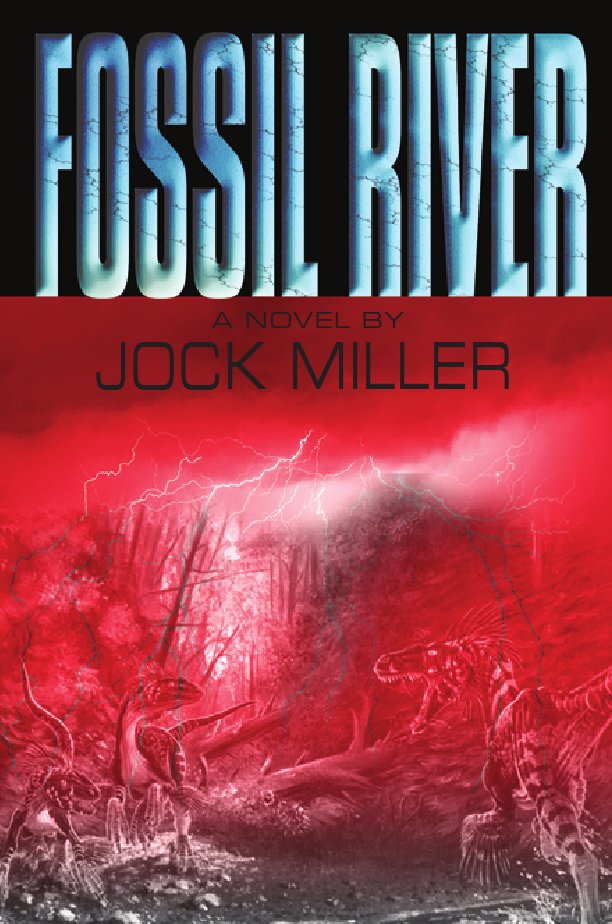
An action thriller by Jock Miller


Fossil fuel has an ageless affinity with dinosaurs. To create oil, dinosaurs died.


purchase on Amazon.com


The perfect energy storm is sweeping over the United States: Japan’s Fukushima nuclear plant meltdown has paralyzed nuclear expansion globally, BP’s Gulf of Mexico oil spill has stalled deep water drilling, Arab oil countries are in turmoil causing doubt about access to future oil, the intensity of hurricanes hitting the Gulf’s oil rigs and refineries has intensified due to global warming, and the nation’s Strategic Oil Supply is riding on empty.

As the energy storm intensifies, the nation’s access to Arab oil, once supplying over sixty percent of our fossil fuel, is being threatened causing people to panic for lack of gas at the pumps, stranding cars across the country and inciting riots.


The U.S. Military is forced to cut back air, land, and sea operations sucking up 58% of every barrel of oil to protect the nation; U.S. commercial airlines are forced to limit flights for lack of jet fuel; and businesses are challenged to power up their factories, and offices as the U.S. Department of Energy desperately tries to provide a balance of electric power from the network of aged power plants and transmission lines that power up the nation.

The United States must find new sources of domestic fossil fuel urgently or face an energy crisis that will plunge the nation into a deep depression worse than 1929.

The energy storm is very real and happening this very moment. But, at the last moment of desperation, the United States discovers the world’s largest fossil fuel deposit found in a remote inaccessible mountain range within Alaska’s Noatak National Preserve surrounding six and a half million acres.

Preventing access to the oil is a colony of living fossil dinosaurs that will protect its territory to the death.

Nobody gets out alive; nobody can identify the predator--until Dr. Kimberly Fulton, Curator of Paleontology at New York’s Museum of Natural History, is flown into the inaccessible area by Scott Chandler, the Marine veteran helicopter pilot who’s the Park’s Manager of Wildlife. All hell breaks loose when Fulton’s teenage son and his girlfriend vanish into the Park.


Will the nation’s military be paralyzed for lack of mobility fuel, and will people across America run out of gas and be stranded, or will the U.S. Military succeed in penetrating this remote mountain range in northwestern Alaska to restore fossil fuel supplies in time to save the nation from the worst energy driven catastrophe in recorded history?

______________________________________________________________________________________________________________________________________


Showing posts with label Video. Show all posts

Flying Texas reptile: World’s oldest Pteranodon?


Fossilized bones discovered in Texas from a flying reptile that died 89 million years ago may be the earliest occurrence of the prehistoric creature known as Pteranodon.

Pteranodon was a type of pterosaur that lived about the same time as some dinosaurs, about 100 million to 65 million years ago. The only reptiles to dominate the ancient skies, pterosaurs had broad leathery wings and slim torsos.


The specimen identified by Myers is an adult pterosaur of the toothless variety and while larger than most birds, wasn’t among the largest pterosaurs, Myers said, noting it had a wing span between 12 and 13 feet, or 3.6 to 4 meters. It was discovered in the Austin Group, a prominent rock unit in Texas that was deposited around 89 million years ago, early in the geological time period called the Late Cretaceous.

Key to identifying the SMU fossils as Pteranodon is a humerus of 5.7 inches, or 14.5 centimeters. The humerus is the uppermost bone in the wing and attaches to the torso. The humerus of the SMU specimen, while complete, did suffer some damage during fossilization when it became compressed and distorted through millions of years of compaction.

“If it wasn’t crushed so badly, it would be possible to determine if it really is Pteranodon,” Myers said. “These bones are easily flattened. They are hollow inside, because they have to be lightweight to allow a pterosaur to fly. So they compress like a pancake as they’re embedded in layers of rock.”

While it’s difficult to narrow the humerus definitively to a specific genus and species, some features clearly identify the specimen as part of the Pteranodontidae family, most likely the genus Pteranodon. It exhibits, for example, the prominent warped deltopectoral crest that is characteristic of members of the Pteranodontidae family, called pteranodontids, he said.

Discovered along with the humerus were parts of the elongated fourth finger that in pterosaurs forms the wing. The SMU specimen’s metacarpal — at 20 centimeters — is incomplete, missing an estimated 37 percent of its length.


Read more

Century-Old Bone Wars Fossil Dispute Unearthed From University Archives


Robert T. Hill
America has seen its share of wars, but did you hear about the Bone Wars? The late 1800s found archeologists digging furiously throughout the newly settled American west in a mad dash to find fossils. This lead to fighting in academic circles, and occasionally in the field itself, over disputes that became known as the Bone Wars.
Leading the search in western Texas were geologist Robert T. Hill, now acclaimed as the Father of Texas Geology, and naturalist Jacob Boll, who made many of the state´s earliest fossil discoveries, writes Margaret Alle for Southern Methodist University (SMU).
Jacob Boll


Both Hill and Boll had supporting roles in the Bone Wars through their work for one of the feud´s antagonists, Edward Drinker Cope, according to a new study by vertebrate paleontologist Louis L. Jacobs. The study by Jacobs expands knowledge about Cope´s work with Hill and Boll.


The study unveils new details about the Bone Wars in Texas that Jacobs deciphered from 13 letters written by Cope to Hill, discovered in an archive of Hill´s papers at SMU´s DeGolyer Library. The letters span seven years, from 1887 to 1894.

Working for the U.S. Geological Survey, Hill not only provided Cope with fossils of interest but also shared geological information about fossil locales. Boll, who was a paid collector for Cope – as was the practice at the time – supplied the well-known paleontologist with many fossils from Texas.

“Fossils collected by Boll and studied by Cope have become some of the most significant icons in paleontology,” said Jacobs, an SMU professor of earth sciences and president of SMU´s Institute for the Study of Earth and Man.

The Bone Wars were financed and driven by Cope and his archenemy, Othniel Charles Marsh, during a period of intense fossil collecting. The two were both giants of paleontology with a very public feud that brought the discovery of dinosaur fossils to the forefront of the American psyche.

The two began their scientific quests as a friendly endeavor to discover fossils. They each prospected the American frontier and also hired collectors to supply them with specimens. Over the years, Cope and Marsh identified and named hundreds of discoveries and published their results in scientific journals.

Their competition, however, evolved into a costly, self-destructive, vicious all-out war to see who could outdo the other. Despite their aggressive and sometimes unethical tactics to outwit one another and steal each other´s hired collectors, Cope and Marsh made major contributions to the field of paleontology, Jacobs said.

Born in 1858, Hill was a teenager when he left Tennessee as an orphan and arrived on the Texas frontier in 1874, eventually earning a Bachelor of Science in geology from Cornell and working as a field geologist for the U.S. Geological Survey (USGS).

Hill was the first to identify and map the distinct rock formations in North Texas that correspond to the Earth´s Cretaceous geologic period, Jacobs said. For much of the Cretaceous, a shallow sea cut North America in half from the Arctic to the Gulf of Mexico. Dinosaurs roamed the coastal shoreline and huge reptiles swam the waters.

Through his reading of the letters, Jacobs found that Cope disagreed with the way Hill named the Cretaceous rock units, and told him so. Cope counseled Hill: “You mustn´t mind criticism. We all get it and get used to it; but it isn´t comfortable at first.”

In subsequent letters, said Jacobs, it´s apparent Hill had changed his approach, for which Cope offered him high praise: “I wish to say definitely that your discovery of the lower Cretaceous series in this country is the most important addition to our geology that has been heard for a long time.”

Cope´s other Texas connection was through Jacob Boll, a much larger supplier to Cope who ultimately made significant contributions to the field of paleontology. Boll “is mentioned, usually in passing, in virtually every history of the subject,” according to Jacobs.

Born in 1828 in Switzerland, Boll was the first to discover vertebrate fossils in the Permian red beds along the drainages of the Wichita and Red rivers and their tributaries. “The discoveries opened up an entirely new chapter in vertebrate evolution some 280 million years old,” Jacobs said. “Boll´s finds include some of the oldest close relatives of mammals whose evolution eventually led to humans.”

While Hill and Boll were linked by their relationship to Cope, it isn´t known whether the two of them ever met, according to Jacobs. “Hill and Boll both made major contributions to frontier science at an important time in American history,” Jacobs said. “They may have been nearly forgotten, but their lives have influenced much that came later.”

At least one scholar has asserted that Cope – to keep the identity of his collectors secret from Marsh – never credited Boll for the Texan´s many fossil discoveries. Jacobs, however, found evidence that in 1878 Cope, in fact, did acknowledge Boll´s contribution, at least for the big-headed, semi-aquatic amphibian Eryops. Cope wrote that the fossil was “found “¦ by my friend Jacob Boll.”

During a break in his field labors, Boll´s fascination with ancient bones prompted him to write in his native German an ode to fossils. Jacobs found the poem in the American Museum of Natural History on a label on the back of Eryops specimen No. AMNH 4183.

SMU biology professor Pia Vogel translated the poem. Vogel and Jacobs worked with SMU English professor John M. Lewis to retain the essence of the poem in English.

“Now you will with some few others
Trek to the professor´s seat.
Awakened through his careful thought,
Be reassembled from your fragments,
To tell to others yet to come
From the sculpting of your teeth
How you lived and disappeared,
Name you he will, and what he found.”


Source: John Neumann for redOrbit.com – Your Universe Online


Reposted from RedOrbit

Solar Prospecting

Solar power is measured by insolation. The insolation rating of a particular area is the amount of solar radiation to hit the ground in a specific time period. This is usually figured in terms of kilowatt-hours per square meter per day (kWh/m2/day). A high insolation rating is a good indicator of a town"s potential for supplementing traditional power plants with solar energy.


Reposted from Curiosity.com

Toxic Land Generates Solar Energy


New Jersey is turning eyesores into solar farms. The U.S. state has become a leader in solar energy capacity. Energy from the sun now comes from contaminated land not suitable for development.

Biofuels at a Crossroads: Perspectives Brett Lund Executive Vice President and General Counsel for GEVO

As part of National Geographic’s Great Energy Challenge initiative, they've brought together two dozen experts from industry, academia, and environmental organizations to discuss whether biofuel can be a sustainable part of a cleaner energy future.


For more, visit greatenergychallenge.com.

Brett Lund, Executive Vice President and General Counsel for GEVO, talks about how next generation isobutanol can replace ethanol as the primary substitute for petroleum products.

See More

Biofuels at a Crossroads: Perspectives Joe Fargione, The Nature Conservancy

As part of National Geographic’s Great Energy Challenge initiative, they've brought together two dozen experts from industry, academia, and environmental organizations to discuss whether biofuel can be a sustainable part of a cleaner energy future.


For more, visit greatenergychallenge.com.

Joe Fargione, Science Director for the North American Region of The Nature Conservancy, tells us how drop-in transportation fuel can be made from biological wastes and residues, reducing land use.

See More

A Billionaire's Bet on Biofuels

Investor Vinod Khosla Bets on "Drop-in" Biofuels 


Silicon Valley investor Vinod Khosla says the risks posed by climate change are on par with those of nuclear terrorism and proliferation, in terms of their potential scope and harm. He argues that biofuels are the cheapest way to scale up a solution to cut greenhouse gas emissions from transportation. He believes the answer isn't ethanol, but biofuels that are chemically identical to today's gasoline and diesel ... like those made from wood chips.

Read More


The Four Winged Dinosaur: Microraptor


 The discovery of a beautiful and bizarre fossil astonished scientists and reignited the debate over the origin of flight. With four wings and superbly preserved feathers, the 130 million-year-old creature was like nothing paleontologists had ever seen before.


The Hidden Costs of Hamburgers

Americans love hamburgers -- we eat about three burgers a week. But what are the hidden environmental costs? See sources from the Center for Investigative Reporting


Directed and produced by Carrie Ching, Reported by Sarah Terry-Cobo and Carrie Ching, Illustrated and animated by Arthur Jones.

Vermont Cow Power!

CVPS Cow Power™ offers significant benefits to CVPS electric customers, participating Vermont farmers and the environment, and furthers state policy. Some customers want to reduce their reliance on non-renewable energy, so providing customers with a renewable energy choice is important. 

Cow Power will provide a new income stream to participating farmers, help reduce some of the water quality impacts of farming through the introduction of innovative manure management technologies, and significantly reduce manure odors, particularly during spreading. Participating farms may also reduce bedding costs by using dry byproducts of the process in place of sawdust or other bedding. Funds not supporting farm methane power will support other renewable generation resources.

Dinosaur Tracking

 Watch a video illustration of what scientists can learn from footprints

Electricity From Spinach

Don't eat your spinach. Put it on your solar panel instead.


OK, that's not actually advisable. However, it is true that the latest attempt to put photosynthesis to work to produce electricity finds researchers at Vanderbilt University reporting big gains with a new concept that uses a protein found in spinach in combination with carefully formatted silicon.

The research at Vanderbilt uses a specific protein involved in photosynthesis called photosystem 1, which was discovered 40 years ago and apparently quickly seduced solar researchers with its ability to convert sunlight into electrical energy with nearly 100 percent efficiency, according to Vanderbilt.

That the stuff is cheap and plentiful – it can be extracted from the rapidly growing kudzu vine, not just 99-cents-a-bunch spinach – compared to common microelectronic materials only increased the lure, according to Vanderbilt.


Read More

Powering The Future: Electricity


The early days of electric power are long behind us, but the principles remain the same: spin a wheel, add a magnet, and you can create an electricity machine -- a generator.

Afghan Energy


Without a national power grid, some isolated communities in Afghanistan rely on wind and solar systems to generate affordable energy.    

 Read More

What is the Future of Energy?

Courtesy of: Cambridge University


Three academics look at wind power, carbon capture and storage and material efficiency as examples of how we can cut our C02 emissions


Read More

Croc Fossil Found in Cave


© 2011 National Geographic; Original video produced by: Phillip Lehman, Dominican Republic Speleological Society and Aquavista Films

Croc Fossil Found in Cave

September 26, 2011—A skeleton of a possibly extinct crocodile is among several fossil surprises unearthed in freshwater caves of the Dominican Republic, paleontologists say.

Invention Nation: Revolving Door Generator


Two engineers are working on a way to save all the lost energy wasted when people push though the thousands of revolving doors in New York City.


http://science.discovery.com