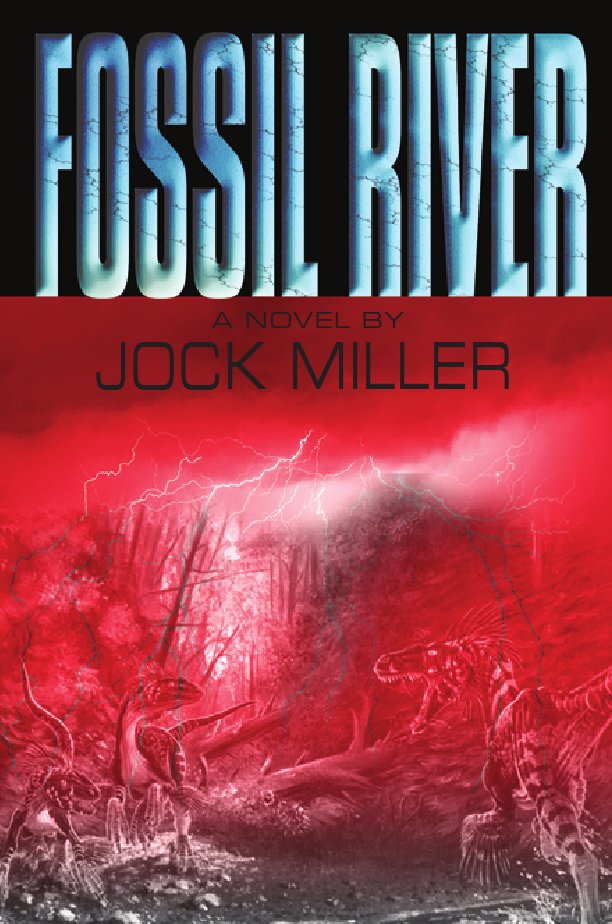
An action thriller by Jock Miller


Fossil fuel has an ageless affinity with dinosaurs. To create oil, dinosaurs died.


purchase on Amazon.com


The perfect energy storm is sweeping over the United States: Japan’s Fukushima nuclear plant meltdown has paralyzed nuclear expansion globally, BP’s Gulf of Mexico oil spill has stalled deep water drilling, Arab oil countries are in turmoil causing doubt about access to future oil, the intensity of hurricanes hitting the Gulf’s oil rigs and refineries has intensified due to global warming, and the nation’s Strategic Oil Supply is riding on empty.

As the energy storm intensifies, the nation’s access to Arab oil, once supplying over sixty percent of our fossil fuel, is being threatened causing people to panic for lack of gas at the pumps, stranding cars across the country and inciting riots.


The U.S. Military is forced to cut back air, land, and sea operations sucking up 58% of every barrel of oil to protect the nation; U.S. commercial airlines are forced to limit flights for lack of jet fuel; and businesses are challenged to power up their factories, and offices as the U.S. Department of Energy desperately tries to provide a balance of electric power from the network of aged power plants and transmission lines that power up the nation.

The United States must find new sources of domestic fossil fuel urgently or face an energy crisis that will plunge the nation into a deep depression worse than 1929.

The energy storm is very real and happening this very moment. But, at the last moment of desperation, the United States discovers the world’s largest fossil fuel deposit found in a remote inaccessible mountain range within Alaska’s Noatak National Preserve surrounding six and a half million acres.

Preventing access to the oil is a colony of living fossil dinosaurs that will protect its territory to the death.

Nobody gets out alive; nobody can identify the predator--until Dr. Kimberly Fulton, Curator of Paleontology at New York’s Museum of Natural History, is flown into the inaccessible area by Scott Chandler, the Marine veteran helicopter pilot who’s the Park’s Manager of Wildlife. All hell breaks loose when Fulton’s teenage son and his girlfriend vanish into the Park.


Will the nation’s military be paralyzed for lack of mobility fuel, and will people across America run out of gas and be stranded, or will the U.S. Military succeed in penetrating this remote mountain range in northwestern Alaska to restore fossil fuel supplies in time to save the nation from the worst energy driven catastrophe in recorded history?

______________________________________________________________________________________________________________________________________


Showing posts with label 10 Worst Energy-Related Disasters of 2011. Show all posts

10 Worst Energy-Related Diasters of 2011

1. Fukushima Nuclear Disaster 


Image credit: Thierry Ehermann via Flickr.


On March 11, 2011, following a 9.0 magnitude earthquake and a tsunami that rocked Japan, the world witnessed its worst nuclear catastrophe since Chernobyl. The damage caused by the earthquake and tsunami led to three explosions at the Fukushima Daiichi nuclear power plant. The explosions at the plant produced radiation levels 100 times above safety standards. The International Nuclear Events Scale gave the Fukushima disaster its highest rating (7) in terms of severity -- only Chernobyl has received an accident rating 7. Six Fukushima workers have died from serious exposure to radiation and the clean up costs are an estimated US$13 billion. Since the accident, several countries have beefed up nuclear regulations, while others such as Switzerland and Germany have abandoned the technology all together. 


Read More

10 Worst Energy-Related Disasters of 2011

2. Northern Russia Oil Leaks
Image credit: Greenpeace

Labelled the world's "worst ecological oil catastrophe," Russia's oil industry spills an estimated 30 million barrels of oil every year -- this is the equivalent of a Deepwater Horizon oil spill every two months. Experts estimate that 10%-15% of this oil gets spilled into rivers, with half a million tons spilling into the Arctic Ocean annually. Seeping through rusted pipes and old wells, this continuous oil leak wreaks havoc on rivers, plant life, and animal habitat. The latest data shows that in 2010, Russia was home to 18,000 oil leaks.


Read More

10 Worst Energy-Related Disasters of 2011

 3. Offshore Oil Spill in the Niger Delta


Satellite image of the 350 mile oil slick caused by the Shell oil leak in the Niger Delta. Image credit: Skytruth


On December 20, 2011, a major leak occurred at an offshore oil platform operated by Royal Dutch Shell off the coast of Nigeria. A break in the flexible line which transports oil from the vessel onto oil tankers led to 40,000 barrels of oil being leaked into the ocean. Nigerian regulators have told Parliament Shell should be fined US$5 billion for the environmental damage caused by its spill -- considered the largest in Nigeria in the last ten years. The Taipei Times reports that over its 50 year history of extracting oil in Nigeria, shell has spilled 550 million gallons into the Niger Delta.

 
Read More

10 Worst Energy-Related Disasters of 2011

 4. Pipeline Explosion in Kenya


 On September 12, 2011, a fuel pipeline exploded in a densely populated area of Nairobi. The explosion was so powerful it flattened homes and reduced some bodies to dust. According to the Red Cross, at least 75 people were killed in the explosion, while other reports suggest more than 100 people died. 118 people were admitted to hospitals with injuries from the blast. The exact cause of the explosion has not been determined. Police believe the pipeline may have been punctured in an effort to steal fuel. Meanwhile, Prime Minister Raila Odinga says a mechanism on the pipeline failed, allowing fuel to spill into a drainage ditch where it ignited -- most likely the result of a lit cigarette. Odinga called the explosion the "worst energy-related disaster in Kenya's history."


Read More

10 Worst Energy-Related Disasterf of 2011

5.  Oil Spill in Northwestern Alberta


Image credit: Rogu Collecti/Greenpeace


On April 29, 2011, Alberta suffered its worst oil spill in 36 years when a pipeline broke spilling 28,000 barrels of oil into a remote area of the boreal forest. The spill occurred just 300 meters from local waterways. The Lubicon Cree Nation is settled 10-kilometers east of the spill. The town of 300 was enveloped by odours which caused several members of the community to become sick. It took five days before Alberta Environment Minister Rob Renner became aware residents were being adversely affected by the spill. Even then, he "could not say for sure" if the odour making residents sick was coming from the spill.


Read More

10 Worst Energy-Related Disasters of 2011

 6. Coal Mine Blast in Pakistan


Image credit: Ahmad Saleem

On March 20, 2011, a series of three methane gas explosions occurred in a coal mine in Baluchistan, Pakistan. 43 miners were killed in the blast. It is reported that two people survived the disaster by not going into the mine that day. The mine is owned by the state-run Pakistan Mineral Development Corporation and was leased to a contractor. Two weeks prior to the explosion, the contractor had been asked to shut the mine down due to an excessive accumulation of methane gas.

Read More

10 Worst Energy-Related Disasters of 2011


7. Coal Mine Explosion in China

Lao Ye Temple Coal Mine Shaft. Image credit : LHOON via Flickr

On October 29, 2011, a gas explosion at the Xialiuchong Coal Mine in Hengyan, Hunan killed 29 miners and injured 6 others. Accidents at coal mines in China are not uncommon, as many mines disregard safety standards. In 2011, 1,973 miners were killed in accidents.  The government, however, continues to increase its safety measures, and the actions are having a positive effect -- the 2011 death total was 19% lower than that of 2010.


Read More

10 Worst Energy-Related Disasters of 2011

8. North Sea Oil Spill


The Gannet Alpha platform. Image credit: Royal Dutch Shell

On August 10, 2011, an oil leak was discovered on the Gannet Alpha offshore oil platform operating off the coast of Scotland. The leak spilled 1,300 barrels of oil into the North Sea. The Gannet Alpha is owned by Exxon and Shell. Although much smaller than other international oil spills such as BP's in the Gulf of Mexico or Shell's in the Niger Delta, this spill is the largest the North Sea has seen in the last ten years. Research by The Guardian shows there are an average of 294 spills in the North Sea every year. However, the spill in August 2011 was more than four times larger than all of the oil spills combined in the North Sea in 2009.

Read More

10 Worst Energy-Related Diasters of 2011

9. Coal Mine Explosion, Salinas, Mexico

Young Mexican miner hauling coal out of a mine shaft. Image credit: Mexico National Commission on Human Rights.

On May 3, 2011, a coal mine in Sabinas, Mexico exploded killing 14 miners and injuring one. Safety standards in Mexico's coal industry are less than adequate. Small coal mines often escape inspection and fall outside of any regulation. Workers are usually teenagers under 18, equipped with basic tools and no helmets. As a result, major accidents such as the one in Sabinas are not uncommon. In 2006, a coal mine explosion killed 65 miners -- the worst in Mexico's history. Since 2006, it is believed another 40 people have been killed in local mines.


Read More

10 Worst Energy-Related Disasters of 2011

10. Rena Oil Spill Off Coast of New Zealand


Image credit: Jeanfrancois Beausejour via Flickr


On October 5, 2011, a cargo ship ran itself aground in the Astrolabe Reef. Carrying 1,700 tons (83,300 barrel equivalent) of oil onboard, the 775-foot Rena leaked almost one-quarter of its fuel, 400 tons (28,000 barrels) into the ocean. The spill led to beach closures and the death of thousands of birds, fish, and other sea-life. 

Rena's spill has been labelled New Zealand's Worst Maritime Environmental disaster of all time.

Read More