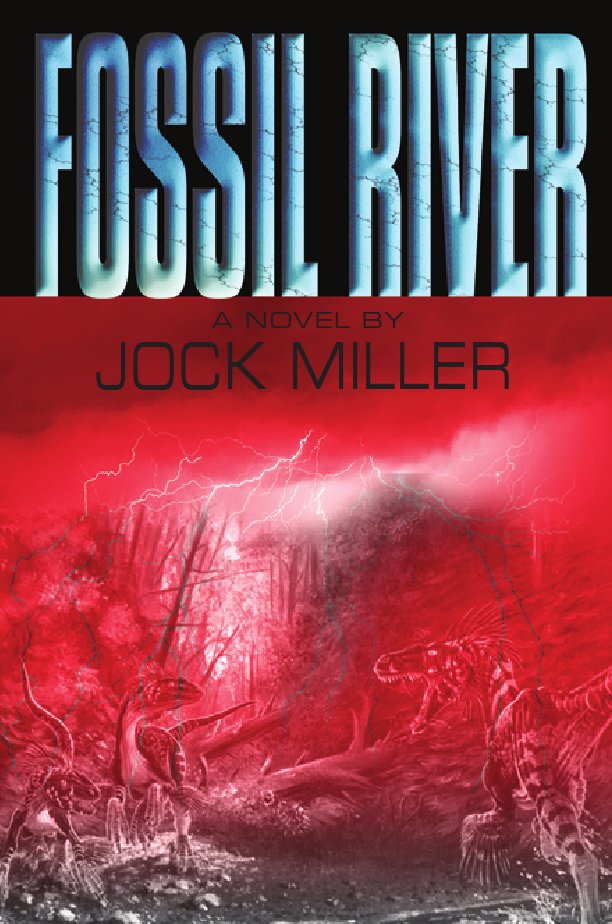
An action thriller by Jock Miller


Fossil fuel has an ageless affinity with dinosaurs. To create oil, dinosaurs died.


purchase on Amazon.com


The perfect energy storm is sweeping over the United States: Japan’s Fukushima nuclear plant meltdown has paralyzed nuclear expansion globally, BP’s Gulf of Mexico oil spill has stalled deep water drilling, Arab oil countries are in turmoil causing doubt about access to future oil, the intensity of hurricanes hitting the Gulf’s oil rigs and refineries has intensified due to global warming, and the nation’s Strategic Oil Supply is riding on empty.

As the energy storm intensifies, the nation’s access to Arab oil, once supplying over sixty percent of our fossil fuel, is being threatened causing people to panic for lack of gas at the pumps, stranding cars across the country and inciting riots.


The U.S. Military is forced to cut back air, land, and sea operations sucking up 58% of every barrel of oil to protect the nation; U.S. commercial airlines are forced to limit flights for lack of jet fuel; and businesses are challenged to power up their factories, and offices as the U.S. Department of Energy desperately tries to provide a balance of electric power from the network of aged power plants and transmission lines that power up the nation.

The United States must find new sources of domestic fossil fuel urgently or face an energy crisis that will plunge the nation into a deep depression worse than 1929.

The energy storm is very real and happening this very moment. But, at the last moment of desperation, the United States discovers the world’s largest fossil fuel deposit found in a remote inaccessible mountain range within Alaska’s Noatak National Preserve surrounding six and a half million acres.

Preventing access to the oil is a colony of living fossil dinosaurs that will protect its territory to the death.

Nobody gets out alive; nobody can identify the predator--until Dr. Kimberly Fulton, Curator of Paleontology at New York’s Museum of Natural History, is flown into the inaccessible area by Scott Chandler, the Marine veteran helicopter pilot who’s the Park’s Manager of Wildlife. All hell breaks loose when Fulton’s teenage son and his girlfriend vanish into the Park.


Will the nation’s military be paralyzed for lack of mobility fuel, and will people across America run out of gas and be stranded, or will the U.S. Military succeed in penetrating this remote mountain range in northwestern Alaska to restore fossil fuel supplies in time to save the nation from the worst energy driven catastrophe in recorded history?

______________________________________________________________________________________________________________________________________


Showing posts with label Alaska. Show all posts

The Frozen Frontier: Is Shell Ready For The Risks Of Arctic Drilling?

Guest blog authored by Jim Coburn, who directs Ceres’s corporate sustainability disclosure program:


Just two years after BP’s Deepwater Horizon rig exploded in the Gulf of Mexico, another oil industry giant is poised to begin drilling in an even more forbidding, unpredictable and remote environment: the Alaskan shoreline.Shell is moving forward with at least two Arctic wells this year, at a time when confidence in the oil and gas industry’s risk management practices is remarkably low.

In the wake of the Deepwater Horizon disaster, several reports have found that many oil and gas companies—not just BP—were poorly managing the risks of offshore drilling. As it prepares to move into the Arctic, has Shell set itself apart from its competitors, or is the company taking avoidable risks in an unforgiving environment?

A new report by Ceres shows that oil and gas companies—Shell included—are not doing enough to manage offshore drilling risks and disclose their efforts to investors. The report, Sustainable Extraction?, examines risk disclosure in SEC filings submitted in the first quarter of 2011 by 10 of the world’s largest oil and gas companies. It finds that out of 50 deepwater risk disclosure scores on key metrics including spill response procedures and drilling risk management, only four scores were good, and 29 (nearly 60 percent) were poor or no disclosure.

This striking lack of disclosure makes it nearly impossible for investors to understand how companies are managing the range of potential drilling risks.  And investors are already wary.

Lloyd’s, the world’s largest insurance market, cautions that “the Arctic is a frontier unlike any other” that will “remain a complex risk environment.” In its Arctic Opening report, Lloyd’s highlights geographic remoteness, ongoing changes to the environment as a result of climate change and extreme weather as key risk factors of offshore drilling in the Arctic.

Read More

New and Frozen Frontier Awaits Offshore Oil Drilling


Jim Wilson/New York Times 

More Details Here

Loch Ness Monster-Like Animal Filmed in Alaska?


The alleged sea serpent has a long neck, a horse-like head, large eyes and back bumps that stick out of the water.

By Jennifer Viegas


A still from a video that claims to show footage of Alaska's version of a Loch Ness monster.

A video from 2009 shows something mysterious moving across the surface of the sea that resembles an Alaskan version of the Loch Ness monster.

Some are claiming that the animal is a "Cadborosaurus," a type of reptile or lizard that got its name from Cadboro Bay, in British Columbia. They say that what's in the video is a sea serpent that dwells in the North Pacific and possibly other regions.

Accounts generally describe it as having a long neck, a horse-like head, large eyes, and back bumps that stick out of the water.


Read More

Oil Fight: Conservationists vs. Shell in Alaska


Green groups worry how oil drilling may affect whales and seals; feds say any risk is negligible.

By Eric Niiler


The endangered bearded seal is one mammal that lives in the area that conservationists are concerned might be affected by Shell's plans.

Federal officials say oil drilling in the Arctic Ocean will have "a negligible impact" on the region's endangered whales and seals, but conservationists say the report fails to account for the long-term effects of oil development on marine wildlife and ignores lessons from the Gulf of Mexico oil spill.

The National Marine Fisheries Service released a 54-page report assessing the risks to marine mammals from drilling planned for several sites in the Chukchi and Beaufort Seas north of Alaska. Shell wants to drill beginning in July 2012.


Read More

Why? Tell Me Why!: Alaska Greenhouse Gas Emissions


For its small population, Alaska is one of the biggest emitters of greenhouse gases. This week Kasey-Dee Gardner finds out why.

Why? Tell Me Why!: Alaska Oil


After spending a week in Alaska, Discovery News' Kasey-Dee Gardner wanted to find out why the state is so abundant in that resource.

Denali National Park Alaska


Wild and primitive Denali National Park encompasses about 9500 square miles (approximately 6 million acres). And year after year, many visitors travel to Denali Park, making it one of the top Alaska travel destinations. Roughly 400,000 travelers journey to the park every year, between late May and early September.
Denali National Park is located about 240 miles north of Anchorage and 120 mile south of Fairbanks on the George Parks Highway. No Alaska vacation would be complete without a trip to Denali Park.