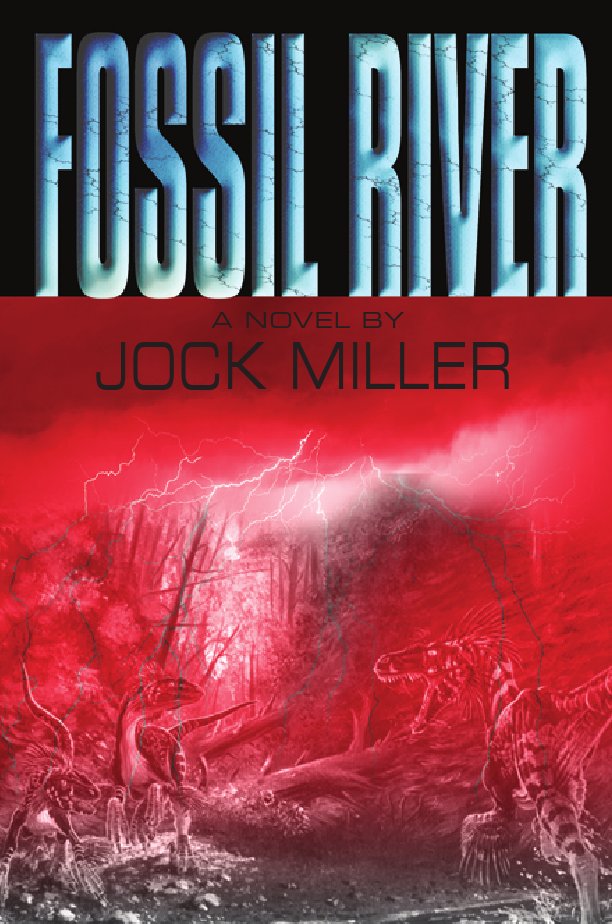
An action thriller by Jock Miller


Fossil fuel has an ageless affinity with dinosaurs. To create oil, dinosaurs died.


purchase on Amazon.com


The perfect energy storm is sweeping over the United States: Japan’s Fukushima nuclear plant meltdown has paralyzed nuclear expansion globally, BP’s Gulf of Mexico oil spill has stalled deep water drilling, Arab oil countries are in turmoil causing doubt about access to future oil, the intensity of hurricanes hitting the Gulf’s oil rigs and refineries has intensified due to global warming, and the nation’s Strategic Oil Supply is riding on empty.

As the energy storm intensifies, the nation’s access to Arab oil, once supplying over sixty percent of our fossil fuel, is being threatened causing people to panic for lack of gas at the pumps, stranding cars across the country and inciting riots.


The U.S. Military is forced to cut back air, land, and sea operations sucking up 58% of every barrel of oil to protect the nation; U.S. commercial airlines are forced to limit flights for lack of jet fuel; and businesses are challenged to power up their factories, and offices as the U.S. Department of Energy desperately tries to provide a balance of electric power from the network of aged power plants and transmission lines that power up the nation.

The United States must find new sources of domestic fossil fuel urgently or face an energy crisis that will plunge the nation into a deep depression worse than 1929.

The energy storm is very real and happening this very moment. But, at the last moment of desperation, the United States discovers the world’s largest fossil fuel deposit found in a remote inaccessible mountain range within Alaska’s Noatak National Preserve surrounding six and a half million acres.

Preventing access to the oil is a colony of living fossil dinosaurs that will protect its territory to the death.

Nobody gets out alive; nobody can identify the predator--until Dr. Kimberly Fulton, Curator of Paleontology at New York’s Museum of Natural History, is flown into the inaccessible area by Scott Chandler, the Marine veteran helicopter pilot who’s the Park’s Manager of Wildlife. All hell breaks loose when Fulton’s teenage son and his girlfriend vanish into the Park.


Will the nation’s military be paralyzed for lack of mobility fuel, and will people across America run out of gas and be stranded, or will the U.S. Military succeed in penetrating this remote mountain range in northwestern Alaska to restore fossil fuel supplies in time to save the nation from the worst energy driven catastrophe in recorded history?

______________________________________________________________________________________________________________________________________


Environmental damages remain issue after BP deal

By


BP's settlement with plaintiffs suing the company over the 2010 oil spill disaster in the Gulf of Mexico may address harm to individuals and businesses, but there is nothing in it that compensates the public for damage to its natural resources and environment, the Justice Department said Saturday.
That's a potentially critical issue because a separate victims' claims fund that was set up months after the Deepwater Horizon rig explosion was also meant to cover environmental damages, but it's now expected to be used to cover the BP settlement with plaintiffs. BP said it expects to pay out $7.8 billion in the settlement with the plaintiffs that was announced Friday.

It's not clear whether environmental claims will now have to be addressed separately between BP and the U.S. government, or whether it will be rolled up into their ongoing discussions over settling the fines and penalties that the British company faces. Both issues also could be resolved at an eventual civil trial, which has now been postponed indefinitely.

The Justice Department noted that the settlement doesn't address "significant damages" to natural resources and the environment.
Read More

Walking With Dinosaurs


Many reptile species died during the K-T event, but snakes, lizards and the crocodilians persevered. Crocodilians have been on the planet for about 240 million years. There are 23 crocodilian species today, including alligators, crocodiles and caimans. Mesozoic crocodilians were generally larger than living species. Another prehistoric order of reptiles is the sphenodontians. Today, there is one living sphenodontian -- the tuatara, which lives in New Zealand.


The tuatara (Sphenodon punctatus) is the only surviving species of an order that flourished 200 million years ago in New Zealand.   Konrad Wothe/Minden Pictures/Getty Images 


The first mammals were monotremes, or mammals that reproduce by laying eggs. Mammals are common today, but only three monotreme species still exist. These are the duck-billed platypus and a couple of spiny anteaters, or echidnas.


A zookeeper cradles rare twin platypus babies. The platypus is one of the few remaining monotremes on Earth.   Jason Edwards/National Geographic/Getty Images
Many reptile species died during the K-T event, but snakes, lizards and the crocodilians persevered. Crocodilians have been on the planet for about 240 million years. There are 23 crocodilian species today, including alligators, crocodiles and caimans. Mesozoic crocodilians were generally larger than living species. Another prehistoric order of reptiles is the sphenodontians. Today, there is one living sphenodontian -- the tuatara, which lives in New Zealand.    

Shale Oil Boom Takes Hold on the Plains

An oil well in Cheyenne, Wyoming.
An oil rig on ranchland west of Cheyenne is among the first to tap into the Niobrara shale beneath Wyoming and Colorado, one of a score of new and renewed oil plays made possible through a combination of horizontal drilling and hydraulic fracturing.

Photograph by Mead Gruver, AP

The rolling high plains east of Colorado Springs saw plenty of change before the "landmen" came. Ranchland that once stretched three or four miles between homes filled in with residential developments on multi-acre lots, bringing more people and paved roads.
Then, about two years ago, came a rush of real estate negotiators, snapping up leases for potential shale oil drilling. "I've never seen anything like it," says Rick Davis, 53, whose grandfather started buying ranchland in the early 1900s in Colorado's eastern El Paso County.  "Turns out that land was right in the center of all the activity."

And it has thrust the Davis family into the middle of a boom in U.S. oil production. Oil exploration is moving to new corners of the country as drillers use a combination of technologies to tap crude that was always known to be there, but only now can be produced economically.

El Paso County, which had plenty of cattle but never a producing well, sits on the Niobrara shale. The geologic formation stretches from Colorado into Wyoming, while also touching parts of Nebraska and Kansas. The Niobrara is one of about a score of new and renewed oil plays made possible  through a combination of horizontal drilling and hydraulic fracturing.
Also called fracking, the sometimes controversial fracturing process mixes water with sand and chemicals to break up underground shale and release hydrocarbons. Gas producers early last decade combined fracking and horizontal drilling with outstanding results, significantly altering the U.S. energy picture and touching off major gas drilling booms in Texas, Louisiana, Colorado, Pennsylvania, and elsewhere.
Read More

Crown of Color


Illustration courtesy Michael DiGiorgio, Yale


The subject of the February 4, 2010, Science study—the 155-million-year-old Anchiornis huxleyi—turns out to have looked something like a woodpecker the size of a chicken, with black-and-white spangled wings and a rusty red crown.
The chicken-size dinosaur species' color patterns were decoded after the study authors had used a scanning electron microscope to study pigment samples taken from fossil feathers all over a specimen and then compared the samples to pigment from modern birds.


http://news.nationalgeographic.com