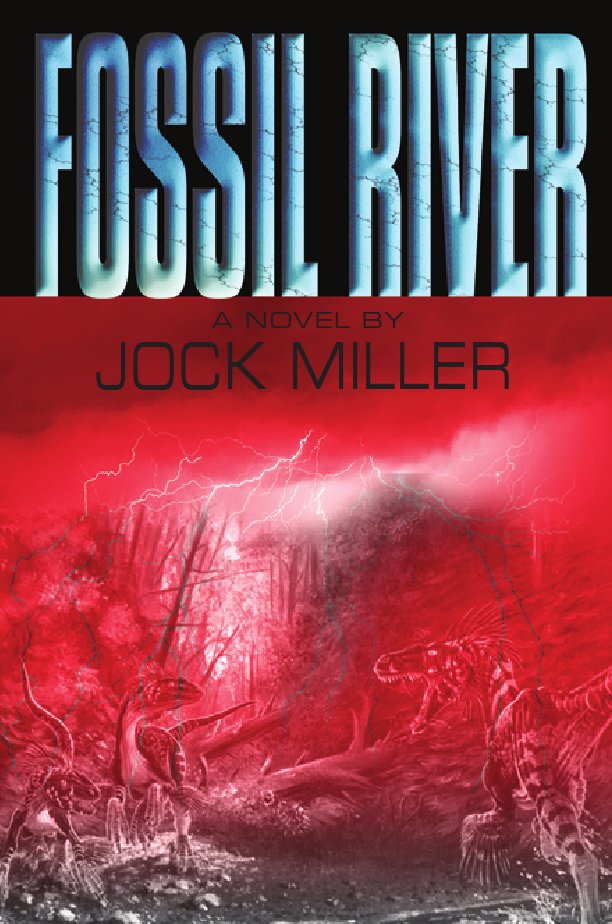
An action thriller by Jock Miller


Fossil fuel has an ageless affinity with dinosaurs. To create oil, dinosaurs died.


purchase on Amazon.com


The perfect energy storm is sweeping over the United States: Japan’s Fukushima nuclear plant meltdown has paralyzed nuclear expansion globally, BP’s Gulf of Mexico oil spill has stalled deep water drilling, Arab oil countries are in turmoil causing doubt about access to future oil, the intensity of hurricanes hitting the Gulf’s oil rigs and refineries has intensified due to global warming, and the nation’s Strategic Oil Supply is riding on empty.

As the energy storm intensifies, the nation’s access to Arab oil, once supplying over sixty percent of our fossil fuel, is being threatened causing people to panic for lack of gas at the pumps, stranding cars across the country and inciting riots.


The U.S. Military is forced to cut back air, land, and sea operations sucking up 58% of every barrel of oil to protect the nation; U.S. commercial airlines are forced to limit flights for lack of jet fuel; and businesses are challenged to power up their factories, and offices as the U.S. Department of Energy desperately tries to provide a balance of electric power from the network of aged power plants and transmission lines that power up the nation.

The United States must find new sources of domestic fossil fuel urgently or face an energy crisis that will plunge the nation into a deep depression worse than 1929.

The energy storm is very real and happening this very moment. But, at the last moment of desperation, the United States discovers the world’s largest fossil fuel deposit found in a remote inaccessible mountain range within Alaska’s Noatak National Preserve surrounding six and a half million acres.

Preventing access to the oil is a colony of living fossil dinosaurs that will protect its territory to the death.

Nobody gets out alive; nobody can identify the predator--until Dr. Kimberly Fulton, Curator of Paleontology at New York’s Museum of Natural History, is flown into the inaccessible area by Scott Chandler, the Marine veteran helicopter pilot who’s the Park’s Manager of Wildlife. All hell breaks loose when Fulton’s teenage son and his girlfriend vanish into the Park.


Will the nation’s military be paralyzed for lack of mobility fuel, and will people across America run out of gas and be stranded, or will the U.S. Military succeed in penetrating this remote mountain range in northwestern Alaska to restore fossil fuel supplies in time to save the nation from the worst energy driven catastrophe in recorded history?

______________________________________________________________________________________________________________________________________


A New Sickle-Clawed Predator from Inner Mongolia


A block containing the partial skeleton of Linhevenator. Abbreviations: ds, dorsal vertebrae; lf, left femur; li, left ischium; lpe, left foot; rh, right humerus; rs, right scapula; sk, skull. From Xu et al., 2011.


What makes
Linehvenator particularly unusual are some of the details of its limbs. Compared to other troodontids, Linhevenator had a relatively long shoulder blade, a relatively short and thick humerus, and its second toe was tipped in a specialized, retractable claw like that seen in Troodon but not in some earlier members of the group. This is a curious suite of characteristics. Whereas Linhevenator appears to have had a killing claw similar to that of its dromaeosaurid cousins like Deinonychus, the newly described dinosaur may have had proportionally short and strongly muscled arms. This may hint that Linhevenator was not using its arms to capture prey in the same way as dromaeosaurids or earlier troodontid dinosaurs, even if it did have a specialized killing claw. Instead, Xu and co-authors argue that the dinosaur may have had arms adapted to digging, climbing, or something else entirely, although testing these hypotheses is difficult at present. With any luck, additional discoveries of troodontids will help flesh out what these peculiar dinosaurs were like in life.


Read More

Why? Tell Me Why!: Alaska Greenhouse Gas Emissions


For its small population, Alaska is one of the biggest emitters of greenhouse gases. This week Kasey-Dee Gardner finds out why.

Why? Tell Me Why!: Alaska Oil


After spending a week in Alaska, Discovery News' Kasey-Dee Gardner wanted to find out why the state is so abundant in that resource.

Dinos: Analyzing Dinosaur Fossils


http://news.discovery.com


Kasey-Dee Gardner gets a behind-the-scenes look at how information is extracted from ancient fossils.

Everglades Oil: What's to Drill?

 By Eric Niiler

Comments by two politicians in the past week have raised a long-dormant debate over oil drilling in South Florida’s huge freshwater wetland. What many people consider a precious natural treasure and home to rare and endangered plants and animals – also sits atop an unknown amount of petroleum. 

In fact, nine wells have been pumping oil from a small section of the Everglades since the early 1940s -- low-grade crude used for lubrication and paving roads.


ELECTRIC VEHICLES: Why aren't we all driving them?

During a campaign visit to Florida last week, GOP presidential candidate Michelle Bachman said last week that she would support limited oil drilling. 

“The United States needs to be less dependent on foreign sources of energy and more dependent upon American resourcefulness. Whether that is in the Everglades, or whether that is in the eastern Gulf region, or whether that's in North Dakota, we need to go where the energy is," she said. "Of course it needs to be done responsibly. If we can't responsibly access energy in the Everglades then we shouldn't do it." 


Aerial view of an Everglades housing development in Florida. The debate over drilling in the Everglades is not dead yet, presidential candidate Bachman and Gov. Scott are raising it and a small industry that started in the 1940s never stopped drilling, despite the low-quality reserves there.   Read More


"Fossil Free" Fossil Fuels May Lie Deep Inside Earth

Brian Handwerk


Reserves of oil and gas, like the puddle of Venezuelan crude seen above, are made from the remains of plants and animals buried just a few miles below Earth's surface.
By mimicking the extreme conditions found much deeper, inside Earth's mantle, scientists have created the chains of carbon and hydrogen that make up so-called fossil fuels—without the fossils.

Photograph by Rebecca Hale

The study addresses the controversial view, first proposed by Soviet geologists in the 1950s, that deep Earth holds reserves of oil made from just minerals and water.
Some scientists have even suggested that material from these deeper reservoirs occasionally migrates to the surface and may help to replenish known oil fields.
Henry Scott, of Indiana University South Bend, was part of a 2004 team that made inorganic methane from marble under simulated "deep Earth" conditions.
Production of heavier hydrocarbons from methane is a "big step forward," said Scott, who was not part of the new study.
The work makes it seem increasingly likely that some abotic hydrocarbons can form in the deep Earth.
However, he cautioned, there is little to suggest that commercially important amounts of oil, gas, and other hydrocarbons have fossil-free origins.
"There is simply an overwhelming body of evidence suggesting [commercial deposits] form from the decay of once-living things," he said.

Denali National Park Alaska


Wild and primitive Denali National Park encompasses about 9500 square miles (approximately 6 million acres). And year after year, many visitors travel to Denali Park, making it one of the top Alaska travel destinations. Roughly 400,000 travelers journey to the park every year, between late May and early September.
Denali National Park is located about 240 miles north of Anchorage and 120 mile south of Fairbanks on the George Parks Highway. No Alaska vacation would be complete without a trip to Denali Park.

Will foreign oil dependence end any time soon?


By Cherise LaPine Grueninger


Will foreign oil dependence end any time soon?


When we think of reducing foreign oil dependency, most of the effort is focused on alternative fuel sources and the engineering more efficient vehicles. It's an easy way to get the message across — buying gasoline is something that hits our wallets frequently. Reducing our gasoline consumption will make the biggest impact, but petroleum is also a component of many common products and manufacturing components, such as asphalt, plastics, waxes and lubricants. Much of our consumer-driven culture is dependent on the cheap and easy availability of fossil fuels.

Dependency on foreign oil challenges our economic and national security because we're not in a position to negotiate over price or availability. In some cases, importing oil strengthens the economies of other countries, and thanks to oil cartel price manipulation, we have no control over the cost of the oil we import, which has a serious impact on the economy.

The U.S. Department of Energy links our recent recessions to oil price shocks. For instance, in the first half of 2010, we spent $50 billion more on foreign oil than compared to the same period in 2009. Despite the cost of the oil, the U.S. still consumes the most oil in the world. In May of 2010, the U.S. imported 61 percent, or 374 million barrels, of oil.

According to the U.S. Department of Energy, we may never be able to eliminate our need for foreign oil.

Read More

Dinos: Mobile Dino Lab Brings Modern Tools to Field


http://news.discovery.com


For the first time ever, paleontologists are chemically analyzing dinosaur fossils the same day they're excavated from the ground. Kasey-Dee Gardner finds out why this new technique is so important.