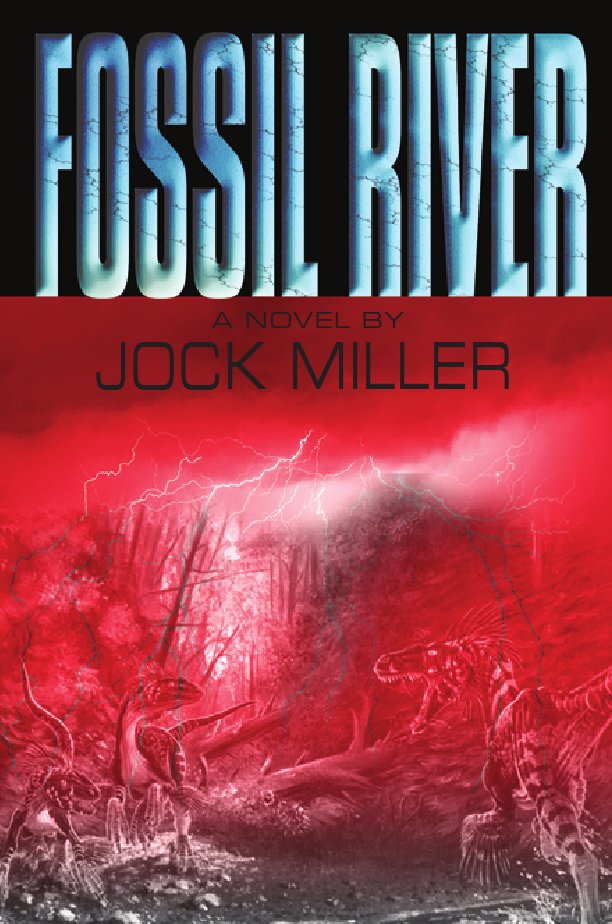
An action thriller by Jock Miller


Fossil fuel has an ageless affinity with dinosaurs. To create oil, dinosaurs died.


purchase on Amazon.com


The perfect energy storm is sweeping over the United States: Japan’s Fukushima nuclear plant meltdown has paralyzed nuclear expansion globally, BP’s Gulf of Mexico oil spill has stalled deep water drilling, Arab oil countries are in turmoil causing doubt about access to future oil, the intensity of hurricanes hitting the Gulf’s oil rigs and refineries has intensified due to global warming, and the nation’s Strategic Oil Supply is riding on empty.

As the energy storm intensifies, the nation’s access to Arab oil, once supplying over sixty percent of our fossil fuel, is being threatened causing people to panic for lack of gas at the pumps, stranding cars across the country and inciting riots.


The U.S. Military is forced to cut back air, land, and sea operations sucking up 58% of every barrel of oil to protect the nation; U.S. commercial airlines are forced to limit flights for lack of jet fuel; and businesses are challenged to power up their factories, and offices as the U.S. Department of Energy desperately tries to provide a balance of electric power from the network of aged power plants and transmission lines that power up the nation.

The United States must find new sources of domestic fossil fuel urgently or face an energy crisis that will plunge the nation into a deep depression worse than 1929.

The energy storm is very real and happening this very moment. But, at the last moment of desperation, the United States discovers the world’s largest fossil fuel deposit found in a remote inaccessible mountain range within Alaska’s Noatak National Preserve surrounding six and a half million acres.

Preventing access to the oil is a colony of living fossil dinosaurs that will protect its territory to the death.

Nobody gets out alive; nobody can identify the predator--until Dr. Kimberly Fulton, Curator of Paleontology at New York’s Museum of Natural History, is flown into the inaccessible area by Scott Chandler, the Marine veteran helicopter pilot who’s the Park’s Manager of Wildlife. All hell breaks loose when Fulton’s teenage son and his girlfriend vanish into the Park.


Will the nation’s military be paralyzed for lack of mobility fuel, and will people across America run out of gas and be stranded, or will the U.S. Military succeed in penetrating this remote mountain range in northwestern Alaska to restore fossil fuel supplies in time to save the nation from the worst energy driven catastrophe in recorded history?

______________________________________________________________________________________________________________________________________


NWF Coastal Louisiana Team: One Year Later


This video is an update on what members of the National Wildlife Federation have done and will continue to do to help restore the Gulf.

New Dinosaur Bolsters Bird-Dino Connection

By Jennifer Viegas


The new species helps to fill in the fossil record and cement the long-held view that birds did indeed evolve from dinos.


  • A new dinosaur sheds light on the evolutionary link between dinosaurs and birds.
  • The stubby-armed, toothy dino had a huge middle finger.
  • This finger likely represented an early evolutionary stage for a massive claw found in later dinos.


The extended bird family tree just gained a new and distinctive member, according to an international team of scientists.

They have found a long-legged, toothy, stubby-armed, three-fingered dinosaur that was an important early member of the lineage that includes birds and their closest dino relatives.

The 160-million-year-old dinosaur, Haplocheirus sollers, is about 10 million years older than what is believed to be the world's first known bird, Archaeopteryx. It exhibits characteristics associated with both dinos and birds, but the new dinosaur was not a very close relative to birds, as some researchers had previously thought.

Nevertheless, the new species helps to fill in the fossil record and cement the long-held view that birds did indeed emerge out of the Maniraptora "hand snatcher" clade.

"Many dinosaurs are very bird-like and early birds are dinosaur-like," co-author Xing Xu told Discovery News, adding that there is still debate over the exact moment when birds first emerged.


Read More

GE Sees Solar Cheaper Than Fossil Power in Five Years

http://www.bloomberg.com

Solar power may be cheaper than electricity generated by fossil fuels and nuclear reactors within three to five years because of innovations, said Mark M. Little, the global research director for General Electric Co. (GE)

“If we can get solar at 15 cents a kilowatt-hour or lower, which I’m hopeful that we will do, you’re going to have a lot of people that are going to want to have solar at home,” Little said yesterday in an interview in Bloomberg’s Washington office. The 2009 average U.S. retail rate per kilowatt-hour for electricity ranges from 6.1 cents in Wyoming to 18.1 cents in Connecticut, according to Energy Information Administration data released in April.

GE, based in Fairfield, Connecticut, announced in April that it had boosted the efficiency of thin-film solar panels to a record 12.8 percent. Improving efficiency, or the amount of sunlight converted to electricity, would help reduce the costs without relying on subsidies.

The thin-film panels will be manufactured at a plant that GE intends to open in 2013. The company said in April that the factory will have about 400 employees and make enough panels each year to power about 80,000 homes.

Solar-panel makers from Arizona to Shanghai are expanding factories to add more cost savings that analysts say will sustain the industry’s expansion. Installations may increase by as much as 50 percent in 2011, worth about $140 billion, as cheaper panels and thin film make developers less dependent on government subsidies, Bloomberg New Energy Finance forecast.

Solar Costs Dive

The cost of solar cells, the main component in standard panels, has fallen 21 percent so far this year, and the cost of solar power is now about the same as the rate utilities charge for conventional power in the sunniest parts of California, Italy and Turkey, the London-based research company said.

Most solar panels use silicon-based photovoltaic cells to transform sunlight into electricity. The thin-film versions, made of glass or other material coated with cadmium telluride or copper indium gallium selenide alloys, account for about 15 percent of the $28 billion in worldwide solar-panel sales.

First Solar Inc. (FSLR), based in Tempe, Arizona, is the world’s largest producer of thin-film panels, with $2.6 billion in yearly revenue.

Smart Grid

Little also said the U.S. transition to a full smart grid will take “many, many years” to develop.

A complete smart grid would consist of millions of next- generation meters installed in businesses and homes, appliances that adjust their energy use when prices change, and advanced software to help utilities control electricity flows, he said.

“I think it’s going to be a long time before we can realize the full potential of the smart grid,” he said. “But it is coming.”

GE this year plans to introduce the “Nucleus,” a device that will let consumers track their household electricity use with personal computers and smart phones. The company also is investing in its appliance and lighting unit, including $432 million for U.S. refrigeration and design centers announced in October.

Utilities need to have incentives to put in place devices that save energy, and Congress needs to provide greater certainty on tax policy surrounding renewable energy, Little said.

To contact the reporter on this story: Brian Wingfield in Washington at bwingfield3@bloomberg.net

To contact the editor responsible for this story: Larry Liebert at lliebert@bloomberg.net

Tarbosaurus Gangs: What Do We Know?


Paleontologist Philip Currie poses with a tyrannosaur skull. Photo courtesy Atlantic Productions.


Tarbosaurus, the great tyrannosaur of Cretaceous Mongolia, hunted in packs. That is the exceptional claim made by University of Alberta paleontologist Philip Currie in a press release, and news outlets all over the world have picked up the story. Just imagine rapacious tyrannosaur families tearing over the prehistoric countryside; it is a terrifying notion that the press release heralds as a “groundbreaking” discovery that will forever change paleontology.


But does the actual evidence live up to all the hype? Unfortunately, the answer is no. The proposal of pack-hunting dinosaurs is old news in paleontological circles, and the hard evidence to support the claims about Tarbosaurus has not yet been released.

Packaged under the theme “Dino Gangs,” the media release, book, and cable-network documentary arranged by Atlantic Productions hinge on a Tarbosaurus bonebed found in Mongolia’s Gobi Desert. The site was one of 90 Tarbosaurus localities surveyed by Currie and the Korea-Mongolia International Dinosaur Project, but it is unique in that it preserves the remains of six individual animals of different life stages. How the animals died and became buried is unknown. Even so, the press claims that these dinosaurs were a single family group that hunted together.

Read More Here

How can the ocean give us clean energy?


In the face of increasing energy demands and increasingly problematic energy sources, the appeal of using the ocean to generate power is obvious: Water covers more than 70 percent of the Earth's surface, and it's not going anywhere any time soon.

And, like the wind and the sun, the ocean — its waves, tides and temperature gradations — can be harnessed to generate clean electricity, with no emissions or byproducts to manage.

Ocean energy taps into the power of interactions between oceans and the wind (wave energy), the moon (tidal energy), and the sun (thermal energy). The technologies are pretty far behind wind and solar as far as large-scale generation goes, but the potential is huge — and growing.

Tidal energy, for one, is already powering homes and businesses.

READ MORE HERE


How to Build a Giant Dinosaur

Sauropods were humongous creatures, but how they got so large is a mystery that paleontologists are still trying to unravel


Argentinosaurus and Futalognkosaurus, pictured, from prehistoric South America, stretched more than 100 feet long and weighed in excess of 70 tons.

They were the most gigantic animals ever to walk the earth. Sauropod dinosaurs—“thin at one end; much, much thicker in the middle; and then thin again at the far end,” as comedian John Cleese described them—were titans that thrived for more than 130 million years. The largest known species, such as Argentinosaurus and Futalognkosaurus from prehistoric South America, stretched more than 100 feet long and weighed in excess of 70 tons. Bones found in the 1870s (and since somehow lost) hint that an enigmatic species dubbed Amphicoelias may have been even bigger still.

No land mammal has ever come close to the size of these gargantuan dinosaurs. The prehistoric hornless rhino Paraceratherium—the largest land mammal ever—was a mere 40 feet long and weighed a paltry 17 tons, and today’s African bush elephants, at 5 tons, would look dainty next to the largest sauropod dinosaurs. (Blue whales, at 100 feet and 200 tons, are a bit more massive than sauropods, but it’s easier, physiologically, to be large in an aquatic environment.)

What was it about these dinosaurs that allowed them to become the biggest terrestrial animals of all time?


Read More Here

Cannes 2011: With documentary on BP oil spill, a festival tries to dig in


http://latimesblogs.latimes.com

24 Frames

Movies: Past, present and future


Fix

The Cannes Film Festival isn't known for its documentaries. But once in a while, a filmmaker takes on a current event in a way that gets the crowd buzzing. That happened in 2004 when Michael Moore came in with "Fahrenheit 9/11" and walked out with a Palme d'Or. And it happened last year when Charles Ferguson premiered his "Inside Job" to festival-goers on the Croisette; amid the glitz and opulence, everyone was talking about the perils of greed.

On Tuesday night, the festival tried the trick again by showing Joshua Tickell and Rebecca Harrell's documentary about the Deepwater Horizon oil spill in the Gulf of Mexico in 2010. There would seem to be a promising cinematic story in the tale of a big corporation acting in dubious moral and legal ways, possibly with the help of the U.S. government, leading to a catastrophe.

The backstory on the spill was a good primer for those who have forgotten the cataclysmic events of that spring. And it was noteworthy to see Peter Fonda pop up; the actor-activist executive produced the film and made a small appearance. But any Fergusonian ambitions were soon extinguished. The crowd squirmed restlessly as the film moved from facts about the spill to topics as tenuously connected as the recent revolution in Egypt and the Japanese nuclear disaster, all while asserting some vague conspiracy between government and corporate activities. The filmmakers are activists in the realm of alternative energy (Tickell previously helmed the doc "Fuel"), and they go from showing the working-man victims in the gulf to talking-head voices of outrage who say things like, "The power system won't save us from corporate forces that kill us."

The you-can-make-a-difference activism is present in Moore's films too, of course, but usually after he has entertainingly worked the crowd into a lather, something that, judging by the audience's reaction here, the filmmakers don't do.

There may yet, however, be a filmic story to tell about the spill -- "Twilight" studio Summit is currently developing one, based on a dramatizing of the hours leading up to the spill.


-- Steven Zeitchik

twitter.com/ZeitchikLAT

IS IT FUTURE YET? HYDROGEN CARS


The Hydrogen Road Tour makes a pit stop in Washington, D.C., and Jorge Ribas takes a hydrogen fuel cell-powered car for a spin around the block. http://news.discovery.com/

Kelmayisaurus


The reconstructed skeleton of Giganotosaurus. Photo by Flickr user hoyasmeg.


What was
Kelmayisaurus? Discovered in 1973, the lower jaw and partial upper jaw of this large, predatory dinosaur from the Early Cretaceous of China have been frustratingly difficult to interpret. Maybe Kelmayisaurus belonged to some obscure lineage of archaic theropod dinosaurs, or perhaps the fossils were simply parts of some other, already-known dinosaur. In a forthcoming Acta Palaeontologica Polonica paper, researchers Stephen Brusatte, Roger Benson and Xing Xu finally solve the mystery.

Read More Here

Photos: One Year After Deepwater Horizon, Portraits of the Gulf Coast

A year after the devastating explosion aboard the Deepwater Horizon, the Gulf of Mexico is still reeling from the debilitating effects of the largest accidental oil spill in history. Photographer and CBS-affiliate videographer Jackson Fager traversed Louisiana’s coastline to document the seafaring men and women—shrimpers, fishermen, oystermen—many of whom have been stuck on dry land since the environmental tragedy. With a new fishing season on the horizon, Fager recalls the courage and perseverance that have kept them afloat for the past year.


By Jackson Fager•
As told to Lenora Jane Estes


http://www.vanityfair.com

... These fishermen remind me of American cowboys—among the most resilient and toughest individuals in the country. They think of themselves as a dying breed. Even before the oil spill, they were facing so many challenges—competition from overseas, hurricanes, fuel prices, and declining demand for their product. Then, when the oil spill happened, they were stripped of their very livelihood, their lifeblood. A lot of them have been out of work for the last year.

They’re such a unique collection of men and women from so many different ethnic backgrounds—Creole, Cajun, Native American, Vietnamese—and most of them are third- or fourth-generation fisherman. They’ve known no other way of life. What’s more, this is the only way of life they want to know. They’re also a people of many skills, out of necessity. If you want to be a commercial fisherman, you also have to be a carpenter, a plumber, and an electrician ...


READ MORE AND VIEW SLIDE SHOW HERE

New Drilling Bills Won't Help With Gas Prices, Will Make Rules Weaker Than Pre-BP Spill

Frances Beinecke

Frances Beinecke

This week the House of Representatives will begin voting on a set of bills that would make offshore drilling rules weaker than they were before the BP oil disaster.

I traveled to Louisiana two weeks ago and spoke to people still trying to rebuild their lives and businesses after the spill. It is unconscionable for lawmakers to call for a sweeping expansion of offshore drilling before they put stronger safeguards in place.

And it is cynical for politicians to claim that more drilling will relieve high gas prices.

More drilling only means more profits for the oil industry -- not lower costs at the pump -- and oil companies hardly need a boost right now. They are receiving billions in taxpayer subsidies and reaping record profits. ExxonMobil made nearly $11 billion in the first quarter of 2011 alone.

On top of that, the oil industry is already drilling more than ever before, even with some safeguards in place. Production in the Outer Continental Shelf has increased by more than a third in the past two years, and production in the Gulf of Mexico brought in 1.6 million barrels of oil per day last year -- and all-time record.

Yet despite all that drilling, gas prices continue to soar. Canada drills even more than America, and their gas prices have risen just as sharply as ours. The reason is clear: with rising competition from China and India and with 70 percent of the world's proven oil reserves owned by OPEC nations, more drilling in North America has little effect on the global market.

Even if we expanded offshore drilling considerably, we wouldn't see an impact on gas prices until 2030, and even then it would be a matter of just five cents per gallon, according to data from the Energy Information Agency.

If instead we raise fuel economy standard to 60 miles per gallon by 2025, we could cut driver bills at the pump in half.

Building cars that go farther using less gasoline is the best way to protect Americans from price spikes. It will also create jobs, slash our oil imports, and reduce dangerous air pollution.

President Obama has already started moving America down this road: he established standards requiring vehicles to reach an average of 35.5 miles per gallon by 2016. Now he has a chance to go farther. In September, the government will release the next round of standards, and NRDC is asking the president to set them at 60 miles per gallon. Technologies to meet this goal are well known: strong standards will ensure they come to market.

You can click here to ask President Obama to jumpstart the real solution to gas prices: raising fuel economy standards to 60 miles per gallon by 2025.

This is the kind of solution we need right now. We don't need lawmakers to promote reckless drilling that will fail to lower gas prices and endanger our coasts.

I urge you to call your representative today at 877-573-7693 and say that instead of passing irresponsible bills designed to weaken drilling safeguards, Congress should be strengthening efforts to protect workers, fishermen, coastal tourism, and the marine environment.

Age of cheap fuel is over: IEA


By Bronwyn Herbert

http://www.abc.net.au/news


The IEA says oil prices are likely to rise 30 per cent over the next three years.

The IEA says oil prices are likely to rise 30 per cent over the next three years. (Getty Images: Guang Niu, File photo)

One major indicator of inflation is the price of petrol and the latest information from the International Energy Agency (IEA) shows it will only get more expensive.

Oil is deeply embedded in the economy, with the cost reflected not only at the petrol bowser but in food and clothing products.

The IEA is an independent, multi-government agency formed out of the wake of the 1973 oil crisis. It forecasts oil production, monitors the international oil market and other energy sectors.

Only five years ago it confidently stated that oil production was set to rise to 120 million barrels a day by 2030.

But IEA chief economist Fatih Birol says the world's crude oil production peaked in 2006.

He says oil prices are likely to rise 30 per cent over the next three years.

"The existing fields are declining so sharply that in order to stay where we are in terms of production levels in the next 25 years, we have to find and develop four new Saudi Arabias," he said.

"It is a huge, huge challenge that we continue to underline."

Dr Birol says although peak crude oil production is already behind us, liquid natural gases may provide a viable alternative.

But he says one of the conclusions the IEA has come to is that the age of cheap oil is over. At the height of the global financial crisis in 2008, oil spiked to $148 a barrel.

Dr Birol says the impact of both a financial crisis in Europe and global instability in oil-rich regions means crude oil will only get more expensive.

"The amount of increase in the oil input bill in Europe is equal to the government budget deficit of Greece plus Portugal put together," he said.

"It is only the increase value of $90. If it increases further ... we believe [it] will increase at least 20, 30 per cent higher in the next few years to come and this would mean additional pressure on the financing of many governments who are the oil importers."

Dr Birol says the oil reserves might be there but the access is not.

He also says it could be in the best interest of producers if crude oil is not always flooding the market.

"The producers, intentionally or unintentionally, may not bring the oil under the reserves to the markets," he said.

"For some producers, it is better that oil doesn't come to market so they would like to see perhaps higher prices as a result of tightness in the markets."

The IEA says governments around the world need to rethink their reliance on oil.

Birds Inherited Strong Sense of Smell From Dinosaurs


Feathers, air sacs, nesting behavior—the earliest birds owed a lot to their dinosaurian ancestors. The first birds also inherited a strong sense of smell.

Modern birds have not been thought of as excellent scent-detectors, save for some super-smellers such as turkey vultures, which detect the scent of rotting carcasses. We typically think of avians as more visual creatures, and in some birds, the part of the brain that processes information from smells is relatively small.

But birds actually have a diverse array of scent-detecting capabilities, and a poor sense of smell may be a more recent characteristic of some lineages. After all, birds have been around for over 120 million years. We wouldn’t expect that birds have always been the same from the time they originated.

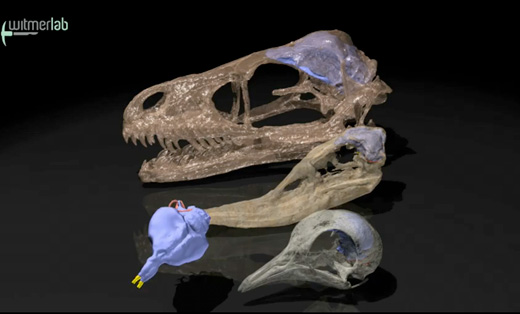
We obviously can’t directly test the ability of fossil organisms to detect scents, but, as shown in a study published this week by Darla Zelenitsky and colleagues, the shape of prehistoric brains may hold some crucial clues about the senses of extinct animals. The key was the olfactory bulb. This is a part of the brain—highlighted by the yellow flash in the video above—that is specialized for perceiving scents.

To estimate how important an animal’s sense of smell was, the scientists looked at the size of the olfactory bulb. This follows from a well-established principle in brain anatomy called proper mass—the more important the function of a brain part is to an animal, the larger that brain region will be. In other words, if an animal had a relatively large olfactory bulb it likely relied heavily on scent, whereas a tiny olfactory bulb would indicate the unimportance of scent to that animal. By comparing modern bird brains with virtual brain casts of extinct birds and non-avian dinosaurs, Zelenitsky and co-authors tracked how the sense of smell developed in dinosaurs and the earliest birds.

The brain anatomy of 157 living and fossil species was examined in the study. What the scientists found did not match the conception that birds lost their smelling skills early. Quite the opposite.

Multiple lines of evidence have confirmed that birds evolved from maniraptoran dinosaurs—a subgroup of coelurosaurs containing dinosaurs such as Deinonychus, Struthiomimus, Oviraptor and others—and the brain studies showed that sense of smell improved during the evolution of this group. The dinosaur Bambiraptor, for example, had a sense of smell comparable to that of turkey vultures and other birds that rely on scents to track down food.

This strong sense of smell was passed on to the earliest birds. Rather than decreasing, the relative olfactory bulb size remained stable during the evolutionary transition between non-avian dinosaurs and the first birds. Unexpectedly, olfactory bulb size then increased as archaic bird lineages proliferated, and the earliest members of the modern bird group—the neornithes—were even better-skilled at picking up scents than their predecessors. In fact, Zelenitsky and colleagues suggest, the improved sense of smell in the neornithes might have made them better foragers than earlier types of bird, and this may have some bearing on why they survived the end-Cretaceous mass extinction 65 million years ago while more archaic bird lineages perished.

The results of the new study reverses one of the long-standing misconceptions about birds and their evolution. Some modern bird lineages lost their powerful scent detecting abilities over time, but, early on, birds were as adept at picking up smells as their dinosaur ancestors. Paired with future studies focused on the parts of the brain associated with vision, studies like this will help us better understand how birds and dinosaurs navigated through their prehistoric worlds.

References:

Zelenitsky, D., Therrien, F., Ridgely, R., McGee, A., & Witmer, L. (2011). Evolution of olfaction in non-avian theropod dinosaurs and birds Proceedings of the Royal Society B: Biological Sciences DOI: 10.1098/rspb.2011.0238


http://blogs.smithsonianmag.com