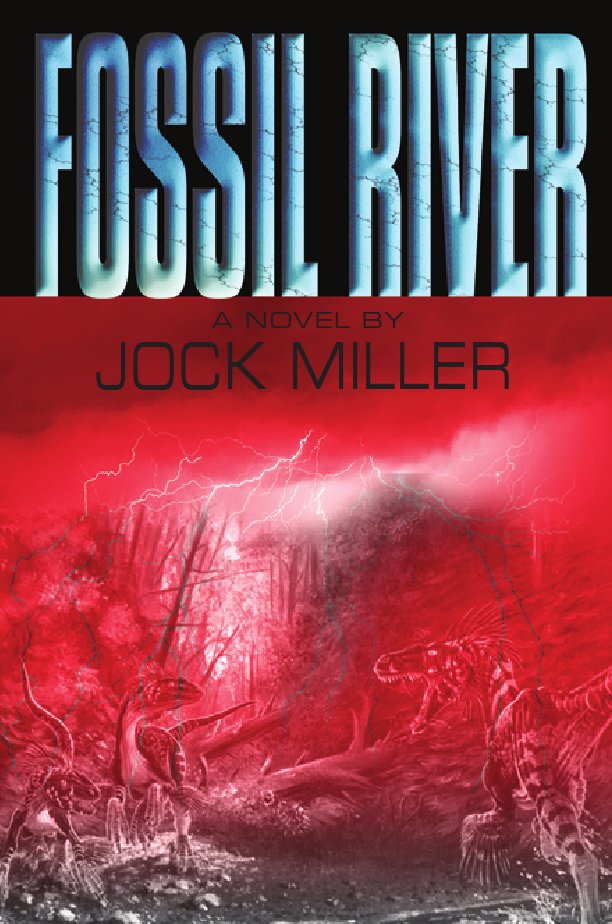
An action thriller by Jock Miller


Fossil fuel has an ageless affinity with dinosaurs. To create oil, dinosaurs died.


purchase on Amazon.com


The perfect energy storm is sweeping over the United States: Japan’s Fukushima nuclear plant meltdown has paralyzed nuclear expansion globally, BP’s Gulf of Mexico oil spill has stalled deep water drilling, Arab oil countries are in turmoil causing doubt about access to future oil, the intensity of hurricanes hitting the Gulf’s oil rigs and refineries has intensified due to global warming, and the nation’s Strategic Oil Supply is riding on empty.

As the energy storm intensifies, the nation’s access to Arab oil, once supplying over sixty percent of our fossil fuel, is being threatened causing people to panic for lack of gas at the pumps, stranding cars across the country and inciting riots.


The U.S. Military is forced to cut back air, land, and sea operations sucking up 58% of every barrel of oil to protect the nation; U.S. commercial airlines are forced to limit flights for lack of jet fuel; and businesses are challenged to power up their factories, and offices as the U.S. Department of Energy desperately tries to provide a balance of electric power from the network of aged power plants and transmission lines that power up the nation.

The United States must find new sources of domestic fossil fuel urgently or face an energy crisis that will plunge the nation into a deep depression worse than 1929.

The energy storm is very real and happening this very moment. But, at the last moment of desperation, the United States discovers the world’s largest fossil fuel deposit found in a remote inaccessible mountain range within Alaska’s Noatak National Preserve surrounding six and a half million acres.

Preventing access to the oil is a colony of living fossil dinosaurs that will protect its territory to the death.

Nobody gets out alive; nobody can identify the predator--until Dr. Kimberly Fulton, Curator of Paleontology at New York’s Museum of Natural History, is flown into the inaccessible area by Scott Chandler, the Marine veteran helicopter pilot who’s the Park’s Manager of Wildlife. All hell breaks loose when Fulton’s teenage son and his girlfriend vanish into the Park.


Will the nation’s military be paralyzed for lack of mobility fuel, and will people across America run out of gas and be stranded, or will the U.S. Military succeed in penetrating this remote mountain range in northwestern Alaska to restore fossil fuel supplies in time to save the nation from the worst energy driven catastrophe in recorded history?

______________________________________________________________________________________________________________________________________


Save the Crabs

One park ranger’s passion for protecting the Gulf Coast’s oil-covered hermit crabs.


October 13, 2010 by Mark Guarino for The Christian Science Monitor

Save the Crabs

Leanne Sarco remembers the day she discovered oil in her lagoons. On the first day, a sheen appeared on the ocean water. The sheen grew thicker and wider, until by the end of the week it became clear that this wildlife preserve at Grand Isle State Park, where the Gulf of Mexico meets the fragile barrier islands of Louisiana, was in peril.

In the weeks following the April 20 explosion of a BP oil rig that sent some 172 million gallons of crude oil into the Gulf, federal, state, and local governments; wildlife organizations; university research labs; oil industry groups; and contractors drew up plans to solve the litany of complex problems created by the huge spill.

But Ms. Sarco, a park ranger, thought small. She decided her best contribution was to collect, wash, and release into safer waters hermit crabs, the most neglected creature in the area, according to Lisa Rodrigues, who teaches in the department of geography and the environment at Villanova University near Philadelphia.

Hermit crabs "may seem insignificant at first," but they clean the ecosystem by eating algae, which helps fish and bird populations thrive, Ms. Rodrigues says.

They also are a key part of the food chain, providing sustenance for larger creatures. "A loss of one species could potentially have a significant impact on the rest of the community," Rodrigues says.

Sarco's efforts are voluntary. The Louisiana Department of Wildlife and Fisheries did not mandate a rescue of the crabs. No one knew exactly how to save them from suffocating in the oil inside their shells.

But soon after the oil's arrival on Grand Isle, Sarco began to see thousands of dead crabs along miles of coastline. Those that remained alive struggled to wriggle out of the oil and make it to shore.

Soon it became obvious that her job running a summer program for children would be canceled because of the contaminated beaches at Grand Isle. So Sarco asked her manager at the Louisiana Office of State Parks a simple question: "Can I pick up the crabs and clean them" instead?

She assembled a small army to help. Since May, Sarco and about 150 volunteers from as far away as California and Quebec have collected about 7,000 crabs, scrubbed them of oil, and released them into a saltwater marsh about 15 miles inland.

After asking local friends to pitch in, Sarco turned to Facebook and put out a call to the world. People soon began to arrive, strangers who came to help, some even sleeping on her couch for weeks.

"It almost feels like they're friends," Sarco says of the volunteers. "It was really nice to connect with people like that after thinking no one really cared about the wildlife aspect of [the oil spill]. It really saved me from quitting."

Sarco's project is "inspiring," says Doug Inkley, a senior scientist at the National Wildlife Federation in Reston, Va. It also fits into the larger picture of citizen volunteer groups doing what they can to rescue neglected wildlife in the Gulf, either directly or by raising money, Mr. Inkley says.

"It's very encouraging [that] people care so passionately ... whether it's a little crab or a big sea turtle," he says. "We have to recognize all these organisms are part of the whole ecosystem, and the hermit crab is just as important."

Sarco grew up in New Orleans, about a 2-1/2-hour drive north of Grand Isle, a remote fishing village of 1,500 people where the state park is located and where she now lives. She remembers spending time as a child at a nature center, where she watched as injured animals were coaxed to recovery.

Her first batch of volunteers in June were "disaster tourists," curiosity seekers who just wanted to check out the blackened sand dunes. She persuaded them to grab a pail and start collecting crabs.

On a Monday afternoon in August, Sarco led a small group along the shoreline where, clad in waders and clutching pails, they bent to gather up hundreds of hermit crabs, recently washed ashore and hidden inside shells coated with oil. The beach reeked of petroleum.

The group crossed the dunes to a tower once used as a concession stand that now is headquarters for Sarco's operation. Here hundreds of collected crabs are placed on absorbent fabric.

One by one, their outer shells are lightly scrubbed with dishwashing detergent. The insides of their shells are cleaned with a cotton swab. The crabs then are placed in donated fish tanks.

After only about 30 minutes in the tanks, the crabs slowly return to life. They crawl atop each other and move toward biscuit crumbs Sarco sprinkles into the water.

The next day they are delivered to the inland saltwater marsh and released.

Most coastal scientists say the oil is so embedded in the beach that it will be there for decades. Yet Sarco is already seeing her volunteer numbers start to dwindle, which she suspects is a result of people assuming the problem has been solved as it slips away from news media attention.

She plans for the hermit crab project to continue into next year – or as long it takes. "I don't see how I can [do] ... anything different from that," she says.

Copyright © 2010 The Christian Science Monitor (www.CSMonitor.com). All rights reserved.

Oil Spill Photo Gallery


MATTHEW HINTON / THE TIMES-PICAYUNE Wildlife Rehabilitator Christina Schilleci, of Louisiana State Animal Response, left, holds an oiled pelican impacted from the Deepwater Horizon oil spill, as she admits the bird to a triage facility at Fort Jackson in Buras, La.


BRETT DUKE / THE TIMES-PICAYUNE An oiled pelican is cleaned inside the Fort Jackson Bird Rehabilitation Center near Buras.

TIMELINE: American Paleontology in the 19th Century

The Louisiana Purchase

The Louisiana Purchase
April 30, 1803

The United States finalizes the Louisiana Purchase from France, adding the land from the Mississippi River to the Rocky Mountains to its territory.


October 1803

Meriwether Lewis, of the legendary duo Lewis and Clark, collects bone specimens at Big Bone Lick, in what is now Boone County, Kentucky.


July 25, 1806

Near the Yellowstone River, William Clark notes an exposed rib bone in the Hell Creek Formation. Paleontologists claim this is the first documented dinosaur fossil discovery on the North American continent.


September 6, 1807

Clark spends three weeks at Big Bone Lick in America's first organized vertebra paleontology expedition. He uncovers a significant cache of bones of creatures presumably drawn to the area by a salt lick.


1822

Henri Marie Ducrotay de Blanville, editor of the French Journal de Phisique, coins the term "paleontology" to refer to the study of ancient animals by using fossils.


April 1824

Congress authorizes the Army Corps of Engineers to complete surveys on roads and canals. This marks the first federally funded survey of the U.S., geographically or geologically.


October 29, 1831

Othniel Charles Marsh is born in Lockport, New York.


1837

Swedish biologist Louis Agassiz proposes his Ice Age theory to a hostile audience. His publication Recherches sur les Poissons Fossiles ("Research on Fossil Fish,") released in five volumes from 1833-43, described over 1,700 species of ancient fish. In 1847, Agassiz will become a professor at Harvard University.


1840

English paleontologist Richard Owen coins the term "dinosaur," which means "terrible reptile."


July 28, 1840

Edward Cope is born in Philadelphia, Pennsylvania.


Smithsonian Institutuon
Library of Congress

The Smithsonian Institutuon
August 10, 1846

The Smithsonian Institution is established after the nephew of British scientist James Smithson dies without an heir. As stipulated by Smithson's will, part of his sizable estate is left "to the United States of America, to found at Washington, under the name of the Smithsonian Institution, an establishment for the increase and diffusion of knowledge among men." The Institution will eventually shelter United States collections of cultural and natural historical artifacts.


1852

Dr. Joseph Leidy publishes 13 paleontological papers in one year.


Hadrosaurus skeleton, 1869
Academy of Natural Sciences, Philadelphia

Hadrosaurus skeleton, 1869
1858

Leidy makes Hadrosaurus the first North American dinosaur to be described from a nearly-complete skeleton. In collaboration with William Foulke, the skeleton is retrieved from a New Jersey mineral pit in 1858 and will be fully assembled for display at the Philadelphia Academy of Natural Sciences ten years later.


November 24, 1859

English naturalist Charles Darwin publishes On the Origin of Species, introducing the concept of natural selection to the theory of evolution.


May 15, 1862

Congress establishes the Department of Agriculture to provide "useful information on subjects connected with agriculture in the most general and comprehensive sense of that word."


Winter 1863

O.C. Marsh and Edward Cope meet for the first time in Berlin, while Marsh is studying at the University of Berlin and Cope is touring Europe. Their amicable relationship will turn famously antagonistic in coming years.


March 3, 1863

Abraham Lincoln establishes the National Academy of Sciences to "investigate, examine, experiment, and report upon any subject of science or art" when requested by the government.


1866

In his article "Discovery of a Gigantic Dinosaur in the Cretaceous of New Jersey," Edward Cope describes an incomplete skeleton of a dinosaur and names it Laelaps aquilunguis, meaning "eagle-clawed terrible leaper." In 1877, Marsh will rename the creature Dryptosaurus, after discovering that the name laelaps had already been used to designate a breed of mite.

This same year, Marsh becomes chair of paleontology at Yale.


1867

For the first time, Congress authorizes geological explorations in the American West. Over the next decade, the King survey, the Hayden survey, the Powell survey and the Wheeler surveys will make the first federally funded forays into geological observation.


August 1868

Marsh visits the American West for the first time on the Union Pacific Railroad during an excursion for the annual meeting of the American Association for the Advancement of Sciences.


Incorrect reconstruction of the Elasmosaurus
Academy of Natural Sciences

Incorrect reconstruction of the Elasmosaurus
1869

Cope reconstructs a plesiosaur he calls Elasmosaurus platyrus. Upon seeing it, Marsh believes Cope has placed the skull on the wrong end of the skeleton; Marsh shows the bones to Leidy who confirms the error, and Cope is humiliated. Cope frantically attempts to recall all printed publications of his findings and publishes a corrected version. Marsh would later write "His wounded vanity received a shock from which it has never recovered, and he has since been my bitter enemy."


May 10, 1869

The Transcontinental Railroad is completed. Trains allow Americans easier access to the West, setting the foundation for the fossil-searching expeditions that will follow.


Fall 1870

In Kansas, Marsh uncovers the first North American pterosaur during his premiere fossil-hunting expedition to the West. Initially led by Buffalo Bill Cody, Marsh is accompanied by a cadre of Yale undergraduates.


October 1871

An attending Yale student publishes an article in Harper's Monthly describing his six months on a geological expedition with Marsh. The account includes run-ins with grizzly bears, Indians, and a day spent with Buffalo Bill Cody.


Bridger basin badlands, Wyoming
American Museum of Natural History

Bridger basin badlands, Wyoming
July 1872

At Fort Bridger, Wyoming, Leidy finds the bones of a creature with elephant-like legs, tusks, and other bony knobs on its skull. He names the fragments Uintatherium robustum.

Also working in Fort Bridger both Marsh and Cope find similar fossils. Rushing to describe and identify their findings, the scientists end up giving the creature three different names.

This is the year that Marsh uncovers examples of toothed birds in Kansas which seem to contribute to Charles Darwin's theory of evolution. Marsh's wide collection of prehistoric horse fossils also provides useful evidence for the theory.


June 1873

Cope and Marsh make their feud public with a series of criticisms, defenses, and rebuttals in The Naturalist.


1875

Marsh publishes "Odontornithes, or Birds with Teeth."


Summer 1876

Cope heads to Montana on a fossil-hunting expedition, where he finds fossils of a creature he names Monoclonius.


August 1876

English biologist Thomas Huxley visits Marsh at Yale and is impressed with his collection of horse fossils, documenting the animal's evolution on the North American continent.


Marsh's drawing of a brontosaurus
Ernst Mayr Library, Harvard University

Marsh's drawing of a brontosaurus
Spring 1877

Amateur painter Arthur Lakes discovers large bones in Morrison, Colorado and sends some to both Cope and Marsh. The two rush to the site and hear of an even greater find in Como Bluff, Wyoming. Frantically, they each try to gather more samples than the other.

This year, Marsh will name the Stegosaurus from bones found near Morrison, Colorado as well as the Apatosaurus ajax. Two years later, he will name another specimen Brontosaurus excelsus, believing it to belong to another genus. However, it is later determined that the two creatures belong to the same genus, and the term Brontosaurus is dropped from formal usage.


March 3, 1879

Congress consolidates the four largest surveys in the West into the United States Geological Survey with the mission to initiate an encompassing national survey.


March 1881

John Wesley Powell takes over the U.S. Geological Survey and names Marsh Chief Paleontologist.


1882

Quarrying operations at Nevada State Prison reveal fossilized animal tracks initially believed by prisoners to belong to pre-Adamite humans. Edward Cope supports the theory; Marsh and others determine that the two million-year-old tracks belong to a giant ground sloth from the late Pliocene age.


1883

Marsh becomes president of the National Academy of Sciences.


1884

Cope publishes over 70 papers throughout the year, describing his findings from his travels in the West.


1887

The first ever Triceratops fossil is found near Denver, Colorado and sent to O.C. Marsh.


Fall, 1889

Cope takes a teaching position as Professor of Zoology and Comparative Anatomy at the University of Pennsylvania.


December 16, 1889

At Marsh's behest, John Wesley Powell announces an audit of Cope's holdings; Cope will be required to return items retrieved using federal funds to the government. The suggestion infuriated Cope, who had spent much of his own money on his expeditions.


New York Herald headline
Academy of Natural Sciences

New York Herald headline
January 12, 1890

The feud between O.C. Marsh and Edward Cope hits a crescendo with personal attacks printed in the national newspaper The New York Herald. The series of disparaging articles accusing each other of plagiarism, incompetence and fraud lasts two weeks.


Summer 1890

In response to the smear campaign in the papers, Congress cuts over a fourth of the Geological Survey budget, firing Marsh and his entire Department of Paleontology.

The Smithsonian claims all fossils collected under US Geological Survey funds, and Marsh is eventually forced to hand over more than 80 tons of fossils from his coveted collection.


April 12, 1897

Edward Cope dies.


March 19, 1899

O.C. Marsh dies.

Panel Chief on the Gulf Spill: Complacency Led to Disaster


William Reilly led the national commission that investigated the Deepwater Horizon oil spill and says he was struck by the totally inadequate response plans that were in place. In an interview with Yale Environment 360, he talks about why it’s crucial to carry out the reforms needed to prevent future disasters.

by john mcquaid

Earlier this month, the panel appointed by President Obama to study the causes of last year’s Gulf of Mexico disaster released its final report, declaring that a “culture of complacency” in the government and energy companies set the stage for the spill. The National Commission on the Deepwater Horizon Oil Spill and Offshore Drilling, co-chaired by William K. Reilly, a Republican and former Environmental Protection Agency (EPA) administrator under President George H.W. Bush, and former Senator Bob Graham (D-Fla.), also made a series of recommendations to improve drilling oversight and restore damaged areas of the Gulf Coast.
William K. Reilly
William K. Reilly

In an interview with Yale Environment 360 contributor John McQuaid, Reilly described the missteps that led to the spill, which occurred after an explosion that killed 11 oil rig workers. Looming behind the immediate causes of the explosion, Reilly explains, was the reality that as offshore drilling took place in ever-deeper waters, safety precautions did not keep pace. Response plans to such a spill were “laughable,” says Reilly, and had scarcely evolved since the 1989 Exxon Valdez oil spill in Alaska, which happened shortly after he became EPA administrator. Reilly says he hopes the new Congress will not impede the Obama administration from carrying out the reforms recommended by the commission, which include creating an “impermeable” wall between the federal officials charged with collecting revenues from offshore drilling and those responsible for safeguarding the environment. Another key recommendation, says Reilly, is the creation of an industry body that will establish stringent safeguards for offshore drilling and ensure they are carried out. As Reilly sees it, the massive fines to be paid by BP should largely be used to fund a program to restore the Louisiana coast, which has suffered severe erosion and pollution problems from 60 years of offshore drilling. “The risk we face,” says Reilly, “is that the country’s span of attention will not maintain support for attending to this spill and its consequences.”

Yale Environment 360:
In a nutshell, is it possible to say why this happened? What went wrong here?
William K. Reilly:
There are two ways of looking at what went wrong. What went wrong on the rig itself in the days and hours leading up to the explosion was a series of bad decisions by three companies. What went wrong in the broader context is an industry, which had not been a high-risk industry when it was drilling in shallow water, became such as it moved down to depths of a thousand feet or more without having adjusted its response capability, its containment technology, to manage those new risks. And government did not do an effective job of keeping up with the industry as it developed very dynamically.

e360:
The report documents problems with BP’s safety record. [In 2005, an explosion at its Texas City, Texas, refinery killed 15 workers; in 2006, a hole in a corroded BP pipeline in Alaska resulted in a major oil spill.] Why do you think BP was unable to address its safety issues before this disaster?
Reilly:
BP is a very large company – the largest, in fact, in terms of offshore oil and gas exploration — and it fell into a pattern of severe cost-cutting in the late 1990s. My understanding is that in the era of $9 oil
The inspectors are not really any match for the people they’re inspecting.”
— everybody’s forgotten that, but there was $9 per barrel oil in the late 1990s — BP became excessively concerned with cutting costs and they did it quite irresponsibly with respect to the refinery in Texas City. I think that that culture continued on into the era that followed Lord Browne [former BP CEO John Browne, who resigned in 2007]. It was he who oversaw that cost-cutting. Tony Hayward, I think, was trying to fix the problem. He just didn’t get to it. And that culture did not change.

e360:
Is it changing now?
Reilly:
They certainly have had every reason to focus laser-like on improving their safety and environmental performance, and I would be very surprised if in 3 to 5 years they are not among the safest oil companies. That was the experience that Exxon displayed after the Exxon Valdez tragedy: They became probably the leader, or one of them, in terms of safety and environmental protection among the oil companies. The BP people are smart and they are clearly going to have to do likewise.

e360:
The report describes serious problems with the Minerals Management Service, the Interior Department agency that oversaw offshore drilling. The Obama administration recently announced a new structure for the agency, splitting it into two different entities, one to collect revenue, the other to oversee permitting, safety, and the environment. Does that begin to address some of the problems, and what else needs to be done?
Reilly:
The old MMS has a long history of being underfinanced, under-resourced, under-trained and under-compensated professionally. All that has to change. It will take time. The reality is the inspectors are not really any match for the people they’re inspecting. We’ve got to make them at least better trained and more capable to carry out the job the law gives them. Whether or not we are able to complete the reforms which the Interior Secretary has begun, reforms which I applaud and admire, really depends now on Congress. The president has asked for $100 million. Something like $30 million was appropriated. That’s got to be improved.

e360:
You’ve also stressed the need for politically independent science and regulation.
Reilly:
Historically, revenues have driven this program, and safety and environment have been subordinate. Three MMS directors essentially said that before our commission. We will not be confident that that can’t
As Tony Hayward told me, the response capability was wholly inadequate to the size of the spill.”
happen again until there is an absolutely impermeable wall between the revenue generation and the environment and safety regulation. We’ve simply got to recognize the reality and have a sustainable situation without any temptation to let revenues affect regulation. There’s going to have to be an independent entity within the department, run by someone who is appointed and confirmed for a term, and not serving at the pleasure of the president or the secretary.

e360: Is there any sympathy for that in the new Congress, where Republicans are playing a much bigger role?
Reilly: I don’t know. They are continuing to consider that, even as they move on these other reorganization proposals. But they’ve not gotten to the point where we on the commission are.

e360:
Taking a step back, was there a sense both with people working on the rig, and also with MMS and the companies, that something this bad couldn’t happen?
Reilly:
Neither folks in the industry nor the government thought that anything like the Macondo explosion and blowout could occur. They just thought it couldn’t happen. That helps explain why, first of all, there was no subsea containment capability. As Tony Hayward told me when I began my work on the commission, the response capability was wholly inadequate to the size of the blowout and the size of the spill. The response plans were laughable. The concerns for walruses, for example, in the Gulf. That, to me, bespeaks the culture of complacency.

e360:
You’ve also recommended there be an industry safety body that self-polices. Can you elaborate?
Reilly:
That is a very important recommendation. The nuclear industry, after Three Mile Island, established something called the Institute for Nuclear Power Operations. It evaluates, monitors and even grades reactor managers, and its grades are highly respected by the industry itself. It’s a high-risk industry that has been made safe. Aviation did the same thing after the 1950s. In 1955, only 20 percent of Americans indicated in a poll that they were even willing to fly. Fifty-five percent said they wouldn’t fly
Clearly we have learned you cannot count on government to protect us from incompetence on the part of industry.”
under any circumstances. The aviation industry had 12 to 15 serious accidents a year. The FAA got together with the manufacturer, Boeing, and they figured out how to improve safety with better training for pilots, better monitors in the cockpits, better navigation instrumentation, a whole range of things, safety practices. So the lessons are there. The chemical industry did something similar after Bhopal with responsible care. The oil and gas industry has not done it and they need to do it for two reasons. One, clearly we have learned you cannot count on government to protect us all from misbehavior or incompetence on the part of industry. Government’s not up to that. Secondly, the best companies have the strongest interest in it, because irrespective of their own performance, if there is a laggard or a corner-cutter who gets in trouble, as we saw in the Gulf, everybody’s rigs will be shut down.

e360:
Are they moving to set something up?
Reilly:
The day after our report’s release I went to Houston and met with about 60 companies. The reaction made clear that they are very seriously looking at the safety institute and considering if they were to do it, the kind of things they would have to do, how it would be structured, what the budget would cost and who would pay it, where it would be housed, and all the practical questions.

e360:
Can you talk about the lack of environmental oversight in offshore areas of the Gulf of Mexico?
Reilly:
We heard the director of NOAA and also the chairman of the White House Council on Environmental Quality admit before our commission that they were not consulted in the [Obama administration] decision to expand areas of the Atlantic coast and eastern Gulf for offshore oil and gas exploration and development, which had not been permitted for 20 years or so. [The decision was suspended after the spill.] That was a bit of a shocker. That would not have happened, say, in the Nixon Administration when Russell Train was the chairman of the Council on Environmental
Gulf Oil SpillGetty Images/U.S. Coast Guard
Fire boats battle the fire on the oil rig Deepwater Horizon after the 2010 explosion.

Quality. [Reilly worked for Train at the time.] That’s an interesting contrast. The reality is that the people who had been regulating oil and gas had been somewhat dismissive of the comments received from other agencies, including the scientific agencies like NOAA. It had no more standing to make comments than an ordinary citizen. And we heard repeatedly that those comments were disregarded. So, for example, we suggested that NOAA recommendations on offshore leasing — the appropriateness of it relative to any threatened species that might be in the area — will have to be considered by the Interior Department. And if they are not accepted, it must be for an overriding public interest and the department must state why and what that interest is. So we’re trying to strengthen the role of the folks that really do have scientific competence and get more and better science into these key decisions.

e360:
Let’s move on to the aftermath and the response. What were the main problems in the response in terms of attempts to cap the well and emergency cleanup operations?
Reilly:
It was a very high-pressure formation that was flowing at a very rapid rate. The failure to determine the flow rate, the underestimate of it, caused the company to believe that it could contain it with a “junk shot,” where the golf balls and rubber tires and things were thrown down into the well, and were wholly ineffective. Had they been clear on the flow rate, they would have known that would not have worked. When they finally did get some clarity on it, they developed a “top hat” containment that did work. In terms of the response itself, the cleanup and capture of spilled oil, I was really shocked to see that that technology had not developed in 20 years, since I saw it in Prince William Sound [site of the Exxon Valdez spill]. Skimmers did not work in Prince William Sound. They were dead in the
In terms of the response itself, I was really shocked to see that technology had not developed in 20 years.”
water, from what I saw, because of the high wave and wind action — skimmers are essentially designed for placid harbors. And they didn’t work much in the Gulf. I think the whole flotilla, and there were hundreds of boats deployed, they collected something like 6 percent of the spilled oil. Clearly that’s one more sign of complacency on the part of government and industry that that technology didn’t advance. In the last 20 years, money that was appropriated for it in the early years after the Exxon Valdez gradually eroded away with not an especially effective evolution as a result.

e360:
Have we learned more on how to collect oil from the Gulf response?
Reilly:
Frankly, I don’t think we’ve learned too much. There are some improvements in the skimmers and in the oceangoing booms since the spill began, but our knowledge of how to do that is somewhat primitive.

e360:
The EPA’s use of the dispersant Corexit to break up oil slicks has been very controversial in the environmental community. Was that a responsible decision?
Reilly:
I was very skeptical of dispersants and did not permit them to be used in sensitive areas in Prince William Sound 20 years ago. And my prejudice was great going into this affair. I concluded reluctantly that the decision to use them in this instance, given the very high volume of the oil and the need to protect some very delicate and fragile wetlands and marshes along the coast, did justify their use. In the commission’s report we do not disapprove of that decision by the EPA administrator. What is really difficult to justify is, there was a debate about the toxicity of the dispersant used only after the spill had occurred. It struck me at the time, it was oddly inverted that you have that debate when you’ve got a serious, real-time need for dispersants. There’s no reason that could not have been tested before and a determination been made about whether under certain circumstances it would be appropriate to use Corexit in the Gulf. That is one more sign of the degree to which the government was unprepared.

e360:
What do we know about the long-term effects of the dispersant, and the oil itself, on marine life?
Reilly:
I think we are uncertain about how long there may be effects on fish life, particularly on those creatures like oysters and crabs that could not escape the oil that may have been deposited upon them and their larvae. That is going to take some time. What that really argues for is a fund that provides, as we did after Exxon Valdez, for long-term monitoring of effects. To the extent we know what happened to species in Prince William Sound, it’s because that funding was there to support that research. We need to do that in the Gulf.

e360:
After the well was capped, much — though not all — of the oil evaporated or was dispersed. Were the environmental impacts less than you feared earlier on in the process?
Reilly:
The volume was such that one had to assume it would take quite some time for it to disappear, to evaporate, or even to actually come to rest on the bottom. The ecology of the Gulf and the capacity of bacteria there to consume hydrocarbons wasn’t adequately understood or appreciated by
The risk we face is that the country’s attention span will not maintain support for attending to the spill and its consequences.”
most of us. It’s clear that the bugs did the best job of any response in getting rid of the oil. I have to say I was surprised it seemed to go so fast. Having said that, there have been substantial trace amounts of oil — in the parts per billion range — that could nevertheless have some consequences for the ecology. We don’t really know that, but it’s not fair to assume that simply because you can’t see it any longer, it’s no longer there. It’s potentially a cause of distress to one or more species that ingest it. That’s one of those questions that will have to be answered by monitoring.

e360:
Louisiana Governor Bobby Jindal lobbied aggressively for emergency sand berms that later proved ineffective at stopping oil from reaching the coast. Can you comment?
Reilly:
The berms, in our view, did not play any serious role in the response and should not have been authorized as a response technology. In fact, only a relatively short piece of the original berm plan was even in existence by the time the well was plugged. And that was predictable, that it was going to take six months or more to build those berms, and they are substantially unbuilt. They were very much the favored choice of the governor and of parish presidents and I think the federal government eventually accommodated strong local opinion and local government relations there in acquiescing in their construction. BP, after all, was prepared to pay $360 million for them. There was no federal money involved. But that should not be assumed to be a constructive response to any future spill. In my view, Louisiana officials were quite shrewd. That money they got for berms is now being spent substantially on beach replenishment, which was probably their primary interest all along.

e360:
Your report recommends channeling substantial funds to coastal restoration. Why?
Reilly:
We recommend that 80 percent of the fines be directed to the area most affected and most damaged over the years by all sorts of things: oil and gas, floodworks, and dredging. That seems to us a quite reasonable proposition: that the fines for doing damage to a region be spent on restoring that region. We’ve known for many years the good projects that

MORE FROM YALE e360

The Legacy of the Gulf Spill:
What to Expect for the Future?

The Legacy of the Gulf Spill: What to Expect for the Future?
The Gulf of Mexico’s capacity to recover from previous environmental assaults provides encouragement about the prospects for its post-Deepwater future, John McQuaid writes. But scientists remain worried about the BP spill’s long-term effects on the health of the Gulf and its sea life.
READ MORE
need to be done in the Mississippi Delta. But we’ve never had the resources, even though we’ve had projects authorized. Now with the prospect of these substantial fines, we may have the money to undertake a $500-million program, each year, for 20 years. That is the kind of effort that is going to be required. It could make a huge difference to the restoration of marshes, some redirection of river courses, and to the sustainable character of an area that is quite resilient if you create the circumstances. Louisiana has something like 30 percent of the continental wetlands in the United States, and they are at risk. They are imperiled and channelization that has accompanied any number of wells dating back to the 1940s has a lot to do with that.

e360:
Going forward, what are you most concerned about? What’s the risk we face right now?
Reilly:
The risk we face is that the country’s span of attention will not maintain support for attending to this spill and its consequences. That Congress, in an anti-regulatory mood, will confuse the kinds of regulatory problems we’ve had there with the defects of regulation and not recognize that some additional regulation, smart regulation, is going to be necessary to avert catastrophe in the future. That the industry will go back to business as usual. After all we went for 20 years without a spill of national significance in our offshore waters. To the extent we begin to not experience catastrophe again, we may be lulled into acceptance and quietude and to go on to other things. This could happen again, if we don’t really learn its lessons.


POSTED ON 27 Jan 2011 IN Climate Policy & Politics Pollution & Health Science & Technology Antarctica and the Arctic North America

Students urged to weigh careers in clean energy


The Record
STAFF WRITER

First they were exhorted to seek out careers that will help solve the challenges of developing clean energy. Then they received a quick lesson in some clean energy projects already under way.

Lawyer Robert F. Kennedy Jr. talking with students and staff members at a conference on environmental issues at Bergen Community College in Paramus on Friday.
DON SMITH/STAFF PHOTOGRAPHER
Lawyer Robert F. Kennedy Jr. talking with students and staff members at a conference on environmental issues at Bergen Community College in Paramus on Friday.

The one-two punch was designed to inspire several hundred high school and college students who attended a conference Friday on environmental issues at Bergen Community College in Paramus.

The event included a panel of five environmental experts followed by a keynote speech by environmental lawyer Robert F. Kennedy Jr., who reiterated the call by President Obama in his State of the Union speech last month for the United States to develop clean-energy technology.

Noting that the New Jersey Constitution makes clear that the state's rivers, including the Hackensack, are owned by the people and not corporations, Kennedy said the right of residents to go fishing and safely eat the fish they catch "has been stolen from the people by large corporations" who used rivers "as waste conveyance systems."

Corporate dumping into rivers not only violated the law but violated "virtually all principles of our democracy," he said.

Kennedy said the nation could invest in solar and wind energy today and reap the benefits of new jobs and cheap clean energy forever.

He said one stumbling block is the lack of an electric grid to get clean energy to urban zones from such locales as North Dakota for wind energy and the southwestern desert for solar.

Another stumbling block, he said, is the billions of dollars in federal subsidies in place to support old, polluting energy sources, including coal and oil.

During Friday's panel discussion, the experts fielded several dozen questions from the audience, many from the students, who asked for advice on how they could play a role in promoting environmental causes or how to turn their environmental interests into a career.

Gray Russell, environmental affairs coordinator for Montclair Township, said a career in the energy sector is a safe bet, given the needs of developing clean energy. "Energy is going to be the overarching issue of your time," he said.

Chris Obropta, a water resources expert with Rutgers University, said water is another field ripe for future talent. He said the United States' drinking water supplies are growing depleted. "We waste too much water; we don't reuse our wastewater," Obropta said.

Darren Molnar, a green building code expert with the state's Division of Codes and Standards, said the country will need more engineers and scientists who understand the dynamics of buildings and how to make them more energy-efficient.

Russell and Kennedy both talked about what they called the "false choice" between either a robust economy or environmental protections and clean energy.

"Energy issues are the solution to our economic problems," Russell said. Switching from foreign oil and polluting coal and investing instead in clean energy technology, such as wind, solar and geothermal, "will create jobs and develop new fields we haven't even thought of yet," he said.

E-mail: oneillj@northjersey.com