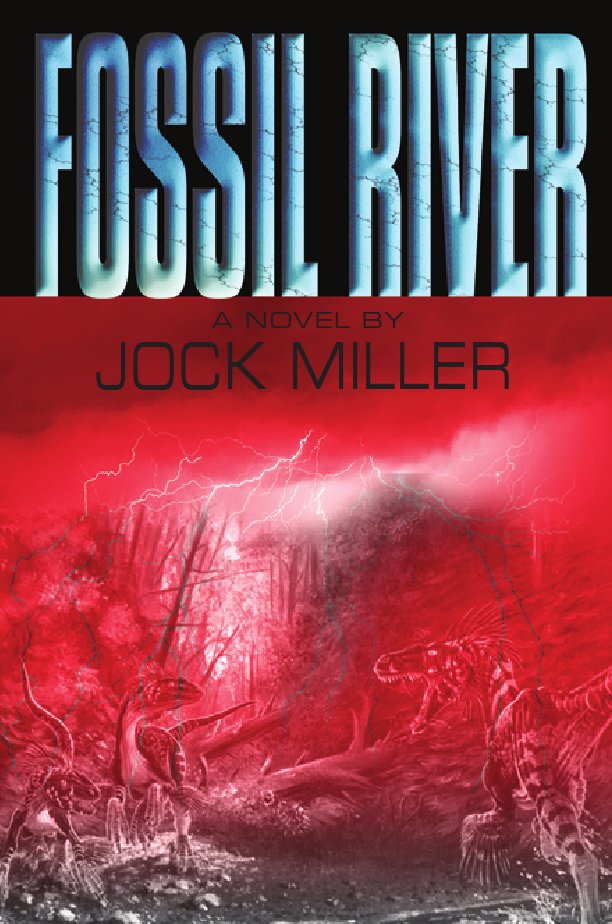
An action thriller by Jock Miller


Fossil fuel has an ageless affinity with dinosaurs. To create oil, dinosaurs died.


purchase on Amazon.com


The perfect energy storm is sweeping over the United States: Japan’s Fukushima nuclear plant meltdown has paralyzed nuclear expansion globally, BP’s Gulf of Mexico oil spill has stalled deep water drilling, Arab oil countries are in turmoil causing doubt about access to future oil, the intensity of hurricanes hitting the Gulf’s oil rigs and refineries has intensified due to global warming, and the nation’s Strategic Oil Supply is riding on empty.

As the energy storm intensifies, the nation’s access to Arab oil, once supplying over sixty percent of our fossil fuel, is being threatened causing people to panic for lack of gas at the pumps, stranding cars across the country and inciting riots.


The U.S. Military is forced to cut back air, land, and sea operations sucking up 58% of every barrel of oil to protect the nation; U.S. commercial airlines are forced to limit flights for lack of jet fuel; and businesses are challenged to power up their factories, and offices as the U.S. Department of Energy desperately tries to provide a balance of electric power from the network of aged power plants and transmission lines that power up the nation.

The United States must find new sources of domestic fossil fuel urgently or face an energy crisis that will plunge the nation into a deep depression worse than 1929.

The energy storm is very real and happening this very moment. But, at the last moment of desperation, the United States discovers the world’s largest fossil fuel deposit found in a remote inaccessible mountain range within Alaska’s Noatak National Preserve surrounding six and a half million acres.

Preventing access to the oil is a colony of living fossil dinosaurs that will protect its territory to the death.

Nobody gets out alive; nobody can identify the predator--until Dr. Kimberly Fulton, Curator of Paleontology at New York’s Museum of Natural History, is flown into the inaccessible area by Scott Chandler, the Marine veteran helicopter pilot who’s the Park’s Manager of Wildlife. All hell breaks loose when Fulton’s teenage son and his girlfriend vanish into the Park.


Will the nation’s military be paralyzed for lack of mobility fuel, and will people across America run out of gas and be stranded, or will the U.S. Military succeed in penetrating this remote mountain range in northwestern Alaska to restore fossil fuel supplies in time to save the nation from the worst energy driven catastrophe in recorded history?

______________________________________________________________________________________________________________________________________


Sea Turtle Populations Drop Following Spill


http://www.ecoworld.com


The BP oil spill was especially unkind to sea turtles, experts say. A new report finds that more turtles were killed or injured in the Gulf of Mexico in the time after the April 20th disaster than in any similar period in the past twenty years.

Researchers with the National Wildlife Federation, the Sea Turtle Conservancy, and the Florida Wildlife Federation say there were four to six times more turtles found dead, disabled, and diseased in the months after the Deepwater Horizon oil spill than average.

The analysis did not pinpoint cause of death, although researchers said that many of the 600 creatures certainly died of exposure to crude. But while many turtles could have died from other factors such as entanglement in fishing nets and cold weather, the spike in deaths following the spill is still significant – and troubling.

“Of all the species affected by the oil spill, those for which I have the greatest concern are the sea turtles,” said study co-author Doug Inkley, senior scientist at the National Wildlife Federation.

Inkley believes the oil spill was at least partially responsible for the above-average deaths, although necropsies performed by the National Oceanic and Atmospheric Association indicate that most of the turtles drowned in fishing gear.

Sea turtles are especially vulnerable because it takes them 10 to 30 years to reach adulthood, so it could take decades to restore dwindling populations to healthy numbers.

Four of the turtle species dwelling along the Florida coast – green, hawksbill, leather back, and Kemp’s ridley – are endangered.

BP's Fund Czar: Gulf OK by 2012, Except for Oysters

Laura Parker

Laura Parker Contributor

Workers offload oysters in Pass Christian, Miss. The oyster industry has been crippled by the BP oil spill, and it could take six to 10 years to recover.
George Barisich, president of the United Commercial Fishermen's Association, and a shrimper and oysterman, was encouraged that his payment will be quadrupled but is uncertain it will truly make up for his losses.

And he's not quite ready to write the happy ending story line, even if it's a decade away.

"We can't keep any small oysters alive," he said. "We never had that before."

Otherwise, the generally rosy projection for the future runs counter to earlier suggestions by environmentalists and scientists that the gulf will take longer to recover and that the full extent of the damage may not be known for years. It is almost certain to stir more controversy over the much-criticized program that is paying claims to spill victims if they forgo suing the oil giant in court. A quick recovery means there will be less damage for which BP has to make amends.

"Predicting the future is not an exact science," Feinberg said Wednesday. "I've tried as best I can to come up with a formula that will work and will adequately reflect the uncertainty about the gulf."

He invited anyone who disagrees with his conclusions to express their views on the Gulf Coast Claims Facility fund's website during a two-week period for public comment.

The environmental findings were made for Feinberg by Wes Tunnell, a marine biologist at Texas A&M's Harte Research Institute in Corpus Christi, who studied the aftermath of the gulf's only other major oil disaster: the Ixtoc spill off the coast of Mexico in 1979. In that spill, the oil ran for nearly 10 months before engineers were able to shut down the blown-out well.

Tunnell was paid $225 an hour by the Gulf Coast Claims Facility, the compensation fund's formal name, to prepare his 39-page report.

He concluded that generally, fish, blue crabs and shrimp should recover to their previous harvest levels this year. But he said some oyster beds may not recover for six to 10 years.

"Oysters are more problematic," Feinberg said. "The inability of oysters to swim away from the oil (makes) it even more uncertain. There won't be any gradual recovery. At the end of a certain period of time, either those oysters will be buoyant and there will be a good market for them, or there won't. We are concerned enough about the uncertainty of the oyster harvesting that there ought to be a premium, an add-on."

In his report, Tunnell noted that no long-term scientific studies tracked the aftermath of the Ixtoc spill, but that fishermen along the mangrove shoreline reported that all mangrove oysters died from heavy oiling "from Ixtoc oil and never returned."

He said it would be difficult to conclude the exact dose of oil many areas received during the Deepwater Horizon spill, even with a review of NOAA's detailed oiling maps. He also noted that many oysters were killed off by the diversion of fresh water in Barataria Bay that was released to help push oil away from the oyster beds. Other oysters were likely killed, Tunnell said, by flooding of the lower Mississippi River.

Barisich said the new young oysters, called spat, are dying after three or four months.

He said the cause of the die-off has not been determined in St. Bernard Parish, where he leases 400 acres of oyster beds. That area was not as heavily oiled as parishes to the west. Barisich believes the prime suspect is the dispersant used to break up the oil as it moved closer to shore.

Barisich said it will cost him $11,000 an acre just to lay down a layer of clean bedding material to rebuild his reef again.

Barisich said oyster harvesting has suffered one calamity after another even before BP's well blew out in April.

In 2005, Hurricane Katrina wiped out his oyster beds, smothering them with mud. He rebuilt his beds in 2006, but they were damaged again in 2008 by Hurricane Gustav.

By last spring, his oysters were recovering, although they were not yet producing at the levels of their pre-hurricane years.

"That's one of the problems with this program," he said. "None of us were back when the spill happened. My production is nowhere near where it used to be. I know it isn't BP's fault that we went through two hurricanes. They want to pay me four times of a 40 percent production, which is where I was last spring. That's not equitable. It's better than nothing."


Photo: Mario Tama, Getty Images


Dinosaur State Park and Arboretum

The Connecticut Valley has extensive fossil discoveries. Some of these fossils date to the Jurassic Period. Many specimens uncovered in brownstone quarries during the 1800s are included into the collections of museums throughout the world. History was made 1966 when hundreds of dinosaur tracks were exposed in Rocky Hill.[1] The dinosaur tracks in Rocky Hill were discovered by a bulldozer operator who was excavating for a new state building. The site became Dinosaur State Park, which became a Registered National Landmark in 1968


Interior detail


Close-up of Eubrontes prints


Eubrontes prints


http://www.ct.gov/dep/site/default.asp

BP will launch test to find boom anchors left in Gulf after oil spill

By Benjamin Alexander-Bloch, The Times-Picayune

The Coast Guard has directed BP to drop test anchors into Gulf of Mexico waters, and then search for them, to find the best way to locate and remove thousands of boom anchors left behind in the Gulf and surrounding waters after the oil spill.
boom-marsh-pelican.jpgView full sizeTimes-Picayune archiveA nesting pelican flies over oil boom near Dead Man's Island in Bay Eloi off the coast of St. Bernard Parish in July.

That first phase, scheduled to begin this weekend, involves finding the best methods for removal. The second phase will entail locating and removing the orphaned anchors in St. Bernard Parish.

The third and final phase of the program -- to retrieve all remaining anchors in state waters -- is conditional. Removal begin in all Louisiana waters affected by the spill if the first two phases are successful.

St. Bernard Parish President Craig Taffaro has estimated there are about 3,500 anchors in St. Bernard waters alone. Thousands more are estimated in Jefferson and Plaquemines' waterways.

While the current plan doesn't guarantee that anchors will be removed outside of St. Bernard, local officials appear confident it will get accomplished.

Jefferson Parish Councilman Chris Roberts, who sponsored a parish resolution in November for boom anchor removal, said the anchors in Jefferson waters will be removed by an means necessary.

"If we need to initiate litigation against BP then we will do that," Roberts said. "But we are very happy to see that it is progressing and we will monitor the program."

The 20- to 70-pound Danforth anchors were used to secure the boom that lined portions of Louisiana's coast to help prevent the oil spewing from BP's Macondo well from reaching the marshes.

Local fishers complain that BP contractors simply cut the boom from the anchors, leaving the hazards in waterways. The fishers say their nets have snagged and been torn by the anchors, and boat propellers have become tangled in the ropes that come up from the anchors and float to the surface.

BP has maintained that its contractors removed all the anchors that weren't embedded deep in sediment or had not long ago drifted away.

And a recent release by the Unified Command, the multiagency organization responsible for oil spill response, contends that every anchor that could be safely recovered was removed, and that Danforth anchors, which are intended to embed in the sediment and collapse flat when not in use, do not protrude above the sediment.

But despite the Unified Command's position that there is no threat, the adamant push by local officials and fishermen seemingly has spurred the Coast Guard to act.

"The federal government team that continues to oversee this response is committed to ensuring that BP uses a safe and proven method to find and remove orphan anchors so that teams do not break submerged pipelines in the area or further harm fragile ecosystems by causing erosion," stated Capt. Lincoln Stroh, federal on-scene coordinator, in a release by the Deepwater Horizon Incident Joint Information Center. "Teams cannot simply drag the waterways with a hook or trawl due to the risk of breaking a pipeline or causing massive erosion."

"The program requires BP to undertake careful planning to ensure there is no environmental damage or destruction to existing pipelines and infrastructure."

•••••••

Benjamin Alexander-Bloch can be reached at bbloch@timespicayune.com or 504.826.3321.

Eubrontes

Eubrontes is the name of the footprints, identified by their shape, and not of the genus or genera that made them, which is as yet unknown. They are most famous for their discovery in the Connecticut River Valley of Massachusetts in the early 19th century. They, among other footprints, were the first known dinosaur remains to be discovered in North America, though they were initially thought to have been made by large birds by Edward Hitchcock, a professor of Amherst College. Another major find occurred at rocky Hill, Connecticut in 1966. Nearly 600 prints are preserved there in an area now designated Dinosaur State Park.


Eubrontes
prints. Dinosaur State Park and Arboretum


Eubrontes, a dinosaur footprint in the Lower Jurassic Moenave Formation at the St. George Dinosaur Discovery Site at Johnson Farm, southwestern Utah

Dinosaur 'heart' looks like a bust


http://content.usatoday.com

By Dan Vergano, USA TODAY


High-tech scans reveal a fossil "heart" within a dinosaur skeleton most likely was just hardened sand that had washed down the gullet of the dead beast.

Tim Cleland

In the Naturwissenschaften journal, paleontologists led by Timothy Cleland of North Carolina State University in Raleigh, report on a Thescelosaurus dinosaur fossil "heart", first described in 2000 within a specimen nicknamed "Willo" on display at the North Carolina Museum of Natural Sciences. Thescelosaurus ("the marvelous lizard") was a medium-sized (13 feet long), plant-eating, two-legged dinosaur that lived about 65.5 million years ago.

"A three-dimensional, iron-cemented structure found in the anterior thoracic cavity of articulated Thescelosaurus skeletal remains was hypothesized to be the fossilized remains of the animal's four-chambered heart," said the study. That mattered because of a continuing debate over whether dinosaurs possessed a four-chambered heart like birds or mammals. "The hypothesis that this Thescelosaurus has a preserved heart was controversial, and therefore, we reexamined it using higher-resolution computed tomography, paleohistological examination, X-ray diffraction analysis, X-ray photoelectron spectroscopy, and scanning electron microscopy."

The result? The dinosaur is left brokenhearted, says the study.

"Neither the more detailed examination of the gross morphology and orientation of the thoracic 'heart' nor the microstructural studies supported the hypothesis that the structure was a heart." Most likely the structure is a sandy "concretion" that formed after the critter died, says the study.

We asked Cleland to comment on his team's findings:

1. How should we describe the origin of this concretion to readers? Just sand that washed down the gullet of the specimen, and hardened there? What accounts for the shape, most likely?

We really don't know exactly how concretions form, but we do know that their shape and chemistry vary quite a lot. For example, the two large concretions in this specimen have very different shapes to them. One being more rounded the other being more flattened. This structure formed when sand grains were hooked together by iron mineral, so it is very hard. As for the shape, there is a lot of evidence that concretions form around decaying organic matter, and even that microbes might be involved in their formation. It could have been sand packing internal spaces of the rotting animal and then cemented in that shape.

2. What sort of hearts did dinosaurs have, irrespective of this one's dubiousness?

We can't be positive what kind of hearts dinosaurs had, but based on their closest living relatives we can make inferences about it. Birds have a four-chambered heart, and oddly for "reptiles" so do alligators and crocodiles. So because crocodiles share a common ancestor with dinosaurs and birds, and birds are the descendants of one group of dinosaurs, it is safe to assume that dinosaurs most likely had four-chambered hearts too.

3. Could you tell our readers whether the results surprised you? Seems like a fun puzzle.

Science is about testing hypotheses, and we should always be willing to re-evaluate our ideas in light of new technologies and new data. When the first paper defining this as a heart came out in 2000, the researchers did a great job putting forth a new idea based on the data at hand. But their ideas were pretty controversial. When NC State University got a new, higher resolution CT scanner, we decided to test this idea again, using criteria set in advance. One thing our lab works on is looking at exceptional preservation in the fossil record, and how it can come about. If this indeed had been a heart, which would certainly qualify. But I was truly surprised to see the small microstructures that look very much like tissue! They aren't mineral for sure, and they sure are intriguing. That was really a surprise.

Study: Undersea Dispersant in Gulf of Mexico Lingered in Deepwater Plume


A core ingredient of the dispersant injected deep underwater at BP's runaway oil well remained trapped in an undersea plume of oil, methane and other hydrocarbons, resisting decay even as it became vanishingly dilute, scientists reported yesterday in the first detailed study of undersea dispersants in the Gulf of Mexico.

During the Deepwater Horizon oil spill, the government and BP PLC injected some 771,000 gallons of dispersant directly into the stream of oil and gas erupting from the Macondo well, more than a mile underwater. The injections, which ended in mid-July, were an attempt to break apart the oil, keeping it far removed from sensitive shorelines while also increasing the amount of crude available for a bacterial feeding frenzy.

While a large portion of the oil and gas escaping from the well stayed in the dark deep -- subsequently consumed by microbes and spread thin over the Gulf's vastness -- it remains uncertain whether dispersants, or simple physics, caused this plume. And while that question remains unresolved, it is now clear that the dispersants stayed put, closely following the hydrocarbon plume's southwest tack, some 3,600 feet below the surface.

During this snaking undersea voyage, at least one dispersant component, a complex surfactant essential to divvying up oil, seems to have resisted microbial decay for several months, instead spreading in practically undetectable concentrations up to 180 miles from the well, according to Liz Kujawinski, a chemist at the Woods Hole Oceanographic Institution and lead author of the study, to be published in the journal Environmental Science & Technology.

The surfactant's stubborn refusal to degrade -- which could be as much a function of its low numbers as its biochemistry -- came as somewhat of a surprise to Kujawinski, who, like most of the public, she said, "had the impression that the dispersant was supposed to have degraded faster."

When Kujawinski began to review past research, however, she saw few studies looking at the degradation of her chosen surfactant, dioctyl sodium sulfosuccinate, or DOSS, and none of those related to the cold, alien landscapes of deep water. What studies did exist were conflicting. "Turns out," she said, "there's not a whole lot of data out there on what should have happened."

"This was a pretty classic example of not having relevant scientific studies to base our expectations," added Dave Valentine, a geochemist at the University of California, Santa Barbara, who co-authored the dispersant paper. "Yet everybody [had] expectations."

Gathering data

Valentine led scientific expeditions into the Gulf during early June and September, those trips providing grist for a series of previously published papers finding that nearly all of the hydrocarbon gas -- methane, ethane, propane -- escaping from BP's well remained underwater, digested by microbes over a few-month span. And while Valentine focused on the gas, he made sure to sample for dispersants, too.

Over several months, Kujawinski analyzed samples taken during Valentine's June trip, which stayed close to the spill's center, comparing the surfactant concentrations to methane. As Valentine's work has shown, methane did not begin to degrade until some days removed from the wellhead. The two chemicals moved together in concentration, and this ratio, among other comparisons, indicated that nearly all of the DOSS remained underwater in amounts that hewed closely to the average reported injection rate.

By Valentine's second trip to the Deepwater Horizon site, in September, U.S. EPA was reporting that it could no longer find any undersea dispersants. More than a month after their last application, they had effectively disappeared. It was a fair assessment to make at the time, Kujawinski said, since EPA's coarser, high-speed tools focused on detecting hazardous thresholds, rather than minute concentrations.

Using advanced lab-based imaging, however, Kujawinski found that DOSS remained in the September water samples, lingering in the parts per billion, 1,000 times below any known effects likely to prove toxic to undersea life. (By September, all the methane had vanished.)

While DOSS only constitutes some 10 percent of the dispersant, Corexit 9500A, used at the wellhead, it is one of the more toxic ingredients, and extrapolated dispersant concentrations also fell below safety thresholds, Kujawinski said.

This drastic reduction in DOSS -- the highest level Kujawinski measured in June was 12 parts per million -- was driven largely by simple dilution, rather than bacterial degradation.

Comparing her figures to the concentrations expected from known water dynamics and the steady undersea currents measured by Woods Hole researchers last summer, Kujawinski estimated that the surfactant would hit such low numbers without any of the bacterial assistance seen in degrading methane and oil, she said.

There are several reasons the bugs could have demurred, Valentine said. Unlike the gas and oil seeps that pepper the Gulf floor, surfactant is a largely foreign compound, so few microbes would have been primed to attack it. And the DOSS was in such low numbers that it may not have warranted the energy needed to adapt to it.

Microbes are smart consumers. "It has to be worth their time," he said.

Good news, bad news

For man and bug alike, the surfactant's complex structure also made it a difficult subject, for dining or study.

Half of the molecule likes to be in oily substances, while the other half likes to be in water, Kujawinski said. It cannot easily be separated from samples, like traditional liquids or gases, and it will stick to Teflon-lined containers.

You wouldn't want your dispersant to behave otherwise, Valentine added. "These are the same properties that make it effective in breaking up oil droplets," he said.

As for whether the deepwater dispersants did their job and caused the oil to divide? That's a physics question, Kujawinski said, outside the bounds of her study. (Using high-resolution video, several physical scientists are tackling the problem.)

The dispersant could have been taken up in methane and missed the oil completely, or it could be associated with the small oil droplets in the deepwater plume.

Both dispersant scenarios seem plausible, she said.

Kujawinski does not want to raise alarm with her study, which will likely provide the baseline calculations for future measures of what effect, if any, dispersants had on life in the Gulf's deep waters. While concentrations were low, the length of exposure hasn't been seen in past toxicity work, and needs to be considered, she said.

"The good news is that the dispersant stayed in the deep ocean after it was first applied," Kujawinski added in a statement. "The bad news is that it stayed in the deep ocean and did not degrade."

Copyright 2011 E&E Publishing. All Rights Reserved.


For more news on energy and the environment, visit www.greenwire.com.
Greenwire is published by Environment & Energy Publishing. Read More »

A New Tyrannosaur Found!


Teratophoneus: Utah’s Monstrous, Murderous New Tyrannosaur

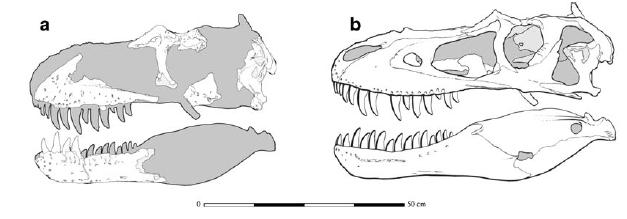
A line drawing of the Teratophoneus skull (a) and a reconstruction based upon the known pieces (b). From Carr et al., 2011.

It missed the 2010 Utah dinosaur rush by nearly a month, but a new tyrannosaur from the southern part of the beehive state makes up for its tardiness by helping to fill a gap in the famous group’s evolutionary history.

Almost one year ago, paleontologists Thomas Carr and Thomas Williamson described Bistahieversor sealeyi, a tyrannosaur from New Mexico and the first representative of this group to be described from the American Southwest. Now, in the journal Naturwissenschaften, Carr and Williamson join colleagues Brooks Britt and Ken Stadtman in describing a second southwestern tyrannosaur. They have named it Teratophoneus curriei, and it was a different sort of predator from its larger, northern cousins.

Found in the 75-million-year-old rock of Utah’s Grand Staircase-Escalante National Monument, Teratophoneus is known from a partial skull and additional elements from the rest of the skeleton. Its head was short—a departure from the typically long-snouted profiles of other tyrannosaurs—and it was a close relative of the northern forms Daspletosaurus and Tyrannosaurus. Based on its anatomy and its geographic place, Teratophoneus appears to be part of a unique radiation of southern tyrannosaurs.

Paleontologists have seen this pattern before. Just last year scientists described two new horned dinosaurs from the same place—Utahceratops and Kosmoceratops—which indicated that dinosaurs in the American Southwest evolved differently from their cousins to the north. There must have been some sort of barrier that kept dinosaur populations separate and caused the northern and southern groups to evolve in distinct ways. The peculiar anatomy of Teratophoneus adds further support to this idea.

Given its name—Teratophoneus roughly translates as “monstrous murderer”—you might think that this predator was a terrifying giant, but the new tyrannosaur was not quite as imposing as the famous Tyrannosaurus. Although it was a bit larger than the long-snouted genus Alioramus from Asia, Teratophoneus is estimated to have weighed about three quarters of a ton—about one tenth the mass of an adult Tyrannosaurus. (As the authors note, though, this first Teratophoneus specimen was a subadult, so they did grow a little bigger.) Just what it preyed on is as yet unclear, but hadrosaurs and horned dinosaurs have already been described from the same rock formations. Juveniles of these herbivores, at least, would have almost certainly been on the menu.

And Teratophoneus was not the only tyrannosaur found within the fossil-rich Grand Staircase-Escalante National Monument. During the 70th annual Society of Vertebrate Paleontology meeting, Utah Museum of Natural History scientist Mark Loewen introduced attendees to an older and even stranger tyrannosaur found there. This creature has yet to be fully described, but, along with Teratophoneus and Bistahieversor, it is one of the many specimens that is rapidly altering what we thought we knew about the evolution of the tyrant dinosaurs.

References:

Carr, T., Williamson, T., Britt, B., & Stadtman, K. (2011). Evidence for high taxonomic and morphologic tyrannosauroid diversity in the Late Cretaceous (Late Campanian) of the American Southwest and a new short-skulled tyrannosaurid from the Kaiparowits formation of Utah Naturwissenschaften DOI: 10.1007/s00114-011-0762-7


Posted By: Brian Switek

http://blogs.smithsonianmag.com

After the Great Spill: How the Gulf Cleaned Itself


By Bryan Walsh


As potential science experiments go, a massive oil spill resulting in severe environmental and economic damage isn't anyone's idea of a good field test. But while the more than 4 million bbl. of oil spilled into the Gulf of Mexico after the sinking of BP's Deepwater Horizon rig last April mucked up coastlines and caused tens of billions of dollars' worth of damage to the Gulf Coast economy, it also gave scientists an unprecedented chance to examine how a major water system would respond to all those hydrocarbons. What would happen to the methane and other chemicals released with the crude? Where would the oil go? The National Science Foundation hoped to answer these questions, fast-tracking grants to eager marine scientists who organized field trips to the Gulf while the oil was still flowing in May and June and then followed up once the spill was capped.

While the jury is still out, the early evidence shows something surprising: the Gulf proved to be much more resilient to the oil spill than scientists might have expected. The vast majority of the oil and other hydrocarbons seem to be gone, less than six months after the crude stopped flowing. And the biggest heroes of the cleanup turned out to be not the thousands of workers who scoured oil from the beaches or the shrimp-boat captains who turned their vessels into oil skimmers. They were actually the microscopic bacteria in the Gulf that digested much of the hydrocarbons while they were still deep under the surface.

"This has really helped us understand the capacity of a natural system to handle this kind of event by itself," says John Kessler, a chemical oceanographer at Texas A&M University. "And it sort of does handle it."

Kessler is a co-author of a study, published in Science on Jan. 6, that examined specifically the fate of the methane that was spilled into the Gulf along with the oil. By weight, more methane was released from the wellhead — an estimated 200,000 tons; potentially far more — than any other single hydrocarbon. (Methane is the primary component of natural gas, which made up about 30% of the output of BP's Macondo well.) When the spill was active, scientists were concerned that the methane might eventually make its way into the atmosphere, where it could have an impact on global warming — and a big one: methane has about 21 times the heat-trapping potential of carbon dioxide. Kessler and his colleague David Valentine, of the University of California at Santa Barbara, took water samples from around the wellhead in June, when the oil was still flowing, and found significant amounts of methane and little evidence that bacteria were breaking down the chemical. "Methane levels were 10,000 times above background," Kessler says. "We assumed it would be around for years."

But when Kessler and Valentine organized follow-up sampling trips in August, September and early October, they found something shocking: the methane had largely disappeared. Working aboard the National Oceanic and Atmospheric Administration research vessel Pisces, the scientists used sensors at 207 locations in an area of the Gulf larger than the state of Maine and found virtually no methane. That doesn't mean they found no sign that the hydrocarbon had been there — there were huge patches of water depleted of oxygen, evidence of action by bacteria, which use oxygen when consuming methane. "The only explanation for that large an amount of oxygen loss is methane consumption by bacteria," says Kessler. "But it's very surprising it happened so fast, with such large quantities." Further confirming that it was microorganisms that did the mopping up, Valentine and Kessler also found genetic fragments of methanotrophs (bacteria that feed off methane) and DNA evidence of an enzyme used to break down methane.

Bacteria also seem to have taken care of much of the oil that was released in the spill. During July and August, researchers at the Lawrence Berkeley National Laboratory took nearly 200 samples of Gulf water, following the likely dispersal path of the oil, but couldn't find any Macondo crude. While there had been concerns earlier in the summer that large underwater plumes of oil might remain intact, researchers at the Woods Hole Marine Biological Laboratory haven't found much underwater oil since the spill was stopped. And a federal report released in November estimated that at most 22% of the oil spilled into the Gulf might still remain in the waters and that bacteria had likely broken most of that remainder down.

Even if that's true, it doesn't mean the ecological threat posed by the spill has evaporated as well. As bacteria suck oxygen out of the water, they create the risk of anoxic zones — known as dead zones — that threaten sea life. But in the case of methane, at least, Kessler says the highest oxygen-depletion levels he saw were 40%, short of the two-thirds reduction considered dangerous to fish. Still, it's possible that some oil could remain buried in the sediment of the sea floor, where it could disrupt the deep ecosystem. And it's possible too that researchers are simply missing some of the oil and other hydrocarbons as they take samples — the Gulf of Mexico is vast, and scientific resources are finite.

"I would be thrilled if I could sit here and tell you, 'Yeah, the methane is all gone. Isn't that wonderful?' " Samantha Joye, a marine scientist at the University of Georgia, told the Christian Science Monitor. "But 500,000 tons of methane does not get microbially consumed in three months."

As scientists keep examining the Gulf, it may turn out that even if the ecosystem isn't perfect, it's much more resilient than expected. Part of that is not just biochemistry but luck. The relatively warm waters of the Gulf — and the fact that the spill took place more than 40 miles (65 km) out to sea — gave the bacteria the time and environment they needed to consume hydrocarbons. (Alaska's Prince William Sound, by contrast, has no natural oil seeps that would support crude-eating bacteria, so there were none around capable of breaking down oil after the Exxon Valdez spill.) The research done on the Gulf will help scientists develop better bioremediation techniques to clean up the next major spill — because you can't always count on nature to heal itself.

What Are the Best Dinosaur Movies Ever Made?

Movie reel, courtesy of Flickr user gomattolson

Movie reel, courtesy of Flickr user gomattolson

As sorry as I am to admit it, most movies with dinosaurs in them are not very good. It is far easier for me to think of bad dinosaur movies (I still have nightmares from Theodore Rex, and that was meant to be a comedy) than good ones, but there are a few shining examples of what dino-cinema can be if done right.

Jurassic Park (1993)

This is the high-water mark for dinosaur films. Based upon the novel of the same name, this 20th-century “Frankenstein” fable featured some of the best-looking dinosaurs ever seen on film and ushered in a new age of dino-mania. Sure, there were a lot of scientific problems and inaccuracies with the movie, but the fact of the matter is that, 17 years after it was released, Jurassic Park is still a lot of fun to watch. (The first film was followed up by two so-so sequels.)

King Kong (1933)

Even though a giant gorilla was the tragic star of King Kong, when I first saw it I was rooting for the dinosaurs. It didn’t matter that they were stop-motion creatures filmed in black-and-white five decades before I was born—the Tyrannosaurus, Stegosaurus, and other assorted prehistoric monsters in the film were every bit as threatening as the movie’s star. The battle between Tyrannosaurus and King Kong, especially, is one of the most exciting confrontations ever projected onto the silver screen.

King Kong (2005)

Ok, it might seem like a bit of a cheat to list a remake as a separate movie, but I think the 2005 version of King Kong deserves special mention. While the story generally hewed to the one laid out in the 1933 original, the creature creators working on the 21st-century remake envisioned what the living descendants of prehistoric creatures might look like. The modern-day descendant of T. rex, dubbed Vastatosaurus rex, got most of the attention, but there were also “raptors” (Venatosaurus), Brontosaurus and a slew of other imaginary dinosaurs. In fact, more dinosaurs were imagined than made it into the film, and the book The World of Kong: A Natural History of Skull Island describes them in detail.

The Land Before Time (1988)

Given the number of annoying sequels this film has produced, I had some qualms about placing it on this list, but since it was the first dinosaur movie I ever saw in theaters it holds a special place in my heart. The tale of a group of anthropomorphic misfit dinosaur trying to make it to the “Great Valley,” The Land Before Time fit in with the notion (still relatively new when it was released) that dinosaurs had family lives and were not just dumb reptiles. Spike, the mute Stegosaurus youngster, was my favorite character, and I think I still have a stuffed animal version of him around here somewhere….

Gojira (1954)

This movie monster, essentially a radioactive dinosaur, has starred in over 28 films to date, but the original 1954 Japanese film is by far the best. As much a social commentary on the use of atomic weapons on Japan during WWII as a straight-up monster flick, the first Godzilla film is arguably one of the most important movies ever made (if for no other reason that its star has had such enduring popularity—a series reboot is already underway).

What makes for a “good” dinosaur film is largely subjective, though. What are your favorites?

Darwins Letter To O.C. Marsh


Aug 31 1880


In the mid-19th century, paleontologists scrambling for fossils focused more on the prehistoric ancestors of contemporary creatures than on dinosaurs. But after Charles Darwin published his On the Origin of Species in 1859, the theory of evolution became one of the most controversial topics of the time.

When American paleontologist O.C. Marsh identified the Equus parvulus (now Protohippus), many biologists considered the skeleton to be validation of Darwin's theory. In this brief letter from Charles Darwin to O.C. Marsh, Darwin expresses his thanks for Cope's work in the field.


 Yale Peabody Museum


My dear Prof. Marsh

I received some time ago your very kind note of July 28th, and yesterday the magnificent volume. I have looked with renewed admiration at the plates, and will soon read the text. Your work on these old birds on the many fossil animals of N. America has afforded the best support to the theory of evolution, which has appeared within the last 20 years. The general appearance of the copy which you have sent me is worthy of its contents, and I can say nothing stronger than this.

With cordial thanks, believe me yours very sincerely

Charles Darwin

http://www.pbs.org/wgbh/americanexperience